Assaying is the art of determining the proportion of any specified metal in a given metallic ore or in an alloy. The various methods of estimating the amounts of base metals present could not, however, be usefully set forth within the limits of the present article, and the reader who requires technical information in regard to them must be referred to the special works enumerated at the end: we shall here limit our attention to the methods commonly adopted for ascertaining the amount of gold or silver present in an ore or alloy. Although the actual process adopted for assaying an ore is the same as for an alloy, the former has to be subjected to certain preliminary treatment in order to bring the metal present into a convenient form. This consists of 'scorification' or 'fusion,' with or without a previous 'roasting,' in case carbonaceous or other oxidisable substances are present, as happens with jewellers' 'sweep,' &c. Such roasting is conducted in an open dish with free access of air, as in a muffle furnace. The process of scorification is conducted also in a muffle furnace, in a non-porous fireclay dish or 'scorifier' heated to bright redness. One part by weight of a carefully taken sample of the ore in a fine state of division is mixed in the scorifier with from ten to twenty times its weight of granulated lead, and one-tenth its weight of borax, and the whole left in the muffle for about half an hour. On withdrawing the scorifier, its contents are poured into a cup-shaped iron mould, and when cold, the slag can be detached from the lead button, which contains all the gold and silver originally present in the ore, and only requires to be cupelled as explained below. When the 'fusion' or 'crucible' method is adopted, the prepared ore is mixed with red lead, charcoal-powder, carbonate of soda, and borax, in proportions depending on the nature of the ore, and placed in a crucible which is heated in an ordinary furnace for about a quarter of an hour, when the whole may be poured into a mould, and a lead button, containing the precious metals, obtained as in the scorification process.
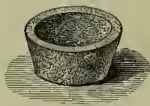
The 'cupellation' method of assaying gold and silver is of the highest antiquity. It depends essentially on the fact that molten litharge, monoxide of lead, PbO, is capable of holding in solution oxides of other metals with which it may be brought in contact, and thus separating them from unoxidisable metals. If, for example, gold, silver, copper, and lead are brought into a state of fusion in a current of air, the lead on becoming oxidised will take up the oxidised copper; the gold and silver, however, being unoxidisable, will not be so absorbed, and it only becomes necessary to provide a means of removing the oxides in order to obtain the precious metals which have thus been isolated. This is readily effected by using a 'cupel,' formed of compressed bone-ash, of some such form as is shown in fig. 1; being porous, it absorbs the oxides, while the molten gold and silver remain on its surface like a bead of mercury. One or more of these cupels, according to the number of assays to be made, are arranged on the floor of a muffle or oven of fireclay, provided with orifices at the sides and ends to produce the requisite draught, as indicated in fig. 2, and heated externally by anthracite, coke, charcoal, or gas. The operations comprised in the assay of an alloy containing silver by cupellation may be thus briefly described. A clean piece of the alloy, say 12 grains in weight, is accurately weighed on an assay balance. It may then conveniently be wrapped up in the whole or a portion of the
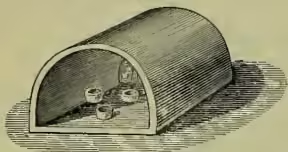
lead required for cupellation in the form of foil. The amount of lead taken, being dependent on the proportion of oxidisable metal present in the alloy, will, of course, depend on the composition as approximately judged from the colour, appearance of cut, &c.: three times the weight of the assay-piece for fine, or nearly fine, silver, six times for English standard (92.5 per cent.), and a still greater proportion for coarser varieties. The muffle having been raised to a red, but not bright-red, heat, the assay parcel is charged into a cupel, and the temperature maintained uniform. After a lapse of from twenty minutes to half an hour, it will be found that all the lead has been converted into litharge, and either volatilised or absorbed by the cupel, the completion of the operation being preceded by the passage of brilliant iridescent colours over the surface of the button, and, as soon as these cease, by an instantaneous increase in its brilliancy, known as flashing or brightening. The muffle is now closely shut up, and the temperature allowed to gradually fall until the button is set. It is then removed, hammered to detach adhering bone-ash, and weighed.
If there is reason to suspect the presence of small quantities of gold, it will only be necessary to dissolve the silver button, after weighing, in nitric acid (equal parts pure acid and water), collect the black deposit (the gold) that remains undissolved, and wash, ignite, and weigh it.
In many cases it is possible to ascertain the amount of silver present in an alloy without resort to cupellation. For this, the humid, or Gay Lussac's method, it is essential that the composition be previously known within comparatively close limits. Knowing this, it is easy to calculate what weight of the alloy contains 1 gramme of pure silver, by simply dividing the estimated percentage composition into 1000. This amount having been dissolved in nitric acid (equal parts pure acid and water), a measured volume of solution of common salt, standardised so as to precipitate exactly 1 gramme of silver, is added. By vigorously shaking the bottle for a few minutes, the white precipitated chloride will agglomerate, leaving a clear solution above; and on adding a small quantity of salt solution, the production of a further precipitate will indicate the presence of silver still in solution. Measured quantities being thus added, and the bottle shaken after each addition, a point will be reached at which no further precipitation occurs, and the total quantity of salt solution employed affords a means of ascertaining how much silver was actually present in the portion of alloy taken for assay. If be the weight of silver alloy taken in grains, its assay, the volume in c.c.s. of standard salt solution (of which 100 c.c. will precipitate 1 gramme of silver) required to saturate it, then .
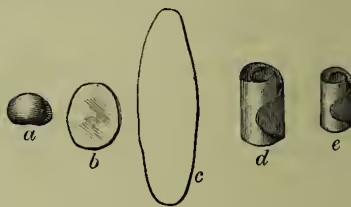
The method of assaying gold alloys remains to be considered. This is always effected by cupellation, and, in the rare event of silver being known to be entirely absent, a simple cupellation with lead, as in the case of silver, will suffice, a gold button being obtained and weighed. If, however, even a trace of silver is present, the process involves several additional operations to effect its complete removal. The inquartation method adopted derives its name from the fact that the gold present is associated with about three times its weight of silver previous to cupellation, the object being to obtain a button in which the gold is distributed like a sponge so as to facilitate the subsequent removal of the silver by solution in nitric acid. The amount of lead varies, as in the case of silver, with the composition. With gold, from pure down to 22 carat, about six times its weight; from this point to 15 carat, eight times; and for lower qualities, ten times its weight will generally suffice. It is generally safer to take a weight of silver equal to two and a half times the weight of gold estimated to be present. The assay-piece, which may weigh half a gramme, having been very accurately weighed, is wrapped, together with the requisite silver, in the lead, and charged into a cupel in the muffle, the temperature of which may be appreciably higher than when cupelling silver. The phenomena observed are similar to those already described, and, on its removal from the cupel, the button, having the form shown at a in fig. 3, is brushed, flattened (b) on an anvil, annealed at a red heat, and drawn out into a fillet (c) in a small rolling-mill to about the thickness of a calling-card, in order to still further facilitate the removal of silver. After being again annealed, this is coiled into a cornet (d) between the finger and thumb. The precise manner in which the boiling in nitric acid is effected depends on the number of assays that are made. In large assay offices, as in that of the Royal Mint, a platinum boiling apparatus is now generally employed; but this is expensive, and, for smaller numbers of assays, the older method of boiling separately in 'parting' flasks is available. When adopting the former method, each cornet is placed in a small perforated platinum cup, a number of these being ranged on a tray of the same metal, which is introduced into the acid (specific gravity 1.2) contained in a boiler also of platinum. After remaining for about twenty-five minutes, the tray is removed, washed in hot distilled water, and transferred to acid of specific gravity 1.3 in a second boiler, and kept at the boiling-point for a similar period. On again being removed, the tray is washed, and raised to a red heat in the muffle, which causes the dull-red fragile cornets to cohere, assume the yellow colour of gold, and shrink in about the proportion of d to e (fig. 3). The cornets are then weighed.
In parting in a flask, the cornet is boiled for ten minutes in 2 or 3 fluid ounces of the first acid, the flask nearly filled with hot distilled water, and decanted. A similar quantity of the second acid having been added, the boiling is continued for fifteen minutes, and water again added. After decanting, and once or twice washing, the cornet is transferred to a small porous crucible, in which it is annealed at a red heat, when it is weighed.
The old method of assaying gold by the touch- stone is still occasionally resorted to when an approximate estimate of the composition is desired without damaging the object. This consists in comparing the appearance of a streak made with the metal on a hard basaltic stone of dark colour, with those produced by certain touch-needles, the composition of which is known, after all the streaks have been subjected to the action of nitric acid. The touch-needle whose streak most nearly corresponds with that of the unknown sample is selected as corresponding with it in composition. Another convenient mode of estimating the assay of a gold-copper alloy, without in the slightest degree damaging it, is to accurately determine its density by any of the well-known methods. From this density the amount of gold present is approximately calculated as follows: Let be the density thus obtained; , the weight of the object; , the weight of gold in the object; , the weight of copper; , the density of gold = 19.3; , the density of copper = 8.6. Then
whence we obtain for , the gold present,
A few words must be added as to ascertaining both the silver and gold contained in an alloy. It becomes necessary either to perform separate assays, or to subject one assay-piece to cupellation twice. The assay is first conducted without adding silver, and the resulting button weighed as though it were a silver assay. After adding silver and lead, the button is again cupelled and treated as a gold assay. The weight of gold finally obtained is deducted from that of the first button, and the difference gives the weight of silver present. Some experience is necessary in order to accurately estimate this latter metal.
The reader who requires more detailed information is referred to Mitchell's Manual of Practical Assaying; Percy's Metallurgy; Makins' Manual of Metallurgy; Balling's Manuel de l'Essayeur; Beringer's Text-book of Assaying (1889); Ricketts, Notes on Assaying (new edition by Miller, 1897).