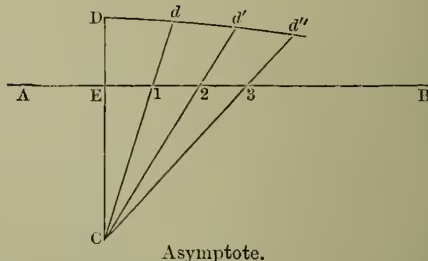
Asymptote (Gr., 'not coinciding'), a line that continually approaches nearer and nearer to some curve, but only meets it at an infinite distance. An example of an asymptote will be seen under HYPERBOLA. As another illustration, let AB be a straight line which can be produced to any length towards B. Take any point, C, without the line, and draw a perpendicular reaching to any distance, D, beyond the line; set off any equal distances, E-1, 1-2, 2-3, &c., along AB; and draw C1d, C2d', C3d'', &c., making 1d, 2d', 3d'', &c., equal to ED. Now it is evident that each of the points d, d', &c., is nearer to the line AB than the one to the left of it; if, therefore, a curve is traced through these points (the curve is called the conchoid), it must continually approach the line AB. On the other hand, it is evident that the curve can never meet AB at any finite distance; for a line drawn from C to any point in AB, however distant that point, must, when produced, cross AB. AB is thus an asymptote to the curve. To the senses, indeed, the curve and line soon become one, because all physical or sensible lines have breadth. It is only with regard to mathematical lines that the proposition is true; and the truth of it has to be conceived by an effort of pure reason, for it cannot be represented. An asymptote may also be curvilinear. For example, certain spirals have a circle as their asymptote. The spiral continually approaches the circle, but never meets it.