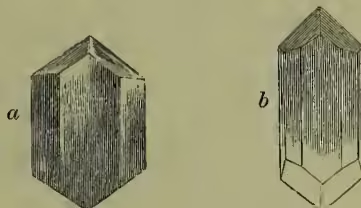
Augite (Gr. augē, 'brilliancy'), one of the Pyroxene (Gr. pyr, 'fire,' and xenos, 'a guest') group of minerals, is very nearly allied to Hornblende (q.v.). Augite consists of 47-56 per cent. of silica, 20-25 per cent. of lime, and 12-19 per cent. of magnesia, the magnesia sometimes giving place in whole or in part to protoxide of iron, and some varieties containing a little alumina, or a little protoxide of manganese. Its specific gravity is 3.195-3.525. It is little affected by acids, or not at all. It is usually of a greenish colour, often nearly black. It crystallises in six or eight-sided prisms variously modified. It is an essential component of several igneous rocks, particularly of Basalt (q.v.) and its varieties, and it occurs as an accessory constituent in a great many more. It is in fact as a rock-constituent that augite derives its importance as a mineral species. Augite rock, consisting essentially of augite alone, occurs in the Pyrenees. It is rarely associated with quartz, in which respect it differs from hornblende, but very often with labradorite, olivine, nepheline, and leucite. Fluorine, which is generally present in small quantity in hornblende, has never been detected in augite. The form of the crystals is also different in the two minerals, as well as their cleavage. In augite, the cleavage-planes intersect nearly at right angles; in hornblende, the angles are and . Rose of Berlin endeavoured to show that the difference between augite and hornblende arises only from the different circumstances in which crystallisation has taken place, and that augite is the production of a comparatively rapid, and hornblende of a comparatively slow cooling. His views have been supported by experiments, and by a comparison of augite with certain crystalline substances occurring among the scorie of foundries.—Diopside, Sahlite, and Coeolite are varieties of augite.—Diallage (q.v.) and Hypersthene (q.v.) are very nearly allied to it.