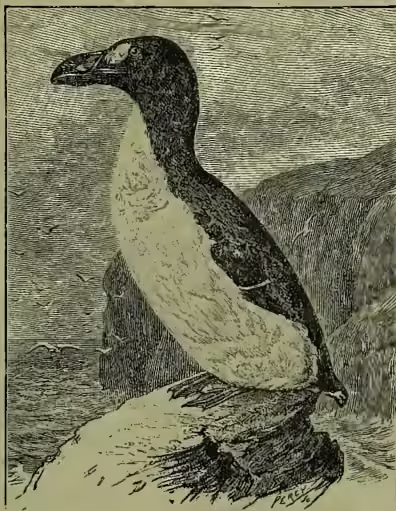
Auk (Alca), a genus of web-footed birds, the type of a family called Alcadæ, which was in great part included in the Linnæan genus Alca, and to many of the species of which, now ranked in other genera, the name auk is still popularly extended. The Alcadæ are amongst those web-footed birds collectively called Brachypteres (i.e. short-winged) or Divers by Cuvier, remarkable for the shortness of their wings, which they employ as fins or paddles for swimming under water, some being even incapable of flying; and for the position of their legs, further backward than in other birds, which makes walking difficult, and compels them, when on land, to maintain an upright attitude. They are distinguished by the very compressed bill, which, in the true auks, is vertically elevated, and so sharp along the ridge as to resemble the blade of a knife; and by their entirely palmated feet, destitute of hind toes. The auks are confined solely to the seas of the northern hemisphere—the penguins taking their place in the southern. All of them have a dense plumage, which generally exhibits on its surface a beautifully polished appearance and silvery lustre. The genus Alca, as restricted by Cuvier and others, contains only two species, distinguished from the Puffins (q.v.), which also belong to this family, chiefly by the greater length of the bill, and its being covered with feathers as far as the nostrils. The bill, both in the auks and puffins, is transversely and strongly grooved. But even the two known species of the restricted genus Alca differ from one another in a most important particular—the wings of the one, the Great Auk, being so short that it is quite incapable of flight, like the penguins, of which it may be deemed the true northern representative, whilst the other, the Razor-bill, has comparatively long wings, and flies well.—The GREAT AUK (Alca impennis), so far as is known, is now extinct. It was about three feet in height. It was an inhabitant of the temperate region of the North Atlantic. At one time large numbers bred on St Kilda, and in prehistoric times it appears to have bred on Oronsay or neighbouring skerries, and possibly frequented other islands of the Hebrides. It occasionally was met with at Orkney and Shetland, and probably bred at Papa Westra until 1812. It was rarely met with along the shores of Norway and Sweden, but in prehistoric times frequented the fjords of Denmark, as its remains have been repeatedly found in the Danish kitchen-middens. There is only one breeding-place in Greenland on record, and that is Gunnbjornesjoerne, supposed to be the same as Danell's or Graah's Islands. It bred on several skerries off the coast of Iceland, and the last Great Auks are supposed to have been killed on one of these named Eldey in 1844. In the North American habitat it bred in great numbers on Funk and other islands off the coast of Newfoundland, on some islands in the Bay of St Lawrence, at Cape Breton, and probably at Cape Cod. Its remains have been found in shell-heaps at several places on the coast of Maine and Massachusetts. The Great Auk was invaluable as food, and but for the abundant fresh supplies afforded by its carcasses to the early voyagers, the fisheries at the Banks of Newfoundland would hardly have been developed as they were. The birds were so stupid, they sat still until they were knocked over by the seamen's short clubs, or allowed themselves to be driven on board the vessels in hundreds across sails or planks stretched from the gunwales to the shore. The rapidity with which this bird moved under water was extraordinary; one of them having been pursued by a six-oared boat for hours in vain. Like most of the Alcadæ, the Great Auk each year laid only one egg, about 5 inches in length, and 3 in maximum breadth. It laid it on the bare rock, without any attempt at a nest. The eggs of the Great Auk are scarce and valuable curiosities; they have repeatedly brought more than £100, and in 1894 one was sold by auction for £315. At that date only 68 auk's eggs were known to exist; and only some 80 skins (one sold in 1895 for £350) and 40 bones are to be found in collections.—The RAZOR-BILL (q. v.) is the only other species (A. torda) now commonly included in the genus Alca. The name LITTLE AUK (Mergulus alle, formerly Alea alle) is often given to a bird also called the Rotche (q.v.), common in Arctic regions.—All the auks feed upon fishes, crustaceans, and other marine animals, which they pursue under water, and for which they dive to great depths. See Symington Grieve's The Great Auk (Edin. 1885).