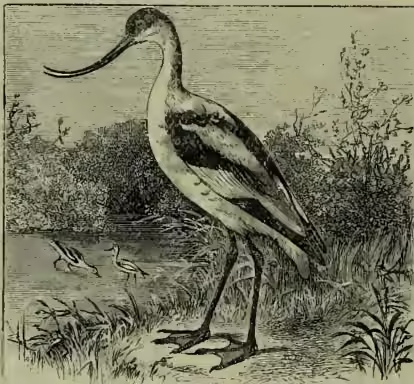
Avocet (Recurvirostra), a genus of birds, which, although having the feet webbed nearly to the end of the toes, is usually ranked among the Grallæ or Grallatores, on account of the length of the legs, the half-naked thighs, the long, slender, elastic bill, and the general snipe-like habit. They are distinguished from all other birds, except a few species of humming-bird, by the strong upward curvature of the long slender bill, which is much like a thin piece of elastic whalebone, and adapted as a tactile organ for seeking food in the mud, as their webbed feet are for walking upon it, and their long legs for wading in the fens and marshes which they frequent. The wings are long and pointed; the tail short and rounded. They can move quickly along the ground, and fly swiftly and low. Swimming is only resorted to by accident or compulsion. They scoop through the mud with the bill, first to one side, and then to the other, in quest of worms and other small animals; although Audubon also observed the American Avocet taking insects which were swimming on the surface of the water, and expertly catching them in the air, running after them with partially expanded wings. The avocets are found in most parts of the globe.—The Common Avocet (R. avocetta), about the size of a lapwing, is sometimes, though very rarely, found in the fenny districts of England; it is a native of the continents of Europe, Asia, and Africa, occurring even at the Cape of Good Hope.—Other species are natives of North America, India, and New Holland.—The American Avocet (R. americana) has the bill less recurved than the Common Avocet.