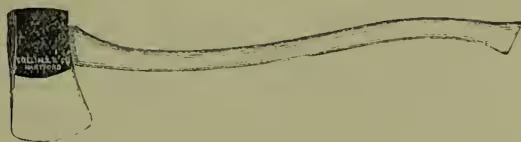
Axe, an instrument, usually of iron, edged with steel, for hewing timber and chopping wood. The haft or handle is of a length and size suitable for wielding with both hands, and is fitted into a head with an arching edge in the plane of the sweep of the tool—the axe differing in this last respect from the adze, which is found in use amongst some uncivilised peoples that do not use axes at all. Similar instruments of smaller size, for use with one hand, are called hatchets (Fr. hachette, diminutive of hache, 'an axe'). The usefulness of the implement made it one of the first tools suggested by the needs of man, and, accordingly, among the very earliest archaeological relics we find almost invariably some form of axe. The stone axes of our own country are the same as those still in use in many islands of the South Pacific, and the Tomahawk (q.v.) of America finds a close parallel in the 'francisca,' a hatchet for throwing, at one time the national weapon of the Franks. These, and the bronze axes of England and Mexico, with the rough iron instrument of northern nations, all witness the primitive use of this weapon. The prehistoric axe is distinguished from a 'celt' proper (see CELT), which was a chisel, by a more complex shape, and by being bored or otherwise fitted for a handle. Within historic times, the axe has recovered its early importance with the progress of colonisation, and its importance to settlers has led to the invention of the American axe, which effects speedier results with the smallest expenditure of strength. The head of this axe is about nine inches long, and the arched head is somewhat broader than the back, while its sides are also convex. The principal advantage of this formation is that, as only part of the edge strikes the wood, on this spot all the force of the blow is concentrated; moreover, the convexity of the sides prevents the blade being caught fast, and facilitates its withdrawal. The handle, which is generally made of hickory or some other elastic wood, is rendered stronger and more elastic by its shape, resembling a half-strung bow. The manufacture of the axe includes more processes than might be supposed. After being cut to the requisite length, and the eye for the handle punched through it, it is pressed into shape between concave dies. With borax as a flux, the edge-piece of steel is now attached to a groove previously prepared, and several processes must follow, including welding, sharpening, tempering, polishing, and varnishing with a mixture of turpentine and asphaltum, to prevent rust, before the finished instrument is ready for the market. A large quantity of these implements are manufactured in the United States, one establishment in Connecticut turning out almost 1000 daily. See also BATTLE-AXE, HALBERT, LOCHABER AXE.