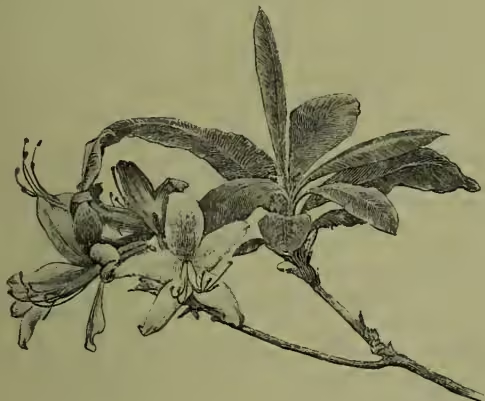
Azalea, a genus of the heath order (Ericaceæ), and distinguished from Rhododendron (q.v.) chiefly by the flowers having five stamens instead of ten. Most of the species of azalea also differ from the rhododendrons in having the leaves thin and deciduous instead of evergreen. Perfectly intermediate forms have now been discovered, and by classifiers the two genera are therefore united under rhododendron; the distinction, however, remains one of practical convenience. One of the species best deserving of notice is A. pontica, a shrub from 3 to 5 feet high, a native of Asia Minor, with lanceolate shining leaves and umbellate yellow flowers, which are externally covered with glutinous hairy glands, and are very fragrant. It may be regarded as, like many of the other Ericaceæ (heaths, &c.), a social plant; and its golden flowers give great brilliancy to the landscape in many parts of the Crimea, the south-east of Poland, the Caucasus, &c. It covers many mountain slopes, but does not ascend to great elevations, giving place to the more alpine Rhododendron ponticum. It is common in gardens and shrubberies in Britain, and varies with orange, red, and almost white flowers. The whole plant is narcotic and poisonous, and the honey collected by bees from its flowers, which greatly abound in honey, is said to cause stupefaction and delirium, as happened to Xenophon's soldiers in their famous retreat in Asia.—North America abounds in azaleas as well as in rhododendrons, and some of the species have been long cultivated in Britain, particularly A. nudiflora and A. viscosa, which, with A. pontica, have become the parents of many hybrids. Both have nearly white flowers, very beautiful, and of delicious fragrance. A. viscosa has the flowers covered with glutinous hairs like A. pontica; but the flowers of A. nudiflora are nearly destitute of them. Both species abound from Canada to the southern parts of the United States. They are taller shrubs than A. pontica. Upon account of its sweet smell, A. nudiflora is called in America the Upright Honeysuckle. A. calendulacea, a native of the southern parts of the United States, is described as frequently clothing the mountains with a robe of living scarlet.—India and China produce several species of azalea, of which one of the finest is A. indica, well known in Britain as a greenhouse shrub. Its leaves are persistent, and its flowers exhibit great brilliancy of colours. Many hybrids exist between the more hardy species and this. Another extremely beautiful species is A. liliiflora, an evergreen, which has been introduced into Britain from China, and is said to be quite hardy.
A diminutive, procumbent, evergreen heath, a native of alpine regions in Europe and North America, plentiful on high mountains in Scotland, was long known as A. procumbens, but is now called Loiseleuria procumbens. The flowers are small, solitary, and rose-coloured. The whole habit of the plant widely differs from that of the ordinary azalea.