Baboon, or CYNOCEPHALUS (i.e. 'dog-headed'), a genus of Old-World monkeys (Catarrhini), with numerous species such as mandrill, drill, sphinx, chacma, and hamadryas. They are at home in Africa, but spread into adjacent parts of Asia. Their most striking characters are—the plump form, the prominent snout, the large canine teeth, the capacious cheek-pouches, the ugly callous cushions on which they sit, and the frequent shortness of tail.
Animals so abundant, ferocious, and repulsively ugly as the baboons, could not escape the observation of the ancients. Aristotle was impressed by the pig-like muzzle of the mandrill, to which he gave the expressive name of Chæropithecus, or hog-ape, and even the comparative indifference of the next eighteen centuries to zoological facts was repeatedly interrupted by the hideous vision of some baboon. But long before Aristotle, the baboon had been an object of veneration in Egypt, and was especially sacred to, and typical of Thoth, the lord of letters. Egyptian monuments are thus frequently adorned with statues and figures of baboons, and their mummies are still occasionally found. They held a less honourable place in the middle ages as curious pets in any completely equipped fashionable establishment. Nor is it so long since the mandrill, Jerry of the Surrey Gardens, used to be brought to amuse George IV. Their interest for us now is on the one hand theoretical, and concerns such facts as the numerous characters in which these animals show affinity to the carnivores, and on the other hand practical, so far as these mischievous and voracious animals commit devastations on plantations and other property in the regions which they frequent.
Distribution.—Fossil remains seem to show that the baboons had once a much wider distribution than the now living species. They have, however, kept their footing well, being widely distributed throughout Africa. The drill and mandrill frequent the west coast (Guinea); the baboon proper inhabits wider and more inland regions from Abyssinia and Kordofan inwards; the chacma and sphinx have rocky homes in the south and west respectively; the hamadryas has its seat among the coast mountains of Abyssinia, South Nubia, and Western Arabia; the geladas occur in the highlands of Abyssinia; and the black baboon is found in the island of Celebes.
Structure.—The dog-shaped head, with its long muzzle and almost constantly terminal nostrils; the capacious cheek-pouches, in which a superfluity of food can be temporarily stowed away, and the frequently large and brightly coloured callous cushions on their hips, are the most prominent external characters. Some of the more internal anatomical characters are no less striking. For while the double curve of the back, and some of the relations of the sacral bone which unites the haunches, and other characters, suggest features perfected for instance in man, the baboons exhibit greater affinity with the carnivora. This is especially marked in the mandrill, where the backbone, the sacrum, the hip-bones, the paw, and other structures, exhibit a suggestive resemblance to those of the carnivores.
Habit.—The baboons are quadrupeds, running swiftly on all fours, climbing with great vigour, fond of sitting on their haunch-pads, and especially at home in mountainous districts. Many of them live in herds, and are therefore formidable both to animals and property. The troops are led by patriarchs, and guarded by sentinels. They fight with rival herds, and have to withstand the attacks of leopards and other carnivores. Playful and amiable when young, the older forms, and especially the males, are notorious for their evil dispositions, and allow their passions to run riot. The facile princeps in iniquity is the mandrill. Those brought home to zoological gardens become specially malicious, the result in part of their sensitiveness to cold, and of the irritations of visitors. They are all clever, dexterous animals, with well-developed brains. Their food varies greatly—fruits, roots, seeds, insects, worms, and many other commodities. The anubis baboon lives principally on the stem and roots of the unique welwitschia, so remarkable for its persistent cotyledons, which act as substitutes for the undeveloped foliage leaves.
Different Species.—About a dozen different forms are known. The Baboon proper (Cynocephalus babuin) is hardly known except in captivity. It is a large animal, with a yellowish-brown hide, long depressed skull, and uncoloured cheeks. It is equally strong and clever, and is often utilised by Arabian and Egyptian conjurers. A near relative is the Sphinx (C. sphinx), with only a stump of a tail. The Pig-tailed Baboon (C. porcarius) occurs in troops in South Africa. Its fur and medium-sized tail are almost black; the muzzle is very long; the colour of the naked parts of the skin is violet-blue; the ridges above the eyes are very prominent, and the eye sockets are curiously separated by an upright ridge of bone; the upper canine teeth are extraordinarily long. The Sacred Baboon (C. hamadryas), frequenting the Abyssinian highlands, stimulants being one of their often observed vices. Their bold plundering habits not infrequently lead them into collision with natives and travellers. The Anubis Baboon (C. anubis) is common in Angola on the west coast of Africa, where it lives in the dry gullies. A closely related or identical form inhabits the safe tops of rocks farther inland, and does much damage by descending for midnight ravages among the Indian corn plantations. The Gelada Baboon (C. gelada), which is somewhat aberrant, owing to the non-terminal position of the nostrils, frequents the hills of Abyssinia up to an elevation of 10,000 to 13,000 feet. For this form a special genus (Theropithecus) has been unnecessarily established. The Mandrill (C. Mormon), with its short tail-stump, its enormous, brightly coloured cheek swellings, its brushed
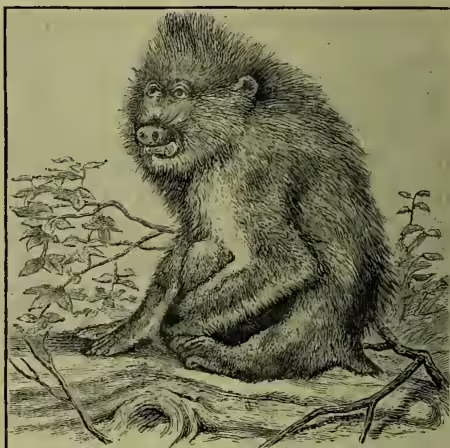
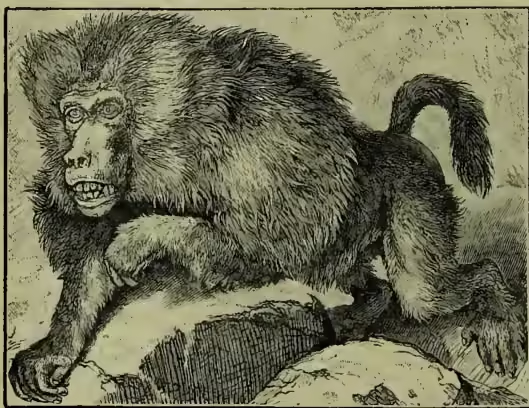
stands about 4 feet high, is of a light-gray and dusky-brown colour, with a naked flesh-coloured face, and a much-compressed ugly skull. Formerly sacred to Thoth, and typical of learning, the hamadryads have sunk in modern Egypt to a subordinate position as luxurious curiosities. They are sometimes caught by being intoxicated with liquor purposely exposed near their haunts, fondness for crown of hair, pig-like snout, 'beetled' brows, sunken eyes, immense canines, and decorated posteriors, is well known as the ugliest and most brutal of the monkeys. Its ugliness is in part, however, a secondary sexual character, the colours, &c. being more marked in the males, and apparently attractive to the less brightly coloured females. It has been already noted how carnivore-like many of its structures are. The mandrill, 'Happy Jerry,' of the Surrey Zoological Gardens, was the subject of many observations as to the habits and disposition of these repulsive forms. The Drill (C. leucophaeus) is a smaller form, with less striking colouring and ugliness; it frequents rocks and plains on the Guinea coast. The Black Baboon (C. niger) is found far from Africa in the island of Celebes, and has been introduced into other islands. It stands about 2 feet high, has long black fur, an upright curl on the crown of its head, and a rudimentary tail. It frequents woods, and its separation from the other species points to some earlier connection of the continents. An able and graphic account of baboons is given by Professor Martin Duncan in Cassell's Natural History, vol. i. See MONKEYS.