Babylonia (Babilu in the Assyrian inscriptions, Babirush in the Persian) was the name given to the low alluvial plain watered by the lower streams of the Tigris and Euphrates, now forming the modern Arab province of Irak-Arabi. In the Old Testament it bears the various names of Shinar, Babel, and 'the land of the Chaldees.' It is difficult to state the true boundaries of this rich and fertile land, for during the various periods of Babylonian and Assyrian supremacy they varied considerably. The northern boundary, from the region of Naharaim or Mesopotamia, was formed partly by the Euphrates and its tributaries, but chiefly by a line of forts and frontier stations established by mutual arrangement between the Assyrian and Babylonian kings at various periods, this being probably the Median Wall of the classical writers. On the east the Tigris formed the natural boundary, but some portions east of that river and south of the Lower Zab at times were included in the Chaldean empire. These were the provinces of Namri or Kurdistan. The western boundary was the Euphrates, or rather the desert to the east of that stream, for from the earliest period the fertile fringe of land along the river's bank in the neighbourhood of Ur (Mugheir) and Borsippa (Birs Nimrud) was under Babylonian rule. The southern limit was the shores of the Persian Gulf, the waters of which then extended considerably farther inland, the two rivers as late as the time of Sennacherib, 705 B.C., entering the sea by separate mouths. The country has from all time been one of the most fertile spots in the whole of Western Asia, and famed for its rich corn-producing qualities. Indeed Herodotus says that it supplied one-third of the corn produced by the whole Persian empire. The inscriptions afford ample confirmation of this fact, the tithe receipts of the temples showing an enormous yield of cereals. This natural fertility was greatly aided by the splendid system of artificial irrigation by a network of canals spread all over the country, many of which are navigable to the present day. The most important of these was the Nar Malka, which was serviceable as late as the 7th century A.D., and only disused when allowed to fall into decay after the Mohammedan conquest. This important artery joined the Tigris and Euphrates in North Babylonia, passing through the ancient cities of Sippara or Sepharvaim and Akkad, and entering the Tigris about 30 miles below Bagdad.
The lines of its course are marked by the modern Yusifieh and Amram canals. This canal was probably excavated by Khammuragas in the 22d century B.C. Other important inland waterways were the Nar Kuti or river of Kutha, the modern Habb-es-Sook, which passed through almost the whole length of Central Babylonia—and the Nar Essu or new river, a large canal in the neighbourhood of Babylon excavated by order of Nebuchadnezzar II. (605 B.C.). According to the ancient records, Babylonia was divided into several provinces, the number and extent varying considerably at different periods in the history of the empire. The chief division appears to have been first into two large provinces of Simir or Shinar (South Babylonia), the region from the Persian Gulf to Babylon, probably at one time, as some critics think, the name of all the lower valley of Mesopotamia, and Akkad or North Babylonia, extending from the boundary of Simir to the Assyrian and Mesopotamian frontier. The capital of this latter province was, like Babylon, built on both banks of the Euphrates, the larger half being called Sippara of Samas, the sun-god (the modern Abu Habbā), and the smaller half Akkad or Agade. The latter was afterwards named 'Sippara of the moon-goddess,' whence the scriptural name Sepharvaim, 'the two Sippars.' Other minor provinces embraced within these two were Gan-Dumiyas (the northern part of the Akkad) and the south part of Akkad, Edina or Eden, called also Zeru or Dura, the plain in the immediate vicinity of Babylon; Gambulu, the marsh region, now the modern Afadj; and Mat Kaldn, the land of the Chaldeans, the region bordering on the Persian Gulf and the east bank of the Euphrates.
The natural products of this fertile land were almost unbounded—corn and many other cereals, and also grapes, fruits of several kinds, semsams, vegetables of several kinds, cucumbers, melons, onions, garlic. Stone being extremely rare, having to be obtained from Upper Mesopotamia or the mountains of Elam, the only building material was clay, an ample supply of which was obtainable.
Ethnology.—Babylonia, according to both sacred and classical writers, has always been a land of mixed races and tongues, and the polyglot and heterogeneous character shown by the monuments to have existed in a very remote antiquity. The earliest of the inscriptions has revealed to us the important fact that the first population was a people belonging to the Ugro-Finnic branch of the Turanian family. The linguistic connection has been confirmed by the recent discovery by M. De Sarzec of statues of these primitive inhabitants which present an undoubted Tartar type of features. The skull is dolicho-cephalic, with high cheek-bones, curly black hair, the eyes oblique and bright; the type being ethnically related to the Elamites of Susiana and the Turanian Proto-Medes, to whom we find this early race linguistically related. These people, the Sumero-Akkadians, were not aboriginal to the plains of Chaldea, but came, as their traditions indicate, from the mountains to the north-east—whence the name of one branch of the family, the Akkakai or 'mountaineers'—and brought with them the already fairly advanced elements of civilisation which they planted in Chaldea. At a very early period in the history of Babylonia the Semites appear as an element in the population, their type being clearly indicated in the sculptures connecting them with the Hebrew and Northern Arabs, while the same relationship is linguistically established. From time to time, by war or commerce, other elements were introduced into the population, until almost every nation finds its representative in the 'mixed crowd of nations' inhabiting the plains of Chaldea.
The Semites having once obtained a footing in Babylonia, soon assimilated themselves to the more advanced culture of their Sumero-Akkadian masters. They borrowed the cuneiform mode of writing, the religion, mythology, and much of the science of that inventive people, and so rapidly increased in numbers and power, that as early as about 3800 B.C. we find a dynasty of Semitic kings under Sargon of Akkad and his son Naram-Sin, ruling in North Babylonia.
Chronology.—Hitherto students of Babylonia have been almost entirely dependent upon the fragmentary portions of the Canon of Kings drawn up by the Greco-Chaldean priest Berossus about 268 B.C.; but these lists are now confirmed and superseded by Babylonian Canon inscriptions dating from the 6th century before our era. The documents are (1) a Canon of Kings by their dynasties, extending from 2200 B.C. until 647 B.C., partly mutilated, but capable of restoration; (2) Tablet of Synchronous History of Assyria and Babylonia, which gives the names of the Babylonian kings from about 1800 B.C. to 732 B.C.; (3) a Chronicle Tablet giving the chief events in Babylonia, the month and day being given in most cases, from 747 B.C. to 660 B.C.; (4) A collection of dated contract tablets extending from 680 B.C. to 150 B.C. This unequalled series of chronological documents gives an almost complete sequence to Babylonian history, and although there are still lacunæ, the basis is now much more sure than when we were dependent solely upon the second-hand statements of Ctesias and Berossus.
Domestic and Social Life.—The few notices in the works of Herodotus and Ctesias and other ancient writers, afford us but a very scanty notion of the highly developed character of the social life of ancient Babylon. The recovery from the libraries and treasuries of the oldest cities of the empire of many thousands of inscribed tablets relating to almost every phase of private daily life, afford us an insight into the sociology of this ancient empire, far more clear than that provided by the records of any other primitive kingdom, excepting perhaps the sister-kingdom of Egypt. The child, immediately after birth, was sealed with the sign of sonship, which was confirmed by witnesses; circumcision followed at the period of eight or ten days. On reaching the age of puberty, the youth was admitted to his portion as a free-born citizen, and his freedom attested to him. The Babylonian legal tablets relating to the laws of marriage certainly do not confirm the statements of Herodotus. The dowry of the woman was secured to her, and was returnable in case of divorce, while marriage was attended by both a religious and civil ceremony. Women, especially married women, occupied an exceptionally favourable position in Babylonia. Offences against the mother were punishable by mutilation and deprivation of civic rights. Women could trade and own slaves and other property in their own right. All free Chaldeans had to be educated and taught tablet-writing. Slaves were protected from cruel treatment, and if injured, had to be supported by their masters. They could own land, and, if able, maintain themselves. Slaves were often apprenticed to learn trades by their masters.
The laws were administered by regular appointed judges, who sat either in the gates of the temple or in the great gate of the city. The supreme judges were called 'the judges of the king.' The decisions were all governed by certain precedents, many of great antiquity, which were drawn up and carefully preserved. The chief punishments were fines, imprisonment, deprivation of civic rights, and in some cases death. The right of appeal to the king could be claimed. The revenues were derived from a fixed tariff of taxes. The chief taxes were the 'king's tax,' apparently a tithe on all property, the army tax, and the dues levied on certain districts for ships. The local taxes were the temple tithes, called tents (esritum), the first-fruit tax, the corn and date and sheep tax, and the road and canal dues. Numerous documents relating to these dues are now in the British Museum collection. The temples had rich estates attached to them, like the modern Arab Wakif lands, and farmed them or leased them at will. The transfer of land was regulated by fixed laws, and leases had in many cases carefully drawn plans of the estates attached to them. The standard currency was a silver one, the units being the talent, maneh, shekel, and paras. Coined money was introduced in the reign of Darius. The first coins, stamped with the figure of a bird, were perhaps the tetradrachma of Athens.
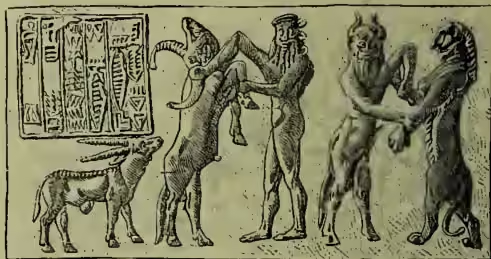
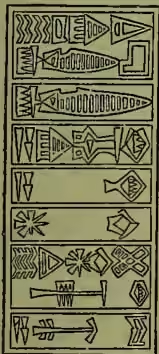
Art and Manufactures.—Babylonian art was until recently represented by a few engraved cylinders and gems; but the recent explorations on the Shat-el-Hie, the site of the ancient city of Sergal or Kulunu, conducted by Mr Rassam at Sippara (Abu Habba), and by M. De Sarzec at Tel-lo, have discovered statuettes which are really good works of art, differing from all previous examples of Babylonian art, and from the later works of the Assyrian artists. The largest of these statues is nearly life-size, and represents the 'high-priest' Gudea, the viceroy of the city, seated on his throne; the statue is extremely accurate in its anatomy, and carved in the hardest green diorite. The whole of the group is covered with a long inscription in archaic characters, recording the restoration of the temple by this prince in (about) 2700 B.C. Still more remarkable is a fine head carved in red porphyry, which clearly bears the appearance of being a portrait, and is true to the facial characteristics of the Sumero-Akkadian race. These statues bear a close resemblance to the remarkable statues of the early Egyptian king Kephren. The execution of these works of art indicates that the art of sculpture had been long practised, and that tools of the most perfect temper must have been used. Along with these were found several bronze statuettes, showing a knowledge of the art of casting metals. Gem-engraving has always been a special feature of Babylonian art, and numerous hard stone seals have been found, the intaglio workmanship of which shows a high development of the lapidary's art. The subjects upon these are chiefly taken from the legends of Gizdhubar, or from the popular myths, while others relate to the future life. Talismanic gems bearing emblems of the gods and magical formula are also frequently found. The stones chiefly selected by the Babylonian lapidaries are hæmatite, green and red jasper, cornelian, chalcedony, crystal, lapis-lazuli, onyx, and sardonyx. Music formed an important feature both in the court and religious ceremonies of the Babylonians at a very early period, and on the sculptures we find the harp, pipe, and cymbals represented. Among the trades mentioned in the tablets we find the weaver, dyer, potter, smith, builder, and carpenter.
History.—The discoveries of the last few years have given to the history of the ancient Babylonian empire a most surprising retrospective enlargement. It is now evident, from the monuments and inscriptions which have been obtained from the traditionally oldest cities of Chaldea, that the civilisation of the ancient people of Babylonia has an antiquity rivalling that of ancient Egypt. The American discoveries at Nippur in 1888–90 carry back Babylonian civilisation to about 7000 B.C., a temple unearthed being of that date. A stone which in the British Museum, brought by Rassam from Sepharvaim, is inscribed in line writing, in which the characters are formed more by lines than by wedges, a style that goes back to a time when the hieroglyphic or pictorial system of writing was beginning to be discontinued. The king's name inscribed is that of Sargon I., king of Akkad, who is now universally assigned to the remote antiquity of 3800 B.C., and other inscriptions of this remote period are to be found in other European museums. Older still, in all probability, are the very archaic records found by M. De Sarzec at Tel-lo, in the neighbourhood of Erech, which, written in the ancient agglutinative dialect of the Sumero-Akkadian inhabitants, must precede the Semitic inscriptions of the northern kingdom of Sargon and his successors. These early inscriptions are mostly of a very short character, containing little more than the names and titles of the kings who ruled the cities, but at the same time they afford us information as to the state of civilisation existing in Chaldea nearly 4000 years before the Christian era. The empire had not become one consolidated whole, and polyarchy was the most prevalent form of government, each city being ruled by its local king. Thus, Sargon was king of Akkad, and especially styles himself king of 'the city.' Ur-bahu and Dungi were rulers of Ur, and others held sway in the cities of Eridhu, Larsa, and Babylon. Some of these early rulers claim the titles of king of Sumir (Shinar) and Akkad, a division which in after-time had the geographical signification of N. and S. Babylonia, but which in the earlier ages are certainly rather to be regarded as ethnic than local divisions of this early population. Babylon, though always one of the most important cities of the empire, was not the earliest capital, for the cradle of Chaldean civilisation was in the region of the south. Here all the ancient legends connected with Gizdhubar as Nimrod are located, and find their centre in the city of Urn-ki, the Erech of Genesis, the name of which means 'the city of the land,' or capital. The next most important city in this southern region was Ur, the sacred city of the Moon-god, the ruins of which are marked by the mound of Mugheir, on the west bank of the Euphrates, the city from which Abram came. Larsa (Senkereh), the Ellasar of Gen. xiv., Sergul or Kulunu, the Calneh of Genesis, now marked by the ruins of Tel-lo on the Shat-el-Hie, and Eridhu, the most sacred city of South Babylonia, called frequently the 'Holy City,' were all seats of local rulers. The first ruler who succeeded in combining those various city kingdoms into one consolidated whole was Ur-bahu, whose reign must be placed about 2700 B.C. This ruler restored temples in nearly all the above-mentioned cities, and appointed 'priest viceroy' to rule in them. He was succeeded by his son Dungi, who has left us a large number of inscriptions. Already Chaldean civilisation had made great progress and was far advanced, and the sciences, especially mathematics and astronomy, were studied; while the ships of Chaldea navigated the Persian Gulf. The first really historical chronicle belongs to this period, and is found on a statue of Gudea, which shows the Babylonians already at war with Elam and the nations to the west. The wars with Elam form the chief features of the history of this period. In 2280 B.C. a powerful confederation of Elamites under Kudur-nakhundi invaded South Chaldea, and sacked the capital, Erech, carrying away the statue of the divine patroness Nana or Istar. This dynasty lasted until about 2120 B.C., and was very powerful, as shown by the numerous inscriptions of the kings found in various parts of Babylon. Of the kings of this period two are specially important—viz., Kidur-mabug, who appears to have been lord-paramount of the confederation of kings, and who claimed the title of 'lord of the west,' or Syria, and his son, Eri-aku, who was ruler of Larsa. This latter ruler is almost universally identified by Assyriologists with the Arioch, king of Ellasar, mentioned in Gen. xiv. This dynasty was overthrown by the powerful usurper, King Khammuragas, who appears not to have been of native Babylonian origin, but rather a Kassite or Cossican who had settled in the land and availed himself of this period of depression to seize the throne. This Kassite dynasty is one of the most important periods in Babylonian history, as great political changes took place at this time. It was at this period that Babylon began to assume its position as the capital of the whole empire. Khammuragas rebuilt the temples of Bel at Babylon, Nebo in Borsippa, and restored several of the sacred edifices in South Babylonia, at Ur, Erech, and Larsa, which had suffered at the hands of the Elamite invaders. His greatest public work, however, was the construction of a canal called the river of Khammuragas, 'joy of men,' which there is little doubt was the Nar Malka or royal river of the classics. This canal crossed North Babylon, passing through Sippara, and is now represented by the Yusifieh canal, one of the few ancient canals navigable to the present day. This dynasty lasted about 180 years, the founder himself ruling 45. The very numerous collection of inscriptions of this period in the British Museum
(From a Drawing by Mr Rylands.)
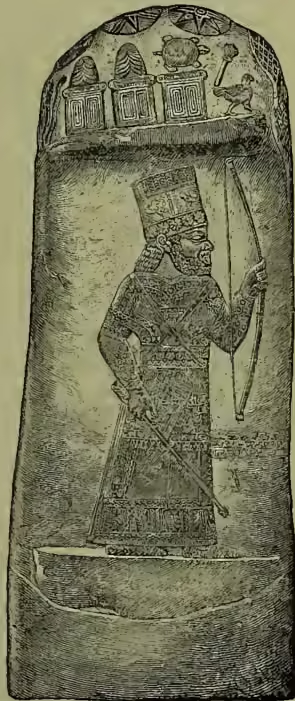
(From a Basalt Stele in the British Museum, about the 12th century B.C.) shows that at this time Babylonia was occupied by a much mixed population, consisting of Sumero-Akkadians, Elamites, Kassites, and a large Semitic element. The Semites appear principally as traders and merchants.
The three succeeding dynasties, extending over a period of about six hundred years, consisted of a mixture of Semitic and non-Semitic princes, who ruled with Babylon as capital. The history of this period is chiefly to be derived from the Tablet of Synchronous History and only a few Babylonian records of the period have been preserved. One of the most important Babylonian inscriptions of this period is the memorial stone of Nebuchadnezzar I., 1150 B.C., a usurper who seized the throne, and waged war against the rising empire of Assyria. In this inscription the king records the result of a campaign against the Elamite chiefs in the region of Namri or Kurdistan and on the banks of the Ulai River, on which the city of Sushan was afterwards built. The description of the campaign undertaken in the hot summer months is extremely graphic for so ancient a document. 'In the month Tammuz he took the road, the rocks were burning and scorched like fire, from the gardens was burned all vegetation, there was no water in the springs, and cut off were the drinking-places, the strength of the great horses wearied, and to the warlike hero his courage returned.' The writer thus describes the battle in which the Babylonians were undoubtedly worsted, and only saved from complete defeat by the aid of the governor of an adjacent city who refused to surrender to the Elamites. In return for this the city has a charter of freedom granted it, declaring it free from taxes and from the usual levy for men in the time of war. The history is after this date chiefly to be derived from Assyrian sources, and it is not until the time of Nabunazir, the Nabonassar of the Canon of Ptolemy, that we have any complete sequence of Babylonian history. Our information is now chiefly derived from the important but unfortunately fragmentary Chronicle tablet already spoken of. Nabonassar, whose reign forms an important epoch in Babylonian history, ascended the throne in 747 B.C., and ruled for fourteen years. During his reign, the country was twice invaded by the Assyrians, and though they claim the victory, they do not seem to have shaken the king on his throne. Nadinu, the Nadinos of Ptolemy, who succeeded to his father's throne in 734 B.C., only ruled for two years, when one of the popular revolts unseated him and placed Ukinziru, the Chimzoros of Ptolemy, on the throne. In the third year the country was invaded by the armies of Tiglath-pileser III., king of Assyria, who drove the Babylonian king from his capital into the marshes of South Babylonia, where he found him and put him to death, ascending his throne under the Babylonian name of Pulh or Pul. This conquest of Babylonia in 729 B.C. was a very important event in the history of the kingdom, for it brought the two courts of the north and south kingdoms once more into close relationship. The death of Shalmaneser IV., king of Assyria, and the usurpation of the throne by Sargon the Tartan in 722 B.C., was the opportunity seized by the Babylonians for once more becoming independent under the leadership of a prince of very ancient descent—Merodach-baladan II. This prince was one of the most popular rulers of the middle Babylonian kingdom, and was supported by all classes of the people as well as by the Elamite court, who were the most powerful opponents of Assyria. For twelve years the wars in Syria and other parts of the empire kept the Assyrians from despatching sufficiently strong forces to the south to crush this powerful prince. In 712 B.C. Sargon was purposing to march into Babylonia, when a counter-action was caused by the Babylonian prince sending an embassy to Hezekiah and the other princes of Syria, and raising a revolt which called the invaders away (2 Kings, xx. 6); but in 710 B.C. the storm broke, and Sargon captured Babylon, proclaiming himself king. On the assassination of Sargon in 705 B.C. Merodach-baladan returned, and after a reign of some nine months was driven from the land by Sennacherib, seeking refuge in the Elamite provinces on the east shore of the Persian Gulf. For some years Babylonia was now ruled by viceroys and princes appointed by the kings of Assyria, although several native princes attempted revolt. In 688 B.C. Sennacherib, after a very severe campaign, in which he defeated the allied Elamites or Babylonians, became sovereign of the two kingdoms. His son and successor, Esar-haddon, attempted to carry out a policy of a more conciliatory kind, and divided his time between the two courts; but the violent opposition of Egypt in Syria weakened his power, and the Elamites and Babylonians constantly harassed. Shortly before his death he appointed his son Samas-sum-yukin, the Saosduchinos of Ptolemy, ruler, which appointment was confirmed by his son and successor Assur-bani-pal. This prince, tempted by the intrigue of the Babylonian priests, revolted against his brother, and was defeated after a terrible war, in which Babylon, Sippara, and Borsippa were besieged, and burned himself in his palace, 647 B.C. Kandalanu, who succeeded him, was little more than a vicerey, depending in every way upon the Ninevite court, although tablets are dated in his reign. On the disruption of the Assyrian empire after the death of Assur-bani-pal, the throne of Babylon was seized by Nabu-abla-utzar, or Nabopolassar, the general of the Babylonian garrison, who had married a Median princess, and was himself no doubt of collateral descent from the royal line of Babylonian kings. The general disruption of the states of Western Asia which took place in 625 B.C., subsequent upon the inroad of a large mass of Aryan and other invaders from the East, afforded the Babylonians an opportunity for throwing off the hated yoke of Assyria, and Nabopolassar was proclaimed king in 625 B.C. He was succeeded in 604 B.C. by his son Nebuchadnezzar, one of the greatest sovereigns who ever ruled over the ancient empire. During a long reign of forty-three years the prince succeeded in recovering the long-lost provinces of the kingdom, and once more making Babylon queen of nations. He not only restored the empire and rebuilt Babylon, but almost every temple and edifice throughout the land underwent restoration at his hands. It is an astonishing fact that not a single mound throughout Babylonia has as yet been opened by the explorers which has not been found to contain bricks, cylinders, or tablets inscribed with his name. In 599 B.C. he captured Jerusalem, and sent Jehoiakim captive to Babylon, and eleven years later, owing to the still disturbed state of the kingdom (588 B.C.), he destroyed the city, and removed most of the inhabitants to Chaldea. Nebuchadnezzar was succeeded in 561 B.C. by his son Evil-merodach, who released Jehoiakim, but was murdered by his brother-in-law, Nergal-Sharezer, who was the rab makhw or 'chief seer' of one of the temples. His reign lasted until 556 B.C., his son Labasi-Kndar, the Laborasoarechad of Ptolemy, only ruling a few months. The throne was in 556 B.C. usurped by a powerful and active prince, Nabu-naid or Nabonidus, the son of a 'chief seer,' whose reign is the most important, next to that of Nebuchadnezzar, in later Babylonian history. The inscriptions of this king are found in almost all temples, and some of them contain important historical facts. In a cylinder found at Sippara, the king records his restoration of the temple at Kharran, which was destroyed by the Scythians, and in his sixth year, 549 B.C., he records the overthrow of Astyages, king of the Medes, and the capture of Ecbatana by Cyrus. In the king's seventeenth year the whole land of Babylonia was in revolt against him for neglecting the duties of court and religion, leaving all to his son Belshazzar. During the summer of this year Cyrus invaded Babylonia, advancing from the neighbourhood of the modern Bagdad, and reaching Sippara on the 14th day of Tammuz (June), which the garrison yielded without fighting. Two days later, Tammuz 16, Babylon is taken in the same manner. Cyrus appointed Gobryas ruler. Three months later Nabonidus, who was a prisoner, died, and after a week's mourning by the people, was buried on the 4th day of Nisan, 538 B.C. Babylonia now became a Persian province, and under the rule of Cyrus (538-29 B.C.) and Cambyses (529-21), it appears to have been peaceful. On the accession to the throne of Darius, son of Hystaspes, the old rebellious spirit once more asserted itself, and for three years (521-19) the city held out against the Persians under Nadinta-Bel, who claimed to be Nebuchadnezzar, son of Nabonidus. Again, in 513 B.C., the city revolted under Arakha, an Armenian.
With the overthrow of the Persian monarchy, Babylonia came under the short-lived dominion of Alexander the Great, who died in that city (323 B.C.). Seleucus I., to whom it had been promised at the conference of Triparadismus, contested and won the possession of it from Antigonus (312 B.C.). About 140 B.C., it was taken from the Syrian monarchs by the Parthians. It came into the hands of the Romans only temporarily, first under Trajan (114 A.D.), under Septimius Severus (199 A.D.), and again, under Julian (363 A.D.). When in 650 the successors of Mohammed put an end to the new Persian monarchy of the Sassanides, the province of Babylonia, where Bagdad was built (762-766), became the seat of the califs till 1258. Since 1638, when the Turks, for the second time, took it from the Persians, it has been under the dominion of Turkey, divided into the pachalies of Bagdad and Basra.
The classic writers represent the civilisation of the ancient Babylonians as of a high stamp. The government was despotic, of a kind to suit a crowded, luxurious, and effeminate population. Arts and commerce were highly flourishing—the last was carried on by caravans with Bactria, Persia, and Media, perhaps as far as India, and by shipping on the Persian Gulf with Arabia. Babylonia was famous for its dyes, its cloths, and embroideries, especially for the manufacture of rich carpets with woven figures of strange animals and arabesques, such as we yet see on the Nineveh sculptures. The general prosperity was such, that Babylonia and Assyria together were able to pay to Persia, in the time of Darius Hystaspes, a yearly tribute of 1000 talents (upwards of £280,000)—a sum greater than that contributed by any other province.
Literature.—The Babylonians, that is, the old Sumero-Akkadian population, were essentially a literary people, and the scribe caste comprised many of the highest in the land. It is evident from the numerous inscriptions as early as 2000 B.C., which are the work of private persons, that a certain amount of education was bound to be attained by every Babylonian, and that this implied access to the temple schools and libraries is certain from the directions given in certain tablets, which show the student how to ask for the works he required from the libraries. The tablets were all numbered and arranged in order according to the various sections to which they belonged, and directions were given to order the works by the numbers attached to them. The literature in the Babylonian libraries was, like the religious development in the earlier stages, largely influenced by local schools of thought, and consequently certain branches of literature represent the teachings of certain temple schools. In the most ancient school of Eridhu, the sacred city of Ea, there was established the chief centre of a school of religio-magic, who devoted themselves almost entirely to the study and composition of works on magic and kindred subjects. In this city the series of tablets known as the books of 'spells relating to diseases of the head,' consisting of more than fifty tablet volumes, was composed. These remarkable works, as M. Lenormant has shown, bear a close resemblance to the Atharvaveda or Black Veda of the Aryans. The epic poem of Gizdhubar, with its twelve books arranged according to the signs of the zodiac (see ASSYRIA), was probably the production of the school of Erech, the most ancient capital of the land, but was traditionally attributed to a scribe named Sin-tiki-unini. Other poems, such as the Sumero-Akkadian version of the war in heaven, which describes the attack of the seven evil spirits on the moon, may be ascribed in all probability to the city of Ur. One of the most perfect specimens of Babylonian literature is the tablet describing the war in heaven between Merodach and the demon Tiamat, which comes from the library of the temple of Nebo at Borsippa. Of this tablet we have both Assyrian and Babylonian versions. This poem describes in most beautiful words the commission of Merodach by the great gods in assembly for the work of crushing the evil demon. The fight of this terrible nature-war, and the conquest of the evil one and his allied spirits of darkness, is all described, and then the tablet closes with a remarkable hymn of praise to the victor. In fact, the literature contained in these libraries comprised every branch of learning known at the time. Historical and mythological documents, religious compositions, legal, geographical, astronomical, and astrological treatises, magic and the arts of divination, poems, fables, and proverbs. In this last branch one of the most curious specimens is the legend of the bird-god Zu, 'the wise one,' who stole the tablets of destiny and the secrets of the gods, and, like Prometheus, brought them down to earth, he himself being driven away to the mountains for his sin. One important distinction between the literatures of Babylonia and Assyria remains to be noticed: in the former the names of the writers are known in most cases, while in the latter all merit is appropriated by the king. Most of the classic works of Chaldea were copied by the Assyrians under Assur-bani-pal, and placed in the library and at Nineveh, and became part of the literature of the northern empire (see ASSYRIA).
Religion.—During the long period over which the monuments and inscriptions extend, numerous changes took place in the religion of Babylonia. The early speculations of the Sumero-Akkadians were a rude fetish-worship or Shamanism, according to which every object in nature was regarded as the abode of an indwelling spirit or life (Zi), which controlled its actions and its relationship to man. Round this primitive creed grew up a body, not of priests, but rather of medicine-men, or exorcists, who dealt only with the malevolent spirits of sickness and disease, and the hostile powers of nature injurious to the life of man.
The liturgy of these priests is found in the hymns and magical texts, large numbers of which have been preserved in the libraries of Nineveh and
Babylon. Gradually the vast host of spirits became grouped in a hierarchy of the spirits of the heavens and the earth; and from these came the first gods of the Sumero-Akkadian pantheon. These two great spirits, so frequently invoked in the sentence, 'Oh Spirit of the heavens, exorcise thou! Oh Spirit of earth, exorcise thou!' became no longer spirits, but Dingri or 'creators,' a word explained by the Semitic Ilu, 'god,' and the parents of all the other gods. Under this new development a number of local gods grew up, and each city had its divine patron, who was worshipped there with a strict henotheistic worship—that is, he alone in his sacred city was supreme among the gods. Thus, in a beautiful litany from Ur of the Chaldees, this phase of the religious life is clearly shown. 'In heaven who is supreme? Thou alone art supreme! On earth who is supreme? Thou alone art supreme!' Yet the same words appear in the local liturgies to Merodach in Babylon, and to Nebo in Borsippa. One of the earliest seats of religious culture in Chaldea appears to have been the city of Eridhu, then on the shore of the Persian Gulf, where was the seat of Ea, 'the lord of the sea.' This strange divinity, whose worship is most ancient, bears the titles of 'lord of the wave,' 'king of the deep,' 'lord of rivers,' and 'the god of boatmen'; the modern Niffer. This great god, whose name means the 'lord of the ghost-land,' was also the ruler of 'earth and mankind,' and, according to one version of the Deluge legend, was the deity who caused the destruction of the wicked men. The wife of the 'lord of the ghost-land' was the goddess Ninkigat or Allat, 'the lady of the great land' of Hades. She was the queen who ruled in the dread 'land of no return,' and 'whose city and palace walls were clothed in dust, the inhabitants thereof wearing robes of feathers like birds.' The child of this dread pair was Namtar, 'the demon of fever and goddess of fate,' who carried out the behests of his parents in spreading disease and death abroad. One of the most holy of the descendants of Mul-lil was the Moon-god, who soon, however, became a greater even than his father, and in his sacred city of Ur, became the centre of a great religious development spreading to Kharran, and Syria, and Arabia. In the city of Ur, 'the dwelling of the moon-god' was worshipped under the name of Nannar or Nanak, both names being preserved to us in the legends of Hellenic Asia. Some of the hymns to this deity are among the most beautiful in the sacred poetry of Chaldea. 'Merciful one, begotten of the universe, who founds his illustrious seat among living creatures. Long- suffering father, full of forgiveness, whose hand upholds the lives of mankind. Lord, thy divinity is as the wide heavens, and fills the sea with its fear.' 'On the surface of the peopled earth he bids the sanctuary be placed—he proclaims their name. The father, the begotten of gods and men, who causes the shrine to be founded, who establishes the offering, who proclaims dominion, who gives the sceptre, who shall fix destiny unto a far-distant day.' In the creed of the ancient population of Babylonia, the moon took precedence of the sun-god, the latter being the son of the former. This was probably due, as Professor Sayce has suggested, to the fact that Mul-lil was lord of the night-sky.
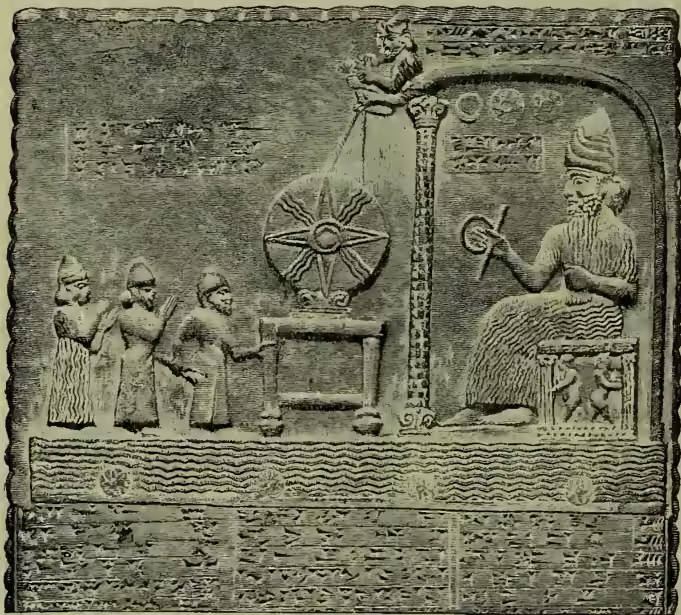
However, under the influence of the Semites, especially those of the northern cities of Sippara and Akkad, Samas the sun-god soon became the head of a special cult which absorbed many of the other older gods, and each city had its local sun-god or solar hero. The old centre of sun-worship in Chaldea was the city of Larsa, 'the dwelling of the sun-god,' where many of the oldest kings restored the great temple. It was, however, in the northern city of Sippara of the sun,' and in the most ancient temple of E Bábara, 'the house of lustre,' where this worship attained to its highest development. The spread of the solar worship in Chaldea received a strong impetus from the patronage of the great Semitic ruler, Sargon I. (3800 B.C.), who restored his temple. The tablet, of which a representation is given (fig. 4), was erected by Nebobaladan, king of Babylon, an ardent votary of the worship of the sun-god, about 900 B.C. The god is seated on a square seat, placed inside a porch supported by pillars, and holds in his hand a ring and a short rod. Before the pillar stands a stool with legs, bearing a figure of the disc of the sun, apparently supported by cords which are held in the hands of two attendant spirits from the roof. Of the three figures standing with their faces turned towards the disc, also we find him called 'lord of wisdom,' 'he who knows all things,' 'lord of laws,' all of which titles aid us in identifying him with the mysterious fish-divinity, who taught, according to Berosus, the elements of culture to the first inhabitants of Chaldea. The consort of Ea was Dav-kina, 'the lady of the earth,' who personified the earth just as Ea represented the sea. Water and the earth were, according to the ancient theogony of the city of Eridhu, the two elements out of which all the world proceeded. This pair had a son, Tammuz, 'the only begotten one,' who, according to the creed of Babylon, was replaced by Marduk or Merodach. The worship of Tammuz in association with his sister and consort Istar, reached a high development in Babylonia, and spread over the whole of Western Asia. Next in importance among the local deities came the god Mul-lil, the elder Bel of the Semitic creed, whose sacred city was Nipur, the first is a priest who holds the stool with his left hand, while with his right he grasps the left hand of the second figure—the king, whose right hand is raised in adoration to the god. The third figure behind the king has both hands raised in adoration. Above the heads of the three figures are the three lines of inscription, 'the image of the sun-god, the mighty lord, the dweller in the temple of Parra (or Bara), which is within Sippara.' Under the god are carvings of two figures, and above are three circles, representing the new moon, the sun, and Istar or Venus. Exactly under these runs another inscription, and two lines run along the roof. Underneath the whole are six columns of Babylonian writing, consisting of hymns to the sun. The rise and spread of the sun-creed in Babylonia mark a great change in the religious life of Chaldea in the meeting and amalgamation of the Semitic and Akkadian religious thought. We have no longer to deal with the dread Mul-lil of the ghost-land, but with a supreme Baal, the head father and creator of the universe, who rapidly absorbed all the other solar deifications in the old Sumero-Akkadian pantheon. Dumzi, or Tammuz of Eridhu, Ningirzu of Sergul, Silikh-mulu-khi of Eridhu and Babylon, all became absorbed in Bel-Merodach or Marduk of Babylon or Samas of Sippara. It is to this age that we must assign the growth and compilation of the great epic of Gizdhubar, the sun-god, which embodies so many solar legends and solar characters. From this religious reformation there grew up the worship of the great Bel-Merodach, once a solar deity, but gradually as the city became the capital of the empire this local deity became the head of the pantheon, and the national god, as Assur became in Assyria. The position which Merodach attains under the religious school of the later empire is a near approach to monotheism, and he visits all neglect of his worship with severe punishment. It was for neglect of his supreme power as lord of Babylon and Babylonia that Nabonidus was visited with the rod of the Persian, and his power was recognised by the conqueror, for Cyrus calls himself the 'servant of Merodach.' Zirpanit, the consort of Merodach, was but a reflex of her lord and master, and as the goddess of wisdom she retains some traces of the former connection between Merodach and his father Ea. It is to this pair that the invocations of the kings of the later Babylonian empire are directed. The temple of Bel-Merodach or the tomb of Belos was one of the wonders of the world. The temple stood on the east side of Babylon, and was certainly as old as 2150 B.C., when Babylon became the capital of a consolidated empire. It bore the Akkadian name of E Sagilla, 'the house of the raising of the head.' Its beautiful entrance-gate, like Solomon's porch in the temple, was called 'the gate of glory,' and just within which was the sacred seat or couch of Zirpanit, the Succoth-benoth of the Scriptures (2 Kings, xvii. 30). In the temple itself was the papakha or shrine of Merodach, 'the holy of holies of the gods of destiny,' which was separated from the ekal or main nave or holy place by a veil. In the centre of the court rose the great Ziggurat, called 'the house of the foundation of heaven and earth.' The ceremonies of the service in this temple present a remarkable resemblance to the Temple of the Jews. The daily morning and evening sacrifice, the meat and drink offering, the free-will offering, the sin-offering, and the show-bread, all formed part of the ritual of this temple. Next in importance to Merodach was the god Nebo, who, with his consort Tasmit, was worshipped in the city of Borsippa (see ASSYRIA). Here he was associated with his goddess Tasmit, and presided at the temple of E Zida, 'the ever- lasting house,' the chief university of Chaldea. Several of the minor gods and spirits survived in the new and highly developed cult—Ninep or Uras, the god of war and the chase; Nergal, the god of death; Gibil, the fire-god; and many local spirit-demons. In addition to the numerous native gods, the Babylonians incorporated many foreign divinities into the pantheon, especially those of their Kassite rulers, such as Samalia, Suga-Muna, and Kit, the Kassite sun-god.
The City of Babylon.—The accounts that we find in the ancients of the origin, the greatness, and the structure of the city are exceedingly confused. The god Belus is named as its founder, and also Queen Semiramis; how we are to understand the two statements is not explained. Semiramis, according to the account of Diodorus, employed on it two millions of workmen, collected from all parts of her dominions. With the capital of the older kingdom, the accounts of the ancients known to us have, for the most part, nothing to do; they are all to be referred to the resuscitated and adorned residence of Nebuchadnezzar. Herodotus gives a description of the city, as if from his own observation. It stood on both sides of the river, in the form of a square, the length of whose sides is variously given; by Herodotus it is stated at 120 stadia, making the whole circumference 60 miles. It must be remembered, however, that the walls, like those of most oriental towns, inclosed rather populous districts than cities, so that the whole mass of the population might easily find shelter within the space inclosed. It was surrounded by a wall 200 cubits high, and 50 cubits thick, and furnished with 100 brazen gates—the last number is raised by Diodorus to 250. The city was built with extreme regularity, with broad straight streets crossing one another at right angles; and the two parts were connected by a roofed bridge built of hewn stones, fastened together with iron clamps. Of this bridge, not a trace has yet been discovered. The western part of the city is undoubtedly the older, belonging to the early and properly Babylonish dynasty. Here stood, in the middle of the city, as it is described, the famous temple of Belus or Baal, called by the Arabs, Birs Nimrud (see BABEL, TOWER OF). The next important point on the west side is the mass of ruins called Mujellibe, which was probably the royal citadel of the old Babylonian monarchy. On the east side of the river stood the buildings of the Neo-Babylonian period, among which the 'Hanging Gardens' of Semiramis are to be singled out as one of the wonders of the world. Of these gardens Diodorus has left us a detailed description. Their ruins may be recognised in the mound called El-Kasr. The city suffered greatly from the Persian conquest. When it revolted under Darius I., and, after a siege of two years, was recaptured through the ingenuity of Zopyrus, the outer walls were demolished. Xerxes plundered the temple of Belus, which had been hitherto spared, and Herodotus found it empty. Although the Persian kings made Babylon their residence, nothing was done for the restoration of the city; and Alexander the Great, who, on his entrance, in 331 B.C., had promised the inhabitants to rebuild the ruined temple, was unable even to clear away the rubbish, although he employed 10,000 workmen for two months. After his death in the palace of Nebuchadnezzar, and the foundation of Seleucia on the Tigris by Seleucus Nicator, Babylon went rapidly to decay. This was partly owing to the new city's being built of the materials of the old, and partly to the want of durable materials for monumental buildings. Stones of any size had to be brought from the mountains of Armenia; their place was mostly supplied by burned brick. As early as the time of Pausanias, there was little to be seen but the ruins of the walls. The older Arabian geographers know, indeed, of a village, Bâbil, but speak more of the great masses of ruins. Since the time of Della Valle, who erroneously looked upon the ruin Mujellibe as the tower of Belus (in which he is followed by Rennel), the site of Babylon has been the object of many travels and researches. The greater number of the explorers, among whom Rich is the most distinguished, consider the town of Hillah, with 7000 inhabitants, as the representative of the ancient Babylon. The great masses of ruins, from which we must not, with Rennel, exclude the Birs Nimrud, embrace, indeed, an enormous extent, but agree perfectly with the accounts of the ancients in being arranged in the form of a square.
See Oppert, Histoire des Empires de Chaldée et d'Assyrie (Versailles, 1865); Layard, Nineveh and Babylon (1867); Loftus, Travels and Researches in Chaldea and Susiana (1857); Lenormant, La Langue primitive de la Chaldée (1875), and Manuel d'Histoire ancienne de l'Orient (9th ed. 3 vols. 1882); Sayce, Ancient Empires of the East (1884), Fresh Light from the Ancient Monuments (1885), and Hibbert Lectures (1887); Sir H. C. Rawlinson, Cuneiform Inscriptions of Western Asia (a British Museum publication, 5 vols. 1861-1884); Delitzsch, Wo lay das Paradies? (1881); Delitzsch and Haupt, Assyriologische Bibliothek (1880); Perrot and Chipiez, A History of Art in Chaldea and Assyria (1884; Eng. trans. 2 vols. 1884); Pinches, Guide to the Nimroud Central Saloon, British Museum (1886); the Transactions of the Society of Biblical Archaeology (1872-87); the Babylonian and Oriental Record (commenced 1886); works named in the articles on George Smith, Maspero, and A. H. Sayce; Jensen's Kosmologie der Babylonier; J. P. Peters, Nippur: the University of Pennsylvania Expedition to Babylon in 1888-90 (2 vols. 1898).