Backgammon, a game of considerable antiquity in England, where, until the 17th century, it was known by the appellation of 'the tables.' Apparently the word is merely 'back-game,' and may have been given because the two players have to bring their men back from their antagonist's tables into their own, or because the pieces are sometimes taken up and obliged to go back—i.e. re-enter at the table they came from. The French name is tric-trac. Backgammon is played with a board or tables, men or pieces, dice, and dice-boxes. The introduction of dice into the game, and their constant use in determining moves, makes backgammon essentially a game of chance. The backgammon board consists of two parts or tables, each possessing twelve points, six at each end, which points are coloured white and black alternately. The game is played by two parties, and with 30 pieces or men. Each party has 15 men, one set of 15 being black, and the other white. In beginning the game, the men are placed on certain points on the tables, as shown in the following figure. The game is played with two Dice (q.v.) and two dice-boxes. The dice are common to both; but each party uses his own dice-box, and the throws are alternate. If a player throws doublets, or both dice of one number, double the number of dots is reckoned; thus, by a throw of two aces, the player does not count 2, but 4. These numbers thrown or accidentally turned up by the dice bear a reference to the points on the tables. In order to understand this connection between the dice and the men, the learner must observe how the men are placed on the points, and the rules by which their shifting from one to another is governed.
The tables are here spread out as if two persons were seated, and about to begin to play. The player owning the white men is seated at W, and the player owning the black men at B. We shall call one player White, and the other Black. White counts round from the ace-point of Black, and Black counts round from the ace-point of White.
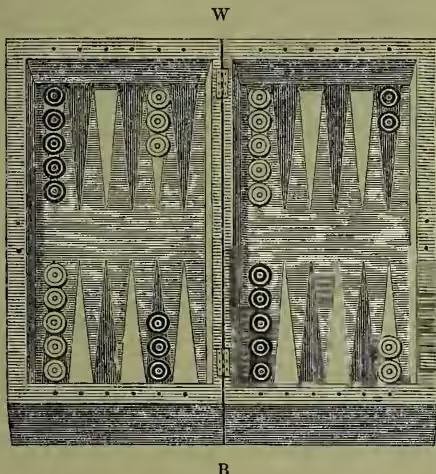
These ace-points are respectively seen to have two men upon them in opposite corners of the same table. The grand object of the game is for each party to get all his men played round into the table containing the aces, removing them from point to point agreeable to the throws of the dice. In throwing, the number upon each die turned up may be reckoned by itself, or collectively, with the number on the other die. Thus, if 4 be thrown by one die, and 6 by the other, a man can be advanced 4 points, and another 6 points; or one man can be advanced 10 points, always providing that a point is open to suit this movement to it. No point can be moved to if covered by two men belonging to the adversary. If covered by only one man, which is called a blot, then that man can be hit, and be removed from the point, and placed on the bar between the tables, his place being taken by the man who has won it. The removal of a man to the bar throws a player considerably behind in the game, because the man must remain out of the play till the dice turn up a number corresponding to an open point on the adversary's table. Being fortunate to get an open point by this means, the man must be entered and wrought round from thence, as in the case of others in the set to which he belongs. The frequent occurrence of this hitting of a blot gives an adversary a great advantage, and allows him to win the gammon. There are two kinds of victory—winning the hit, and winning the gammon. The party who has played all his men round into his own table, and by fortunate throws of the dice has borne or played the men off the points first, wins the hit. The gammon may be explained as follows: When you have got all your men round to your own table, covering every point, and your adversary has a man out, then you are enabled to bear or lift your men away. If you can bear all away, so as to clear your table before the adversary gets his man placed by a throw on your table, you win the gammon. If the adversary has been able to bear one before you have borne all your men, it reduces the victory to a hit. Two hits are reckoned equal to one gammon in playing matches. To win two games out of three is called winning the rub, as at whist.