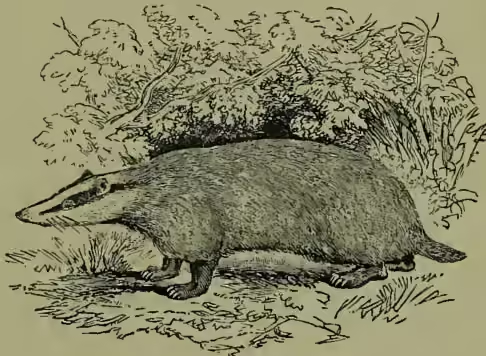
Badger (Meles), a genus of carnivores of the Mustelidæ or Weasel and Otter family. The Skunks (Mephites), Sand-bears (Arctonyx), American Badgers (Taxidea), Ratels (Mellivora), &c., are closely related genera in the same sub-family as the Badger (Melidæ). Badgers, like the rest of the family to which they belong, are almost quite plantigrade—i.e. they walk on the whole sole of the foot, and not merely on the fore part of it. The body is thus brought nearer to the ground than it otherwise would be from their length of limb. The lower jaw is locked into its socket in a very remarkable way, which explains their tenacious grip. The head is long, with a pointed muzzle; the tail short; the skin very thick, loose, and tough; the hair long. Both ears and eyes are small. The gait is slow, the habits nocturnal and solitary. There are five toes on each both of the fore and hind feet, and the feet are peculiarly adapted for digging and burrowing. A peculiar characteristic of the badgers is the possession of a bag beneath the tail, for the secretion of a peculiar substance, of a disagreeable odour, which is supposed to be of use in directing the sexes to each other in their solitary wanderings.—The Common Badger (M. taxus or M. vulgaris) is the only bear-like quadruped now found in the British Islands, and that only rarely. It is widely diffused over Europe and the middle parts of Asia. The colour is grayish brown, verging to red above and black beneath; the head white, with a longitudinal black band on each side; the body long but robust, in size about equal to that of a small fox, the hair coarse and reaching to the ground as the animal walks. The average length is 2 feet 6 inches, and the height at the shoulder 11 inches. It haunts the gloomy recesses of woods, or thick plantations on the sides of hills, and digs for itself 'a deep and well-formed domicile, consisting of more than one apartment, the single entrance to which is by a deep, oblique,
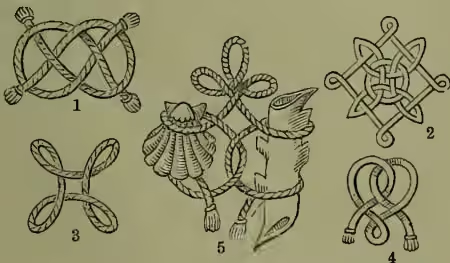
Ormond knot (fig. 1), it is not difficult to trace a W and two Os. The Bouchier knot, as seen on the tomb of Archbishop Bouchier at Canterbury, bears a resemblance to two BS, and the Stafford knot to two Ss. The Lacy knot (fig. 2) contains within it a rebus on the four letters of the name 'Lacy.' As examples of the badges of two different families entwined by a knot and used by the descendants of both, are the badge of the Dacres (fig. 5), combining their own escallop-shell with the ragged staff of Neville; and that of Edward, Lord Hastings, uniting the garbe of the Peverells with the sickle of the Hungerfords. and even tortuous excavation.' In such an excavation as this, the animal sleeps during the day and through the winter. It uses its nose in digging, and scrapes with the fore-paws, flinging the earth as far back as possible, and when the accumulation is considerable, pushing it away by means of the hind-feet. The habits of the badger are extremely cleanly. It is one of the most perfectly omnivorous of animals, in a wild state as well as in confinement; fruits, roots, beech-mast, eggs, young birds, small quadrupeds, frogs, snails, worms, and insects, equally constitute its natural food. For the sake of the larvæ of wasps and wild bees, it even ventures to dig up their nests, its hide being impervious to their stings. It is often caught by digging, or by placing a sack in the mouth of its hole, when it is out at night. Dogs sent into the hole are often foiled by the earth which the animal throws back upon them, to block up their way, nor is it easy for a dog to contend with it, owing to the great strength of its legs and jaws. A barbarous sport, called badger-baiting, or drawing the badger, was formerly common, but has been prohibited by act of parliament since 1850. A badger kept in a barrel was assailed by dogs, and at last, yielding to superior numbers, was dragged out, upon which it was released, and allowed to go back to its den, to recover itself, and be baited again, which happened several times daily, when the badger was kept as an attraction to a public-house of the lowest sort. The verb to badger, expressive of persevering annoyance by numerous assailants, was originally employed with reference to this practice. The flesh of the badger is said to be very agreeable, particularly when cured like hams. It is usually fat, like that of most sluggish heavy animals. In China it is much used for food. The badger is easily domesticated when taken young, and becomes very tame. In Scotland and the north of England, a badger is still called a Brock, its Anglo-Saxon name, preserved in the name of some places; in some parts of England it is termed a Grey. The Indian Bhalú-soor (i.e. Bear-pig), or Sand-bear (Arctonyx collaris), closely resembles the badger, but is taller, and has a more hog-like muzzle, and a longer tail. Its habits and its food are very similar, and when attacked, it likewise defends itself with great vigour. It is chiefly found in hilly districts.—The American Badger, or Taxel (Taxidea americana), is a distinct, more carnivorous genus, differing in dentition and in some features of the skull. It chiefly preys on small animals, such as marmots, which it pursues into their holes in the sandy plains near the Missouri and the Rocky Mountains. In its pursuit of the smaller quadrupeds upon which it feeds, it enlarges their burrows, and renders some parts of the plains dangerous to persons on horseback. Its prevailing colour is hoary gray in winter, yellowish brown in summer, and under parts generally yellowish white; a white stripe runs from the nose over the forehead to the neck. The hair becomes not only very long but woolly in winter.—The burrowing powers of this animal are extraordinary. It sometimes makes burrows 6 or 7 feet deep, running under ground to a length of 30 feet. See Alfred Pease, The Badger (1898).