Bagpipe, a wind-instrument, whose fixed characteristic has always been two or more reed-pipes attached to and sounded by a wind-chest or bag; which bag has in turn been supplied either by the lungs of the performer or a bellows. Some such instrument seems to have been generally known, at least throughout Europe and Asia, from a very early period. It was known to the Hebrews, Greeks, and Romans, and appears on their sculptures and coins—e.g. a coin of the Emperor Nero, who is said to have been a performer upon it. An ancient terra-cotta, excavated at Tarsus in Asia Minor, by Mr W. Burckhardt Barker, and supposed to date from about 200 B.C., represents a wind-chest with vertical rows of reed-pipes firmly fixed to the body of a performer. Sir William Ouseley met with it in Persia, where it is called 'reed-bag.' It is known in China and in some parts of India, and still continues in use in many countries of Europe, including Italy, the south of France, and Britain. In the 15th and 16th centuries it was common in Germany and England; carvings occur of it in churches at Boston, Great Yarmouth, and Hull; as also at Melrose. It is mentioned by Chaucer and Spenser, and several times by Shakespeare. Fuller in his Worthies describes the Lincolnshire bagpipe, and it was played at Manton in that county not long before 1850. Geoffrey of Monmouth describes the bagpipe as a Welsh—not Irish or Scotch—instrument (see Leyden's essay in Murray's edition of The Complaynt of Scotland, 1872). The earliest Scotch bagpipe is probably one bearing the date 1409. Except that it wants the large drone, introduced early in the 18th century, it is similar to the Highland bagpipe of the present day.
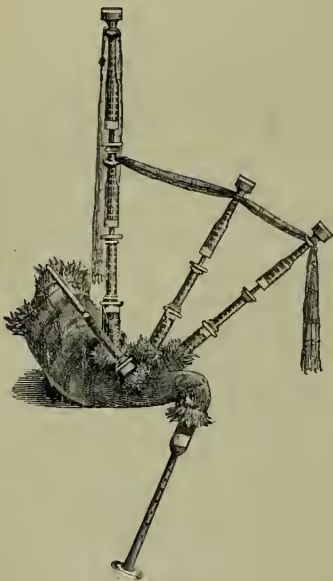
There is an entry in the Exchequer Rolls in 1362 of 40s. 'paid to the king's pipers,' which may indicate the use of the bagpipe at that date, and it is certainly mentioned in the poem of James I., Peblis to the Play. James VI., on a Sunday of 1581, returned from church at Dalkeith with two pipers playing before him; and the bagpipe has been employed in the services of the Catholic Church—e.g. at Edinburgh in 1536. It is supposed to have first been used in war by the Highlanders at the beginning of the 15th century, superseding the war-song of the bards. It has left its traces very distinctly in music, many popular national airs of different countries being evidently founded upon its drone bass and imperfect scale; while imitations of its effect are to be found in the works of many of the great modern composers. The Scotch Highland bagpipe is the only form of the instrument which is keeping its ground in Britain. It consists of an air-tight leathern bag, inflated by the breath of the player through a valved tube; and from this bag the sound proceeds, through three wooden pipes containing reeds of fixed tone called drones, which furnish a continuous bass, and another reeded pipe of conical bore with holes in it, which produces the melody, and is termed the chanter (see fig.). The drones have reeds somewhat like those of the organ, the two smaller producing a note in unison with the lowest A of the chanter, the larger one A an octave lower. The chanter has a double reed like that of the oboe or bassoon, and has seven holes in front for the fingers, and one behind for the thumb of the left hand. The compass is only nine notes, from G in the treble clef to A above it; these, however, do not form a diatonic scale, not being all accurately tuned to each other; the general effect of the music approximates to the key of A, but with the sevenths flat. This imperfection of scale, together with its somewhat harsh tone, is the cause of its unpleasant effect upon the accurately sensitive ears of those accustomed to music in the natural diatonic scale; but from the same cause results its semi-barbarous, exciting stimulus upon the Highlander in the battlefield. In playing, the drones are thrown over the left shoulder, the bag tucked under the left arm, the blowpipe taken in the lips, and the chanter held with the fingers. In the Highlands, the 'skirl' of the bagpipe is equally esteemed in the 'lament' or at the merrymaking. The piper usually walks up and down while playing. The very abundant music for the instrument comprehends reels, strathspeys, marches, and pibrochs, a special peculiarity being the use of frequent and sometimes largely extended groups of ornamental passing notes, termed warblers. First-rate pipers have been known to introduce warblers of eleven notes between the last up beat, and the first down beat of a bar. Warblers of seven notes are common, and five usual, but their effect can only be understood from hearing the performance of a really good piper. That many of the older airs are written in the so-called pentatonic scale, omitting the fourth and seventh, is probably to be accounted for by the already-mentioned fact that several of the intervals on the instrument are not in perfect tune, and would naturally be avoided. Until recently bagpipe music was taught and even written in a notation of its own; but there are now several large collections of the music printed in ordinary notation. In music printed for the Highland pipes, no signatures are required, its nine notes being invariable. Each burgh in Scotland had formerly one or more pipers, and they formed also a regular part of the retinue of the Highland chieftains, the office being in both instances frequently hereditary. The most famous performers were the MacCrimmons, who for several generations were hereditary pipers to the MacLeods of MacLeod, and the last of whom died in 1822. Next to them the MacArthurs, pipers to the MacDonalds of the Isles, were held in esteem. Among burgh pipers the family of Hasties were hereditary pipers of Jedburgh for upwards of 300 years; the last of them died at the beginning of the 19th century. The clan piper still takes a prominent part in Highland festivities, funerals, and other celebrations; and a piper forms one of the royal establishment at Balmoral. Pipers are attached to all the Highland regiments (see BAND, MILITARY), and bagpipe performances and contests form a feature at Highland gatherings, at home or abroad, when prizes are offered to the best players of pibrochs, reels, &c.
The Scottish burgh pipers, above alluded to, are supposed to have played on a variety of bagpipe called the Lowland pipe. It was smaller than the Highland pipe, and played with a bellows instead of by the mouth, otherwise, however, being exactly similar in principle; as was also the old form of the
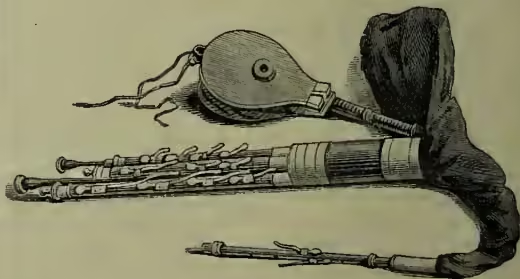
Northumbrian pipe. A newer form of the latter is still played. It is also a bellows instrument, and has several keys on the chanter, giving it a chromatic scale. A peculiarity of its fingering is that only one hole is uncovered at a time, and the end of the chanter is closed. The Irish bagpipe is a much more complete instrument than the Highland, as its chanter possesses a nearly full chromatic scale with a compass from D below the stave to D above the stave. The drones, which are all fixed on one stock, also possess keys, which are played with the wrist of the right hand, giving an harmonious bass which is very effective in the hands of a good player. Some of the drones are of great length, winding as many as three times the length of the apparent tube. The general arrangement may be seen from the figure. The player is seated, with one side of the bellows tied firmly to his body, the other to his right arm; the bag under the left arm, the drones resting over his leg, and the end of the chanter resting on a pad of leather on the knee, on which it is 'tipped' for the purpose of articulating many of the notes. From the softness of the reeds used, the Irish pipe is a very sweet instrument, but its use is rapidly dying out. The Italian bagpipe, familiar in Britain through the wandering pifferari, is a very rude instrument, consisting of a goat's skin with an enormous drone, on which the player performs by means of a mouth-tube; another player playing the melody on a separate chanter.