Balanoglossus, a worm-like animal of much zoological interest as a connecting link between invertebrates and vertebrates. The genus, which includes at least four species, occupies so unique a position that it is regarded as representative of a distinct class of Enteropneusta ('gut-breathers'). The animals live in fine sand, which they appear to saturate with slime. They eat their way through it, drawing themselves on by means of the contractions of the most anterior part of their body.
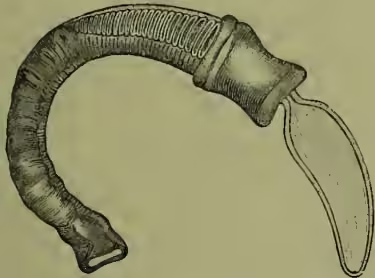
The body is richly ciliated and extremely soft; and it is thus very difficult to obtain large specimens intact. Balanoglossus sarniensis, which occurs as a rarity in the English Channel, has been aptly compared, as regards its softness, to wet bread. This form may attain a length of 8 inches or more. Two species have been found in the Gulf of Naples, and two in more northerly waters. The body exhibits four distinct regions, a large 'proboscis' in front of the mouth, a muscular collar of some length, a respiratory region, through slits in which water flows out from the gullet, and lastly, a long gastric region with most of the digestive and reproductive systems.
Apart from numerous peculiarities in the structure and development of balanoglossus, the general fact of importance is its remarkable combination of characters uniting it to widely separated types. It is what is known as a synthetic type—that is to say, it unites features characteristic of very different groups. In the language of zoological pedigree, it is a survivor of an ancestral group from which several others started. Thus the larva, which is known as Fornaria, is in some respects 'intermediate between the larva of an echinoderm and the larval type common to molluscs, chaetopod worms,' &c. Indeed, Johannes Müller, who first described the Fornaria, regarded it as the larva of an echinoderm. This very close structural resemblance between the Fornaria and the typical echinoderm larva is usually interpreted as suggesting a common origin for the two groups. Quite as striking are the affinities between balanoglossus and a primitive vertebrate. As in the latter the anterior portion of the alimentary canal, which is supported by a horny basket-work, is pierced by paired respiratory gill-slits, to all appearance comparable to those which persist in low vertebrates, and appear in the embryonic life of all. There are also structures which are believed by some to be more or less directly comparable to the dorsal nerve-cord and the supporting axis or notochord, so characteristic of vertebrates. Undoubted affinities must be admitted, and this fact likewise is interpreted in terms of the history, by regarding balanoglossus as a survivor of a primitive ancestral group, from which not only echinoderms, but vertebrata diverged. See CEPHALODISCUS, VERTEBRATA.