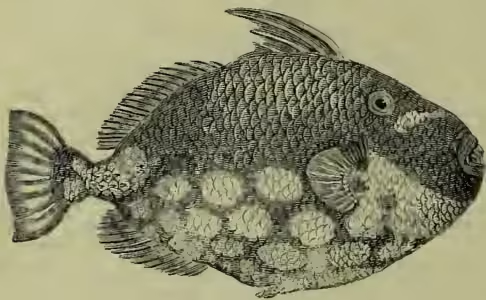
Balis'tés, or FILE-FISH, a genus of bony fishes of the order Plectognathi (q.v.) of Cuvier; the type of a large family, Balistidae, the species of which are almost all inhabitants of tropical and subtropical seas, frequenting rocky coasts and coral-reefs. One species has been occasionally found on British coasts. Their colours are generally brilliant. The skeleton, as in the other Plectognathi, is in part gristly or cartilaginous, and the external covering of the body often resembles that of the Ganoid (q.v.) fishes, consisting, in some of the genera, of bony plates, disposed in regular rows, and not overlapping; in others, of very small rough scales, with stiff bristles, as densely crowded as the pile of velvet. The snout protrudes slightly, and the teeth are few, but well developed. But the most interesting thing in connection with these fishes, is the provision for fixing the first dorsal spine in an erect position, or lowering it at the will of the animal. The spine is articulated by ring and bolt to a broad bony plate in connection with the backbone. 'When the spine is raised, a depression at the back part of its base receives a corresponding projection from the contiguous base of the second ray, which fixes it like the hammer of a gun-lock at full cock, and it cannot be let down until the small spine has been depressed, as by pulling the trigger; it is then received into a groove on the supporting plate, and offers no impediment to the progress of the fish through the water. This trigger-like fixing of the spine takes place also in the dead fish; and when a Balistes is removed from the bottle for examination, it is generally necessary to release the spine by pressing on the small trigger-ray.' The fish is called at Rome pesce balestra, in reference to the resemblance between the principle of the above mechanism and that of the Roman dart-throwing engine, ballista. The first spine is roughened with enamel projections, whence the name File-fish. The flesh is unwholesome.