Balloon (Fr. ballon, 'a large ball'). According to the principle of Archimedes (q.v.), bodies immersed in a fluid are buoyed upwards with a force equivalent to the weight of the fluid displaced by them. If their own weight is not sufficient to counterbalance this force—that is, if they are lighter than the fluid—they rise upwards with a force equal to the difference between the weight of the displaced fluid and their own weight. A balloon, therefore, which consists of an integument inclosing a gas within it, will rise in air in the same way that a cork rises in water, provided that the weight of the whole be less than that of an equal volume of air. If one, for instance, occupy as much space as 1000 lb. of air, but weigh itself—covering, gas, and appendages—600 lb., it will be impelled upwards with a force of 400 lb. The gases employed for filling balloons are either hydrogen or ordinary coal-gas. The former, when pure, is between fourteen and fifteen times lighter than atmospheric air, and the latter generally about two and a half.
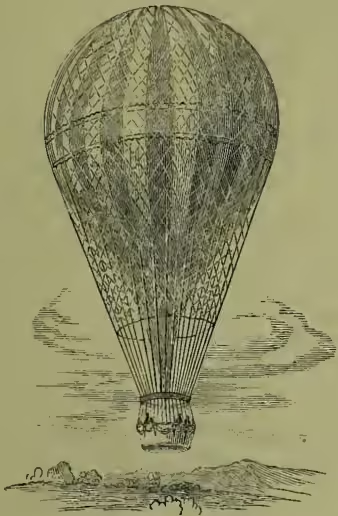
Construction.—A balloon of the common type (fig. 1) is best made of silk, but owing to its cost, either alpaca or cotton is more usually employed. The pieces or gores are sewn together, and the whole varnished to prevent the escape of gas. At the top there is a valve made of wood, from 1 to 3 feet in diameter. This is kept close by a spring, but it can be opened at will by a valve-line which descends through the interior of the balloon by its neck or mouth to the car. M. Giffard's valve, which is liked by some aeronauts, consists of a metallic disc pressed against a wooden hoop by 16 steel springs. A network of cord extends from the circumference of the valve over the surface of the balloon, and supports the hoop from which the car is suspended by six or more strong ropes about 4 or 5 feet long. These ropes require to be carefully adjusted so as not to strain the network. Through inattention to this, a silk balloon tore at Paris, in July 1882, when about 2300 feet above the ground. The furniture of the car is ballast or sand-bags; the barometer, and other scientific instruments; and the grappling-iron, tied to the end of a long rope, for anchoring the balloon at the descent. The aeronaut has, until very recently, had at his disposal the means of guiding his air-ship only in an upward or downward direction, the motion of translation being wholly dependent on the wind by which it is borne. If he wishes to ascend, he throws some of the ballast over the side of the car; and if to descend, he pulls the valve-rope, so that, the gas rushing by virtue of its specific lightness through the passage made for it by the open valve, the buoyant material may be lessened. It is evident that the power of thus directing his machine becomes more limited with each exercise of it, for in each case there is an unrepaid loss of the means necessary. In ordinary flights, the mouth of the balloon is left open, so that there is no danger of explosion arising from the expansion of the gas in the rarer regions of the atmosphere. The diffusion that takes place through the open neck is inconsiderable during the few hours that an aerial voyage lasts. Early aeronauts, who kept their balloons closed, frequently ran considerable risk by inattention to the valve when the imprisoned gas demanded vent for its expansion. Small pilot balloons are often made of thin india-rubber, and still smaller ones of gold-beaters' skin. Those generally used at illuminations are made of thin oiled or waxed paper. Very small balloons have been sometimes usefully employed in experimenting on the ventilation of large halls to show the directions of currents of air. The balloon is usually spherical in shape, more or less modified, but sometimes it is ellipsoidal, or approaches a lenticular form, and at others it is somewhat like a cigar in shape. Controllable balloons are usually elongated.
History.—The earliest attempts by man to rise in the air were no doubt made by the use of some kind or kinds of artificial wings (see FLIGHT). The art of traversing the air by means of balloons, generally called Aeronautics, and sometimes Aërostation, is of comparatively recent date. The French missionary Basson, writing in 1694, says that a balloon ascended at the coronation of Fo Kien at Pekin in 1306. There is, however, reason to believe that the first balloonist was Padre Guzman, who made an ascent at Lisbon in 1709, using heated air. But the germ of the invention of gas-balloons is to be found in the discovery by Cavendish, in 1766, of the remarkable lightness of hydrogen gas, then called inflammable air. Professor Black, of Edinburgh, seems to have been the first who conceived, in 1767, the idea that a light envelope containing this gas would rise of itself, and is said to have tried the experiment. Cavallo, in 1772, made an unsuccessful attempt to raise swine's bladders and paper-bags with hydrogen, but he succeeded in raising soap-bubbles inflated with the gas. The invention of the balloon is usually ascribed to the two brothers Stephen and Joseph Montgolfier, paper-makers at Annonay, in France, whose names are as distinguished in the development of their own branch of manufacture as in the history of aeronautics. It immediately struck these brothers, on reading Cavendish's Different Kinds of Air, that by inclosing a light gas within a covering of inconsiderable weight one would be able to navigate the air. Being paper-makers, they naturally fixed upon paper as the most fitting material for the purpose, and first attempted to make balloons of paper filled with hydrogen. Finding that this gas quickly escaped, they sought for another kind, and tried the gas resulting from the combustion of straw and wool, thinking that heat gave it an upward tendency, and that its electrical properties caused it to be repelled from the ground. The failures, of course, arose from the use of a paper envelope. At Avignon, in November 1782, Stephen Montgolfier first succeeded in causing a silk parallelopiped, of about 50 cubic feet, to rise to the roof of a room. Encouraged by this success, the brothers made experiments on a larger scale at Annonay with an equally happy result; and finally, in June 1783, they raised a balloon, 35 feet in diameter, to a height of 1500 feet. This last, nearly spherical in shape, was made of packcloth, covered with paper, and was heated by an iron chafer placed beneath it, in which ten pounds of moist straw and wool were burned.
The news of this extraordinary experiment soon reached Paris, where it produced a most lively impression. Such was the excitement that a sufficient subscription was filled in a few days to repeat the Annonay experiment, and the construction of the balloon was intrusted to the brothers Robert, famous philosophical instrument makers of the day, and to Professor Charles, a young but experienced physicist. Charles fixed upon hydrogen instead of Montgolfier gas for his balloon. By ingenuity and perseverance combined, he triumphed over the difficulty, then very great, of filling a silk globe, as large as 12 feet in diameter, with this light gas. This balloon was transferred to the Champs de Mars, the largest open space in Paris, where, on the 27th of August 1783, it ascended in the presence of 300,000 spectators, half the population of the city. At the instance of the commission already referred to, Stephen Montgolfier constructed a fire-balloon, 72 feet high, and 41 feet in diameter. It ascended before the commission on the 12th of September 1783, but being held captive, it was much injured by a violent wind, which blew at the time, and after it descended it was finally broken up by heavy rains. Joseph Montgolfier sent up a balloon at Versailles seven days later, carrying a cage with a sheep, a cock, and a duck. These were the first aerial travellers.
The balloon was now a fait accompli, and it began to be seriously discussed whether it might not be serviceable as an air-ship for bearing men aloft as passengers. The solution of this question was first given by Pilâtre des Rosiers. In a Montgolfière, as the heated-air balloon was called, 74 feet high, and 48 feet in diameter, supporting at its base a gallery of wicker-work, he, in company with the Marquis d'Arlands, made the first aerial voyage in a free balloon, 21st November 1783. They remained in the air twenty-five minutes, and sailed across the Seine and over a considerable part of Paris. The year 1783, so fertile in the annals of aërostation, did not pass away without witnessing a greater triumph. On the 1st of December, Professor Charles, along with Robert, rose from the Tuileries gardens with a hydrogen balloon—then called a Charlière—made from the proceeds of a public subscription. This balloon was made of alternately red and yellow gores of silk sewed together, and coated with caoutchouc varnish. It was covered with a net which supported the car, and was furnished with a valve, a barometer, and sand-ballast, and was, in fact, a complete aerial machine, no essential change or improvement on which took place for a hundred years. Before fire-balloons became obsolete, several remarkable voyages were made in them. The same Pilâtre des Rosiers made 30 leagues in one of them, the longest voyage ever executed in a Montgolfière. Mr J. Tytler made the first balloon ascent from British soil from the Comely Gardens, Edinburgh, on August 27, 1784. Lunardi made an ascent at London a few days later—viz. on 15th September 1784. J. P. Blanchard, along with the American Dr Jeffries, crossed the English Channel from Dover to Calais in circumstances of almost unparalleled danger, January 7, 1785. Garmin first descended from a balloon by a Parachute (q.v.), October 22, 1797. The first aëronaut, Pilâtre des Rosiers, fell a victim to a blind devotion to his art. Having constructed a compound machine, consisting of a hydrogen balloon above and a Montgolfière below, and started from Boulogne on the 5th of June 1785, he had not ascended many minutes, when, on attempting to open the valve of the hydrogen balloon, he caused a rent of several yards in it, so that it emptied itself almost immediately, and fell on the Montgolfière beneath. The fire in the latter not being kindled, the whole machine fell with frightful rapidity to the earth, and the ill-fated aëronauts perished on the spot. The introduction of coal-gas, instead of hydrogen, by Mr Green, is the most important advance in aërostation since the earliest days of the art. His large coal-gas balloon, in 1836, bore Messrs Green, Holland, and Mason from London to Weilburg, in Nassau, distant 500 miles, in 18 hours.
Scientific Results.—Balloons have been enlisted on behalf of science. The first ascent for scientific objects was made at Hamburg, July 18, 1803, by Robertson and Lhoest, and a notable one by Gay-Lussac, who, on 16th September 1804, rose to the height of 23,000 feet. Later scientific ascents were made by Humboldt in America; by Mr Rush and Mr Green in 1847–49; and by MM. Barral and Bixio at Paris in 1850. The most important ascents for this purpose were those made by Mr Glaisher between 1862 and 1866. He went up 28 times, and 11 of these ascents were made, like those of Mr Rush, on behalf of the British Association. Mr Glaisher found that the rate of decline of temperature with elevation, near the earth, differed much according to whether the sky was clear or cloudy. At the height of 5 miles cirrus clouds were seen apparently yet another 5 miles up, suggesting that their presence at anything like this elevation can hardly be due to moisture at all. The time of vibration of a horizontal magnet was found to be longer high in the air than on the earth. In nearly every ascent, currents of air in different directions were passed through. Sometimes the direction of the wind was the same for only 500 feet above the earth, while at other times it did not change till a height of 20,000 feet was reached. In some of the voyages directly opposite currents were met with at different elevations. As regards physiological observations, Mr Glaisher found that his own pulsations were 76 before starting, and 110 at greater elevations than 20,000 feet. The faces of some persons became glowing purple when up 10,000 feet, while others showed no change. In a balloon the voyager has usually no sensation of motion. Observations made by M. Flammation in eight or nine ascents from Paris in 1867 and 1868, confirmed for the most part Mr Glaisher's results. Some interesting instantaneous photographs have been taken from balloons in France.
High Ascents.—An ascent of fully 7 miles was made from Wolverhampton, September 5, 1862, by Messrs Glaisher and Coxwell, which is the highest on record. At this great height the cold was intense, the thermometer standing at . The barometer fell to 7 inches, as compared with 29 at the surface of the earth. When the balloon was 29,000 feet high, Mr Glaisher became insensible, and remained so for seven minutes. Mr Coxwell, at this height, had to mount into the ring to adjust the valve-line, when his hands became frozen, and he had to open the valve by seizing the line with his teeth. He too was very nearly insensible. Up to the height of 5 miles the aëronauts experienced no difficulty in breathing, except when some exertion had to be made. Perfect stillness and silence reigns 6 miles above the earth, but a railway train in motion can be heard at a height of 4 miles. In this ascent the aëronauts passed through a cloud saturated with moisture, about 1100 feet in thickness, entering it one mile above the earth. On another occasion, in the same year, they passed through a similar, or perhaps still denser cloud, during the descent, in which case the balloon so collected weight by the condensation of moist vapour, that notwithstanding all attempts to lighten it, the car on coming to earth received a shock sufficient to break nearly all the instruments.
A remarkable but disastrous ascent was made from the gas-works of La Villette, Paris, on the 15th April 1875. Three aëronauts were in the car of the balloon, which reached the height of 5 miles. Of the three, Gaston Tissandier alone survived. The two others, Sivel and Crocé-Spinelli, lost their lives when high in the air, either by suffocation from the escape of gas, or from the vertigo of high regions. Tissandier had been unconscious for some time as well as his companions. On the 13th August 1887 another ascent was made from the same place. This time the aëronauts were M. Mallet and Captain Jovis. They did not attain a greater height than miles, and yet M. Mallet was twice seized with a fainting fit, though his companion felt no inconvenience. The highest recorded ascent was made in 1894 by Dr A. Berson from Stassfurt in Prussia. His balloon travelled 186 miles and reached the height of 31,500 feet, the thermometer recording a temperature of F. The ballooning enterprise most largely discussed was probably the Swedish engineer Andrée's unfortunate attempt to reach the North Pole in 1897 from Dane's Island in Spitzbergen, with a balloon 60 feet in diameter, having a conical appendage: in 1901 his fate was still unknown.
Balloons in War.—In 1794, during the wars of the Revolution, an aerostatic institution was formed at Mendon, near Paris, for training a corps to observe the enemy by means of balloons; and its skill was tested at the battle of Fleurus, fought against the Austrians in that year. Reconnoissances were made by use of the balloon in the Italian war of 1859, and in the American civil war. During the siege of Paris, 1870–71, nearly 2,500,000 letters and post-cards, besides several persons (including Gambetta), left the beleaguered city by balloons. Carrier-pigeons were the return messengers. At Suakin in March 1885 a balloon was for the first time employed by a British force in war. In 1887 the British War Department conducted a series of experiments at Chatham on the use of 'captive balloons' for observations; and in July 1886 Mr Eric S. Bruce applied electricity to a captive balloon, so that signals might be flashed in it by an operation on the ground. There is now a special corps of engineers trained in the use of balloons, which were found of service during the war in South Africa in 1899–1901.
The balloons generally used for observation purposes in war are capable of lifting about cwt., and are anchored by a wire rope. It has been found, however, that the use of the ordinary spherical balloon was greatly interfered with when strong winds were blowing, and German scientists have sought to overcome this difficulty. The Parseval-Siegsfeld captive balloon (1897), found to answer the purpose, is cylindrical, with round ends. Partly underneath and round one end is fixed a smaller cylindrical 'ballonette' having its lower end open to the air; this, as the air fills it, acts as a steadier to the balloon and neutralises the disturbing effect of the wind.
Captive balloons and kites have been much used in meteorological observations. The 'box-kite' used is box-shaped, the sides being covered with silk and the ends open. Such kites, anchored by fine piano-wire, and with self-recording apparatus attached, have been in active use for several years at Blue Hill Observatory in New Jersey. The greatest height attained was in 1899 by a string of tandem kites which recorded 12,440 feet. In France and Germany, to obtain observations at still greater heights, free balloons have been used on the almost certain chance of their being recovered however far they may travel. In Germany, in 1894, a computed height of 60,500 feet was reached, and the attached thermometer recorded a temperature of F.
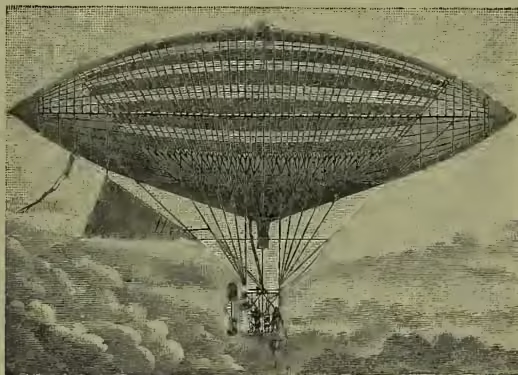
Controllable Balloons.—Although there were one or two earlier experiments tried in the way of steering balloons (as by Giffard in 1852, and Dupuy de Lôme in 1872), Gaston Tissandier was the first aëronaut who ever partially solved this difficult problem. His controllable electric balloon, made at Paris in 1883, is shown in fig. 2. Elongated in form, it was 91 feet long, 29 feet in diameter through the middle, and covered with thin cloth coated with an impermeable varnish. Over the balloon, which was inflated with hydrogen gas, was a netting suspending the car by means of twenty ropes. A kind of rigging connected the suspension ropes about 6 feet above the car; to this rigging the guide and anchor ropes were attached, and the rudder of unvarnished silk was also arranged behind. The screw propeller, 9 feet 3 inches in diameter, consisted of two blades, driven by elec- tricity; and the electrical apparatus consisted of a bichromate of potassium battery and a dynamo-electric motor. The car, with the motor, batteries, screw, anchor, and other fittings, weighed nearly 1200 lb.; the ballast usually taken up weighed 850 lb.; and the balloon itself weighed 600 lb. In one trial, with the screw making 180 revolutions per minute, Tissandier was able to keep head to a wind moving at the rate of 10 feet per second, and when proceeding with the current, to deviate from the line of wind with great ease.
From 1900 onwards many inventors experimented with controllable balloons, mainly in the endeavour to discover something which would be really useful in war. M. Santos-Dumont, a South American, devised a cigar-shaped balloon supporting a spar on which he rode bicycle-fashion, with a gasoline motor working a propeller; a rudder at one end gave direction. Andersen, a Swede, made a journey of 40 miles from Fulham in a balloon with two propellers worked by a hand-crank. Roze, a Frenchman, had two cigar-shaped balloons coupled together with a propeller at each end, driven by a 20 horse-power gasoline motor. The most notable invention is the 'air-ship' of Count von Zeppelin, a German general; cylindrical, pointed at both ends, 420 feet long, and 38 feet in diameter, it is constructed of a light aluminium trellis-work frame, covered with a water-tight permagoid material above and light silk underneath. Inside, it is divided into seventeen compartments, each containing an independent gas-tight balloon. Underneath is suspended a gangway 346 feet long, having attached two aluminium cars, each containing a Daimler benzine engine of 16 horse-power working a pair of propelling air-screws attached to the sides of the balloon; these cars also contain oil-tanks and water ballast, and from them all the machinery is operated. Two rudders at each end control the direction, and a weight working on a cable underneath elevates either end as it is moved backwards or forwards, and so regulates its ascent or descent. Its total weight, with a crew of five persons, is about 11 tons. Three very successful experiments were made at Lake Constance, where the balloon was constructed in 1900; the air-ship covering on one occasion a distance of 4 miles in 17 minutes, and being under perfect control. Count von Zeppelin, who was in 1901 decorated by the
Emperor with the order of the Red Eagle, expected his air-ship to attain a speed of 17 miles an hour.
Though melancholy cases of loss of life are on record, the number of casualties in the navigation of the air has been less in proportion than in the navigation of the sea.
See Hatton Turner's Astra Castra (1865); Voyages Aériens (Eng. ed. by T. Glaisher, 1871); Les Ballons dirigeables, by Tissandier (1885); My Life and Balloon Experiences, by Coxwell (1888); Brewer and Alexander, Aéronauties (1893); De Fonville, Manuel Pratique de l'Aéronaute (1894); Andrée and his Balloon, by Henri Lachambre and Alexis Machuron (1898); the Reports or Proceedings of the Aeronautical Society of Great Britain (founded 1866), the Balloon Society of Great Britain (1880), the French Académie d'Aérostation (1872), and the German Aeronautical Society (1881); the Paris L'Aérophile (since 1893).—The flying-machines of Langley, Maxim, and Lilienthal are totally distinct; see FLYING.