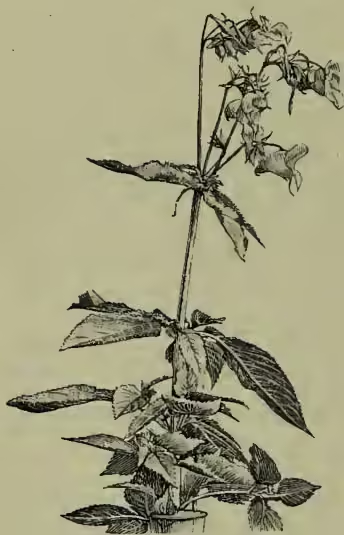
Balsam is also the common name of a genus of succulent herbaceous plants, of which the beautiful balsam (Impatiens balsamina), so much cultivated in gardens and greenhouses, is a familiar example. Upwards of one hundred species are known, natives chiefly of damp bushy places in the East Indies, and many of them plants of great beauty. They are almost all annuals, and have generally white or red flowers. The balsams are usually regarded as a sub-order of Geraniaceæ (see GERANIUM), of which they are simply the most differentiated type, but are distinguished by the extreme irregularity of the flowers, which have been the subject of much controversy among morphologists, and also by the beakless fruit, which is a five-celled capsule, bursting by five elastic valves. The leaves are simple, and without stipules, the flowers generally axillary. The common balsam is a native of the East Indies and Japan. Many fine varieties, double as well as single, and of all varieties of colour and marking, have resulted from careful cultivation, and florists distinguish pyramidal, dwarf, and camellia-flowered races. It has an upright succulent stem, usually about 1-2 feet high, but in favourable circumstances will attain a greater size. In Britain, the seed is usually sown on a slight hotbed, and the plant is often kept in the greenhouse; although even in Scotland it may be made an ornament of a sheltered border. It is one of the flowers frequently to be seen in cottage-windows. A vulnerary was formerly prepared from it, whence it has its name. One species of balsam (Impatiens noli-me-tangere), called Yellow Balsam or Touch-me-not, is a native of Europe, and a doubtful native of Britain. It has yellow flowers, and one of the petals prolonged into a spur. Its ripe capsules burst on the slightest touch, scattering the seed.