Baltimore, a port of entry and the largest city of Maryland, and the seventh city of the United States in population, stands on the northern bank of the river Patapsco, an arm of Chesapeake Bay, about 250 miles by ship-channel from the ocean, 96 miles SW. of Philadelphia, and 40 NE. of Washington, D.C., in 39° 17' N. lat., 76° 37' W. long. Its site is uneven, and its surroundings are picturesque and pleasant. The plan of the streets is not so strictly uniform as in many American cities. The harbour is spacious and perfectly secure, having a minimum depth of 24 feet, and access from the sea is safe and easy. Baltimore is reached by numerous lines of railway connecting in a Grand Union Depôt, and having several other stations in various parts of the city. It is an important centre of the traffic in breadstuffs, which are largely received by rail and shipped at this point. Other leading articles of export are tobacco, provisions, coal, cotton, naval stores, canned fruits, and oysters. The imports include large amounts of guano, coffee and other tropical products, fertilisers, iron, steel, tin-plate, and chemicals. Baltimore is also the seat of extensive and varied manufactures, and in 1880 it ranked as the eighth city of the United States in the extent of its manufacturing interests. Its manufactured products include cotton and woollen goods; flour of superior quality, largely produced in Baltimore and vicinity; tobacco and cigars, in the manufacture of which is employed a capital of more than a million dollars; beer; glassware; boots and shoes; iron and steel, including machinery, car-wheels, iron bridges, stoves, furnaces, &c.; clothing, in the manufacture of which nearly 4,000,000 are invested, producing goods to the value of about 10,000,000 per annum; pianos, organs, &c. One of the principal industries of Baltimore is the canning of oysters, in which over 6500 hands are employed during the annual oyster season—several thousand vessels being engaged in the oyster fishery, and bringing to this port from 8,000,000 to 12,000,000 bushels of oysters. It is estimated that the various departments of the oyster industry of Baltimore give employment to over 20,000 hands, whose wages aggregate about $3,500,000 each year.
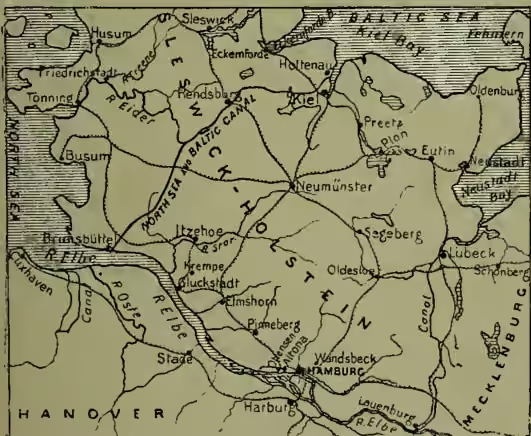
Baltimore is noted for the fine architecture of its public and other buildings, among the finest being the chamber of commerce, the Roman Catholic cathedral, the custom-house, the Maryland Institute, the academy of music, the city-hall, the Johns Hopkins Hospital, the post-office, and the Peabody Institute (see PEABODY). The public a great ship-canal from Brunsbüttel, at the mouth of the Elbe, to Holtenau, near Kiel, was constructed in 1887-95, designed for the largest vessels, especially German war-ships (see CANAL). Inaugurated with great ceremony in 1895, it is 61 mouuments, of which five or more are noteworthy (the Washington column being 210 feet high), have given Baltimore the name of the 'monumental city.' There are several public squares and parks, the beautiful Druid Hill Park of nearly 700 acres, purchased by the city at a cost of about 800,000, being the most celebrated. There are some 200 churches, among which the Roman Catholic, the Protestant Episcopal, and the Methodist denominations are conspicuous. The educational institutions are many and important. The Johns Hopkins University, endowed with over 3,500,000 by a Quaker philanthropist of that name (1795-1873), was opened in 1876, and already takes rank as one of the first seats of learning in the country. Among other institutions are the Baltimore City College, the Baltimore Female College (Methodist), the academy of science, the law school, three or more medical schools, Loyola College, St Mary's University, and a state normal school; and there are complete systems of graded public and parochial schools. The city has a number of good libraries, of which the largest is that of the Peabody Institute (1876).
Baltimore is a place of much wealth and social refinement, and is noted as an art-centre. It is the seat of a Roman Catholic archbishop, who has the rank of primate of the United States, the see being the oldest in the country. The diocese of Baltimore was created in 1789; and the see became archiepiscopal in 1808. Dr John Carroll was the first bishop and archbishop. Owing to the fact that Maryland was originally settled to a great extent by members of the Roman Catholic Church (chiefly of English birth), that church and its adherents have always had a greater social influence in Baltimore than in most American cities of its size. Baltimore is also the seat of a bishop of the Protestant Episcopal Church. The population of the city is of various origin. Less than one-sixth of the people in 1880 were of African descent, and about one-sixth were of foreign birth. Among the native-born population of the city there is a rather large element of German descent, and many Irish and French creole families were among the earlier settlers. In colonial days, the English Puritans, and later, the Scotch-Irish Presbyterians, were here numerous. Of the present inhabitants, a considerable proportion have been born in states lying farther north than Maryland.
Founded in 1729, the city was named in honour of Lord Baltimore, the founder of the Maryland colony, and in 1796 was incorporated as a city. It very early became noted for its commerce and ship-building. It was the scene of important events during the war of 1812-15, and in the early part of the civil war of 1861-65. Pop. (1790) 13,503; (1830) 80,625; (1860) 212,218; (1880) 332,313; (1890) 434,439. Several large and populous suburban towns are not represented in these official census figures.