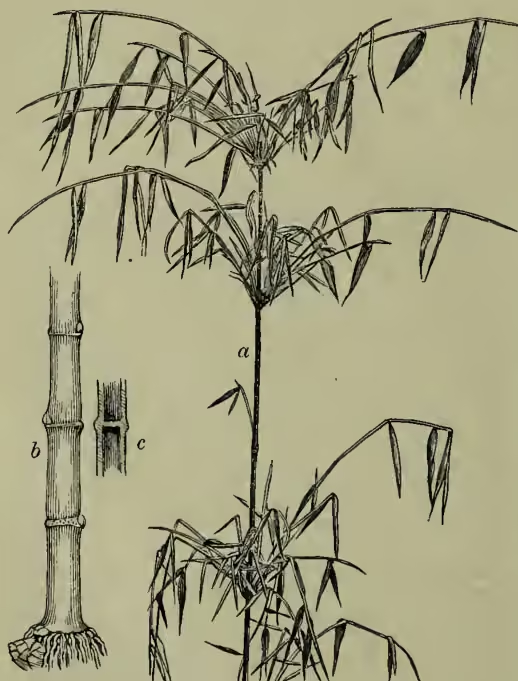
Bamboo (Bambusa), a genus of grasses, of which most of the species attain a great size, many of them 20 or 30 feet, some 70 or 100 feet in height. The species are numerous, and are found in tropical and subtropical regions, both of the eastern and western hemispheres. Some of the species grow to the height of only a few feet; and almost all of them are slender in proportion to their height, although B. guada has often a trunk 16 inches in diameter. All of them have a jointed subterranean root-stock (rhizome), which throws creeping stems. The stems grow to their full height unbranched, but afterwards throw out straight horizontal branches, especially in their upper parts, forming a dense thicket; some of the smaller kinds are often planted as hedges. The stems are jointed like those of other grasses, very hard, but light, elastic, and hollow, containing only a light spongy pith, except at the joints or nodes, where they are divided by strong partitions. The stems of different species vary also very much in the thickness of the woody part, and so in their adaptation to different purposes. In China and Japan is found a bamboo the stem of which, instead of being cylindrical like that of other bamboos and all grasses, is square. At three years old, this stem is one inch in section each way (see Nature, vol. xxxii.). The hairy bamboo is one of the most useful in China. The external covering of the stem is, in all the species, remarkably siliceous; the stem of B. tabacaria is so hard that it strikes fire when the hatchet is applied. There is perhaps scarcely any plant that serves such a variety of domestic and economical purposes. It would be difficult to point out an object in which strength and elasticity are required, and for which lightness is no objection, to which the stems of the different species are not applied. In the whole of the East, particularly in India, China, and Japan, in Jamaica and other parts of the West Indies, and some parts of South America, it forms almost the sole material of which the houses of the poor are built. It is employed for water-pipes, for which purpose its hollow stems (after the partitions at the joints are removed) render it eminently well fitted. It is used in the building of bridges, in the manufacture of furniture, ladders, masts for boats, rails, fences, spear-shafts, domestic utensils, and agricultural implements. The stems are also split up finely and worked into mats, and ropes, and even into the sails of boats. From both the external and internal pellicles of the stems an excellent paper is made by bruising and steeping it in water till it becomes a paste. Large quantities of bamboo cane are imported to Europe for various purposes, such as the making of walking-sticks, stakes for flowers and the training of fruit-trees in nurseries, and the manufacture of wicker-work. The leaves of some kinds are used as thatch in the making of hats and mats; those mats seen enfolding chests of tea being made of the leaves of one species cultivated by the Chinese for that purpose. The shoots, when young and tender, are eaten in the same way as asparagus, or boiled with milk, or made into broth with the addition of animal food, spices, and salt; also along with the young root-stocks they are pickled in vinegar wherever they abound in the East, and are imported into Europe as an eastern condiment under the name Achiar or Achar. The pith of some species is sugary, and at certain seasons a saccharine juice exudes from it at the joints, which becomes concrete on exposure to sun and air, and is used for domestic and economic purposes in India. This substance is called Indian Honey, and is erroneously also sometimes named Tabaris or Tabasheer, a name which properly belongs to another and very remarkable substance produced in the hollow internodes of the stems of some of the species (see TABASHEER). The seeds of some species are used as rice, and for making a kind of beer. Bamboos are generally of very rapid growth, and they are often found in arid situations, which would otherwise be destitute of vegetation. B. guada and B. latifolia, both natives of South America, have the internodes of the stems filled with clear fluid of an agreeable taste, which, though containing slight traces of sulphates and chlorides, can scarcely be distinguished from pure spring-water. It is not improbable that they may yet be up 10-100 stems. These are generally straight and erect; although one large species (B. agrestis), common in dry mountainous situations in the south-east of Asia, has crooked, and sometimes employed, where they do not naturally abound, to render districts productive which are now little else than deserts, in climates like those of Arabia, the north of Africa, and Australia; and the quality of the grain of different species seems to deserve more attention than it has yet received. The species common in the West Indies (B. vulgaris) is supposed to have been introduced from the East Indies. A few species are found in the Himalaya, to an altitude of 12,000 feet, and a dwarf species from that region has been successfully tried in the open air in England. See JUNGLE.