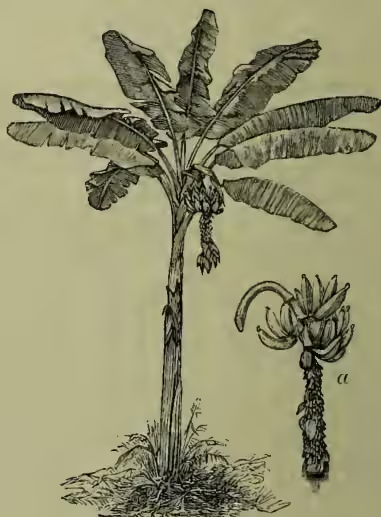
a, fruit.
Banana, the fruit of Musa sapientum, a herbaceous plant of arboreal proportions and palm-like aspect, belonging to the natural order Musaceæ. It is believed to have been originally of the East Indies, but is now found, along with the plantain, distributed and cultivated by man throughout the tropical and subtropical regions of the globe. The banana and the plantain were formerly regarded as distinct species, the latter being named M. paradisiaca, but there is no real specific distinction between the two forms. The varieties are very numerous, and run into each other by almost imperceptible gradations, while on the same bunch have been found growing fruits as diverse in form and other qualities as the distinct types commonly known as banana and plantain. To the large-fruited group is often ascribed the more farinaceous quality usually associated with the plantain, and to the small-fruited group the highly saccharine character of the banana.
This distinction can hardly be maintained as constant. Though really herbs, the bananas assume all the appearance of trees. Their stems, formed merely of the sheathing bases of the stalks of the large palm-like leaves, are soft, spongy, and destitute of woody structure, yet attain, according to the different species, the height of from 5 to 25 feet. In the tropics the stems are annual—that is, they die after perfecting the fruit, and fresh stems are developed from buds in the root-stock, which is perennial. These stems, or rather buds, furnish the common means of propagating and making fresh plantations, and the growth is so rapid that the fruit is usually ripe within ten months of the time of planting the offsets. When full grown, the stem is surmounted by a crown of large leaves, 6 to 10 feet long by 2 to 3 feet broad, the blade resembling the blade of an oar, with a strong fleshy foot-stalk and mid-rib. The flowers spring in great spikes from the centre of the crown of leaves, and are arranged in whorl-like clusters along the spike; the female flowers occupying the base of the spike, and the male the apex. The fruits are variously formed, some being angular, others cylindrical or even spherical, and vary in length from 4 to 12 inches, and in diameter from 1 to 1½ inches. The average weight of a bunch is about 25 lb., but individual bunches often exceed 40 lb.
It is one of the principal sources of food in tropical countries, taking the place of the cereals of more temperate climates. Its productive powers are prodigious; per imperial acre, it was estimated by Humboldt to produce 44 times more by weight than the potato, and 133 times more than wheat. It is stated that the fresh core of the fruit yields about 40 per cent. of dry meal. The more mealy kinds are never eaten raw except when ripe, but in all its unripe stages it is boiled and eaten as a vegetable. It is roasted also and flavoured with the juice of orange or lemon and sugar, and made into compôtes; dried in ovens or in the sun, with the addition of spices and sugar, it is formed into a paste that will keep in a perfect condition for years. In South America, besides forming an indispensable article of diet in its fresh state, it is also an important article of internal trade in the shape of flour. The sugary or luscious kinds are used also in a variety of ways, and preserved by drying. By fermentation it yields a wholesome wine.
The banana is in many other ways useful to man. The stem yields a juice that is employed as an astringent, and its spongy pith, when pounded and boiled, forms a tolerably nutritious food of a starchy character. In Tonquin the stems are burned, and the ash used in purifying sugar. All parts of the plant abound in fibre which is believed to be well adapted to the manufacture of cordage and paper, but has never been systematically utilised, except in the most limited manner. The inhabitants of Dacca make from it the string of the bow with which they tease cotton, and in some of the islands of the Indian Ocean cloth is made from it. The top of the stem is boiled and eaten as a vegetable, and the leaves are used in packing, and for many domestic purposes.
There are many other species of Musa, the most notable of those besides the banana having edible fruit being M. Cavendishii, a very dwarf form, largely cultivated in China; the fruit having similar qualities to the typical form of plantain—i.e. farinaceous rather than saccharine. It is not uncommon in hothouses in this country, being easily cultivated. M. textilis (Abaca, q.v.) is the plant that yields the valuable fibre known under the name of Manila Hemp, a product of the Philippine and neighbouring islands. The finer qualities of this fibre are worked into delicate fabrics, so extremely fine that many yards may be inclosed in the hollow of the hand. M. troglodytarum, remarkable for bearing its clusters of fruit erect (not pendent as in the other edible species), furnishes food to the natives of the Moluccas, where the plant grows wild. M. Ensete, a native of Abyssinia, does not yield edible fruit, but the stem, before it becomes hard and fibrous, is an excellent esculent. Bruce says: 'When soft, like a turnip well boiled, if eaten with milk or butter, it is the best of all food, wholesome, nourishing, and easily digested.'