Bandages are used by surgeons to keep a part of the body at rest, to apply pressure, or to retain dressings or apparatus in position. There are two chief varieties—the roller, and the triangular handkerchief bandage. The former is that most used for applying pressure and retaining dressings: the latter for fixing splints and as slings, and as an immediate surgical appliance in cases of accident or emergency.
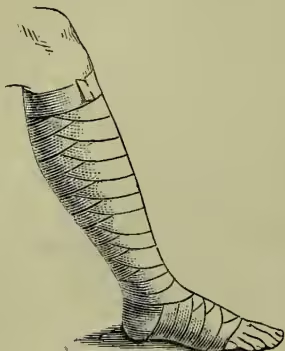
The Roller Bandage is a strip of calico, flannel, or elastic webbing, six yards long; its breadth should be one-fifth of the average circumference of the part to which it is applied. In applying it to a limb, it must commence at the extremity, and pass upwards without interruption towards the trunk. It must cover the whole surface, and exert gentle and equable pressure throughout, especially in regions likely to be dependent, since swelling and discomfort occur at points where the bandage is absent or too slack; too tight bandaging, on the other hand, may hinder the circulation and lead to mortification of the part. Both edges of the bandage must be equally tight, or it will not lie smoothly on the limb, but will gape and tend to slip off. No two skin surfaces (e.g. two fingers) must be bound in contact, since the accumulation and decomposition of cutaneous secretions between them will give rise to irritation. This can be avoided by interposing a layer of absorbent, antiseptic material, such as boracic lint. When a harsh and inelastic bandage is used, it must not be applied directly to the surface, but over closely fitting woollen hose, arm-gloves, &c., which mitigate its pressure and protect the skin. A soft bandage may be applied directly; elastic webbing must only be applied over thick dressings or layers of cotton-wool that distribute and equalise the strong pressure it exerts. A bandage will slip unless both its ends are secured. In commencing to bandage any part of a limb, fix the roller by passing it round alternately above and below the prominence of the nearest available joint; then cover the part to be bandaged by encircling it with coils of bandage applied consecutively from below upwards, each loop covering the upper two-thirds of that previously applied. In parts where the limb thickens rapidly from below upwards, the bandage must be frequently 'reversed' to make it lie smoothly. Holding steady the loops already applied, the bandage is folded sharply upon itself from above downwards, so that the external surface of the loop next applied is the same that was next the skin in the previous loop. This corrects the tendency to leave portions of skin uncovered in conical parts of a limb. The bandage is fastened by a safety-pin, which should traverse several layers of the roller and any texture introduced between the bandage and the skin. The toes and finger-tips should be left uncovered; if they look dusky or become cold, it shows that the bandage is too tight, and must be at once loosened or removed.
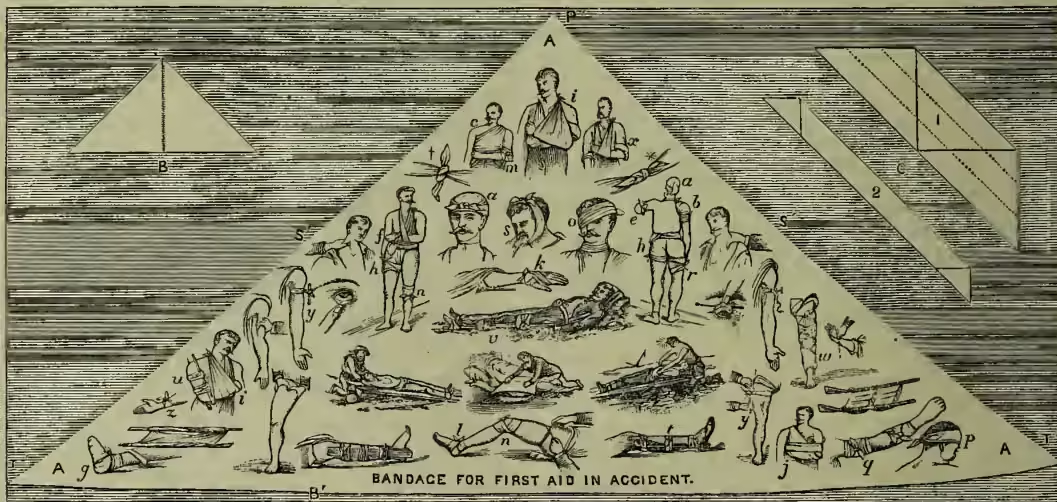
The Handkerchief Bandage (fig. 2) is a triangular piece of cotton cloth, made by cutting a square yard of the material diagonally from corner to corner. It may also be constructed from an ordinary pocket-handkerchief, by dividing it in the same way, and combining the two small triangles thus produced into one larger triangle by tacking together two of their shorter sides (see fig. 2, B). When thus constructed, the bandage consists of a peak (fig. 2, A, P'), two sides (S'S'), two tails (T'T'), and a base (B'). This appliance may be used for a great number of purposes in addition to those for which the roller bandage is applied. If it be desired to fix dressings in position, and to cover a large area of the body surface, it is used unfolded. If it be required to apply pressure firmly and locally, or to fix dressings, splints, or other applications on movable parts, it is folded into a broader or narrower cravat form, as shown in fig. 2, C, and is thus applied to the part in question. In folding the bandage, the peak is turned over, so as to touch the middle part of the base (C, 1), and the handkerchief is then folded upon itself longitudinally to one-half or one-third of its present breadth, according to the larger or smaller circumference of the limb it is intended to encircle, and the size of the area it is desired to cover. For most purposes the narrower form (C, 2) will be found most convenient, since it adapts itself more easily to the inequalities of the part to which it is applied. In its unfolded form the handkerchief is used as a covering for the head (fig. 2, a), and as a support to dressings applied to the shoulder (b), chest (c), stnmp (e), hand (f), foot (g), and hip (h). In this form also it is used as the ordinary sling for injuries of the upper extremity (i), where the weight of the arm is supported by the patient's neck and shoulders, and the injured parts are thus saved from strain and kept at rest. If this be supplemented by a second handkerchief bandage, folded narrow, which encircles the chest and the injured arm above the elbow (j), the whole upper extremity is not only supported but kept firmly immovable; which adds greatly to the comfort and safety of a patient immediately after an accident, during his transference to a hospital or to his home. In its folded form it makes an admirable temporary support to injured joints, such as the wrist (k), ankle (l), elbow (m), and knee (n), and in wounds of the eye (o), scalp (p), arm (q), thigh (r), &c., while the careful application of such a bandage satisfactorily supports the jaw (s) in cases of severe bruising or fracture. One of its most important uses in the narrow cravat form is to fix improvised splints in situ in cases of fracture of the extremities (t, u, v, and w). In this form it is also used as a wrist or hand sling (x), where the wrist-joint only is injured, and alone needs to be supported, or where a wound of the hand necessitates that member's complete rest. In cases of severe bleeding from wounds of the extremities, it should be used as a tourniquet (q.v.). If the bleeding be of a spitting character, it implies that an artery of considerable size is divided. In this case the bandage must be made to encircle the limb higher up than the seat of the wound, and must be tightened by twisting (y) until the limb is completely constricted and the bleeding temporarily arrested, while immediate surgical assistance is sought for. If the bleeding be of an oozing character, the bandage is not applied higher up the limb than the wound, but over the wound itself. A stone or other hard substance is firmly wrapped in a piece of cotton cloth or lint and thrust into the wound, and the cravat-handkerchief applied around the limb at the part sufficiently tight to hold this extemporised plug in position (z). Here, the object is not to control the circulation of the whole limb, but to prevent the escape of blood from the wound. This can be greatly assisted by attending to the position of the wounded limb in relation to the law of gravitation. In such circumstances it is usually sufficient, after applying the plug and bandage, to support the upper extremity in a sling, and to prop up the lower extremity on a high pillow. Should this, however, prove ineffectual, it is well to try firm flexion of the joints above the wound, which usually stops the bleeding. If this too fail, the whole limb must be constricted by the twisted handkerchief as above described; which, however, one would gladly avoid if possible, since it is a source of great suffering to the patient. In securing the ends of the bandage, they should either be tied together with a 'reef' knot (*), which will hold firmly, in contradistinction to the 'granny' knot (+), which tends to slip; or if the knot from its position cause discomfort to the patient, it should be dispensed with, and the two ends of the handkerchief sewn together with strong thread or sewing worsted. The figure represents the handkerchief bandage supplied by the St Andrew's Ambulance Association to its members for use as a 'first aid' to the injured in cases of accident and emergency.