Bandicoot (Perameles), a genus of small marsupials, occupying in the fauna of Australia a place somewhat analogous to that of the much higher shrews in Europe. Like the 'native rabbit' (Macrotis lagotis) and the peculiar form known as Chæropus, the bandicoots stand midway between carnivorous marsupials like the Tasmanian Devil, and the vegetarian Kangaroos, resembling the former in their dentition, the latter in the structure of the hind-feet. They have altogether 48 teeth, suited to their mixed diet of insects, worms, and roots, and have 10 upper incisors to 6 lower. In the fore-feet the three middle toes are long and clawed, the two outer rudimentary and clawless. The hind-feet are long and narrow, with only the fourth toe well developed.
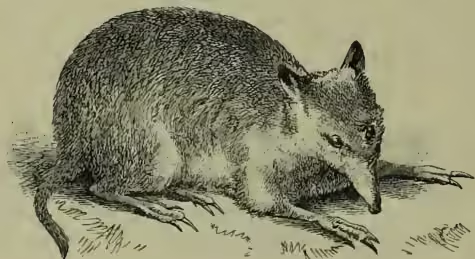
The fur is short and rough. The long head forms a pointed snout, the tail is rather short, the marsupial pouch is complete and opens backwards. They keep to the ground, making nests in the hollows. Their movements and habits are like those of hares or rabbits. The largest form (P. nasuta) measures about a foot and a half from tip of snout to origin of tail. Numerous species occur in Australia and New Guinea. Their ravages on farm-produce make them of some practical importance. See MARSUPIALS, and Gould's Mammals of Australia.