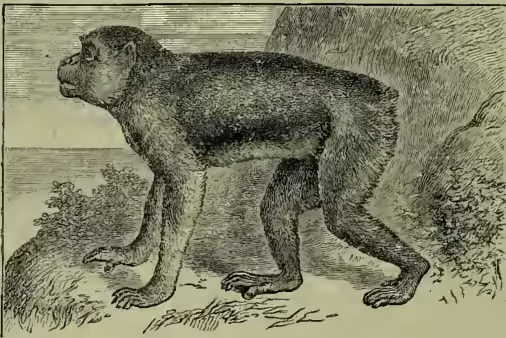
Barbary Ape, PIGMY APE, or MAGOT (Macacus sylvanus, or Inuus ecaudatus), a small species of tail-less monkey, interesting as the only form now found in Europe, where it is restricted, however, to the Rock of Gibraltar. There can be little doubt that before the strait was formed which now separates the continents, the ancestors of the Gibraltar family wandered over from Africa in an entirely natural way. The magot inhabits the precipitous sides of the rock, feeding it is difficult to know how, and enjoys a certain measure of protection from firearms in return for the amusement afforded by its manners. It is said on one occasion to have had historic importance by warning the British occupants of a Spanish surprise. Large numbers are often seen together, the females carrying the young upon their backs. It is extremely abundant in some parts of North Africa, inhabiting rocky mountains and woods, displaying great agility in passing from tree to tree, and often descending in herds to plunder gardens and plantations. It feeds on fruits, roots, &c.; and its fondness for eggs may have given rise to the ancient story of the battle of the pignies and the cranes. It is of a yellowish-brown colour, paler underneath; and in size resembles a middle-sized dog. The characters generally agree with those of other macaques, differing most conspicuously in the stump-like rudiment of a tail, provided, however, with the usual muscles. The absence of tail and the length of the muzzle make the magot somewhat baboon-like. It is one of the commonest imported monkeys, being often seen in a consumptive state in the company of an organ-grinder, and is capable of learning any number of tricks. In order to this, however, it must be taken young, as the older ones are often sullen and mischievous. It usually walks on four feet, although it can be trained to stand or walk, in a more awkward manner, on two. It is filthy in its habits. Its anatomy was first studied by Galen in the 2d century, and the animal is thus of some historic interest, as it supplied him with an opportunity of understanding by analogy the anatomy of man when obscurantist regulations made the dissection of the human body all but impossible.