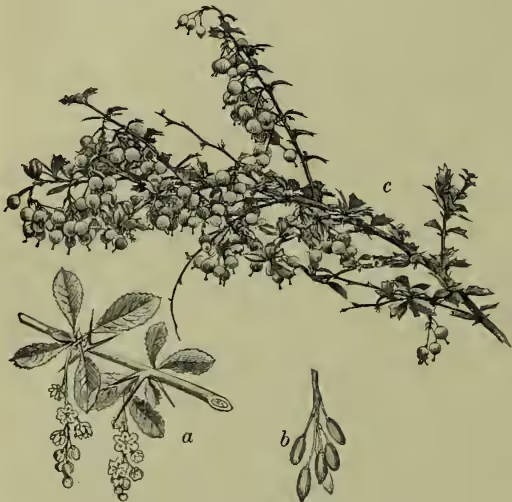
c, Branch in fruit of B. Darwinii.
Barberry (Berberis), a genus of plants, of the natural order Berberideæ (q.v.). All the species, which number about 100, and range through the temperate regions of the world, with the exception of Australia and South Africa, are shrubs with yellow flowers, having their parts usually in multiples of three. The stamens are sensitive, moving inwards when irritated, so as to dust the insect visitor with pollen, and so facilitate cross fertilisation. The fruit is a berry with two or three seeds. The genus is divided into two sections—those with simple leaves, whether deciduous or evergreen, forming the sub-genus Berberis proper, and those with pinnate evergreen leaves, the sub-genus Mahonia.—The Common Barberry (B. vulgaris) is a native of the Palearctic region, but has been introduced into the United States; it is a very ornamental shrub, especially when covered with its brightly coloured berries. The fruit of the ordinary varieties is too acid to be eaten, but makes excellent preserves and jelly, and is also a convenient source of malic acid. Although an excellent hedge-plant, its extirpation in such localities is advisable, since (as was indeed suspected by De Bary) it furnishes the intermediate host for the 'alcidium-stage' of the fungus which occasions the rust of wheat (see RUST). The yellow root and bark has been used in dyeing, and numerous species are so employed in Chili and Peru, and in the Himalayas; the astringent bark has also been used in tanning. B. Lycium is peculiarly astringent, and its extract is employed in North India in ophthalmia. B. dulcis, the Sweet Barberry, is a native of Chili; its fruits resemble in size and colour those of the black currant. Wholesome and pleasant fruits are produced also by B. aristata and B. asiatica, the berries of both of which are dried in Nepal, after the manner of raisins, and by several other species; but more frequently they are insipid or harsh, especially in Mahonia. New species and varieties are frequently introduced, and are ornamental, easily cultivated additions to the shrubbery.