Barker's Mill (Fr. Roue à réaction, Ger. Segner's Wasserrad), a water-wheel invented by a Dr Barker towards the middle of the 18th century.
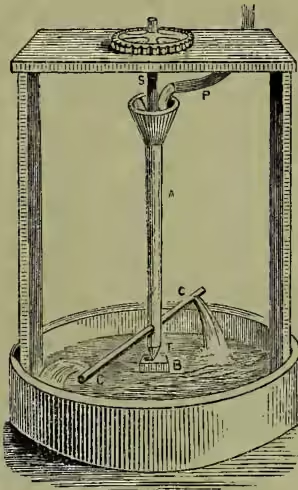
It is represented in its simplest or typical form in fig. 1. A is a wide metal pipe, resting at its lower end, by the steel spindle T, on a metal block B, and kept in a vertical position by the spindle S, at its upper end, which passes through the frame of the machine. Near its lower end, two smaller pipes or arms C, C, are inserted, which project horizontally from it, and these have each, at the outer extremity, a hole cut horizontally in them, opening towards opposite sides. The water is supplied by the pipe P. The reaction caused by the water gushing from the arms, forces them backwards, and gives to the whole machine a rotatory motion. Suppose that the arms were closed all round, the pressure of the water against the sides would be proportional to the height of the water in the pipe A, and the pressure against any particular surface of the side would produce no motion of the arm, because an equal pressure is exerted in a contrary direction upon a corresponding surface opposite to it. Now, if one of these surfaces be cut out, the pressure against the other being uncounteracted, forces the arm in the opposite direction to that of the side in which the hole is made. This being done to both arms on opposite sides, two equal pressures are produced, which conspire in generating the same motion of rotation. As soon as motion ensues, centrifugal force comes into play, which, throwing the water out towards the ends of the arms, increases the rapidity of its discharge, and therefore increases the reaction.
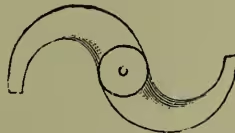
The power is manifestly increased by heightening the water-column, or by lengthening the arms—the former increasing the pressure of the water, and the latter increasing the leverage. In the mill shown in the figure, the column in A cannot be advantageously heightened, for the higher it rises, the greater must be the weight which the conical spindle, T, has to sustain, and the greater, consequently, becomes the friction. Hence, in the reaction-wheels now in use, the original Barker's Mill has been so modified as to allow of the water being conducted from the reservoir below the arms instead of above. The power of these machines may be also increased by using curved (fig. 2) instead of straight arms. See WATER-POWER.