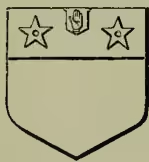
Baronet, a hereditary title which, etymologically signifying a little baron, seems to have originated in a misapprehension of the derivation of the word Banneret (q.v.), sometimes called in Latin baronetus. This dignity was instituted by James I. in 1611, avowedly for the defence of the new plantation of Ulster, but really to replenish the king's exchequer, and was bestowed by letters-patent. The recipient of it was to be a gentleman of coat-armour for at least three descents, with a clear revenue of £1000 from lands. His patent specified his precedence as before all knights, including Knights of the Bath, and such bannerets as were not made in the field in presence of the king: the style was given him of Baronet, and the prefix 'Sir' before his name, while his wife was to have a precedence corresponding to his own, with the style of 'Lady,' 'Madame,' or 'Dame.' Each baronet came under an obligation to maintain thirty soldiers in Ireland for three years, at the rate of 8d. per day for each, the wages of a year being paid into exchequer on the passing of the patent. The sum thus exacted, with the fees of honour due to the officers, exceeded £1000 on each patent. It was stipulated that the number of baronets should not exceed 200, and that on the extinction of a baronetcy, no other should be created to fill up the vacancy. The original baronets were among the most considerable landed gentlemen in England, the first being Sir Nicholas Bacon of Redgrave, Suffolk, Knight, whose patent is dated 22d May 1611, and whose descendant is still the premier baronet. All the original patents were granted to the recipient and the heirs-male of his body. King James never exceeded the 200, except by five creations in room of five baronets who were elevated to the peerage; but his successors disregarded the restriction, and the number became unlimited. The qualifications regarding birth, estate, &c. have not been rigidly adhered to in later times, though it is still required that each baronet, before his patent be issued, shall be certified by the proper authorities to be a gentleman of coat-armour. In 1612 a dispute for precedence between baronets and the younger sons of viscounts and barons was decided by the king in favour of the latter; and it was at the same time directed that baronets might bear in their shield of arms, in a canton or inescutcheon, the arms of Ulster, argent, a sinister hand erect couped at the wrist gules—the 'bloody hand' (fig. 1). In the same year, the king knighted the heirs of the existing baronets, and ordained that the eldest sons of baronets might in future claim knighthood on attaining majority, a provision also set forth in the earlier patents, which, after falling into disuse, was recognised in three instances, in 1824, 1827, and 1835, but disallowed in the case of the eldest son of Sir James Broun, a Nova Scotia baronet, in 1836.
An order of baronets similar to that of England was instituted in Ireland in 1619, the arms of Ulster being also allowed them, and the money going to the Irish exchequer. The first baronet of Ireland was Sir Dominick Sarsfield, then Chief-justice of the Common Pleas in Ireland, whose patent was dated October 14, 1619.
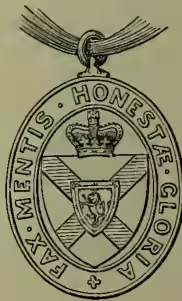
The institution of the degree of baronet in Scotland, contemplated by James I., was carried out by his successor, the avowed object being to aid Sir William Alexander's scheme for the colonisation of Nova Scotia. The number was not to exceed 150; the sum payable was £3000, and the patents at first included grants of specified lands in that colony. As the lands conveyed and described had no actual existence, the grants were illusory; and the practice of including such grants in the patents continued down to 1638, though Nova Scotia had long before that date passed into the hands of the French. Baronets of Scotland are often called baronets of Nova Scotia; but the name can hardly be given with propriety to those created after 1638. The first creation was that of Sir Robert Gordon of Gordonstone, second son of Alexander, eleventh Earl of Sutherland, whose patent bore date 26th May 1625. The later creations of Charles I. included gentlemen unconnected with Scotland, and in one instance a lady, Dame Maria Bolles, of Osberton, Notts. In almost all patents by Charles I. the limitation was to heirs-male whomsoever; afterwards, though there was considerable variety, the most common limitation was to heirs-male of the body. It was at first provided that baronets of Scotland should charge their coat-armour with the arms, supporters, and crest of Nova Scotia on a canton or inescutcheon. In 1629 they became entitled to wear a personal decoration or badge pendant from an orange-tawny ribbon—viz. in an escutcheon argent, a saltire azure, thereon an inescutcheon of the arms of Scotland, an imperial crown above the escutcheon, and round the whole the motto, Fax mentis honestæ gloria (fig. 2). The wearing of this badge, having fallen into disuse after the Civil War, was revived at a meeting of the baronets of Scotland in 1775. In representations of the arms of a baronet of Scotland, it is usual to place this badge below the shield, hanging from an orange-tawny ribbon surrounding it.
No baronets of Scotland have been created since 1707, and of Ireland since 1801. Later baronets are of Great Britain or of the United Kingdom.
Baronets take rank immediately after the younger sons of barons; and it is usually understood that they take precedence among themselves, after the analogy of peers, as follows: Baronets of England; of Scotland; of Great Britain; of Ireland; of the United Kingdom. The Ulster King of Arms, however, contends that in the absence of any direct legislative provision to the above effect, baronets of all classes should rank only according to the dates of their patents.