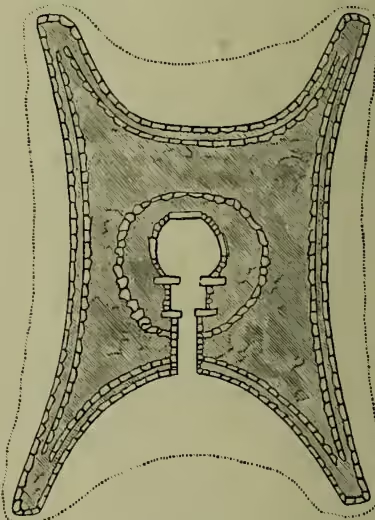
Barrow, a sepulchral mound of earth or stones raised over the site of a burial as a mark of honour to the dead. The barrows of the Stone Age in Europe are mostly constructions of stones, oblong, oval, or circular on the ground-plan, and containing chambers for the reception of the burials. A passage opening from the exterior gives access to the chamber, which is usually situated at or near the centre of the barrow. The chambered barrows, which are peculiar to the Stone Age of Britain, are now structureless heaps in external appearance, but were originally faced with dry-walling on the external outline of the ground-plan. The oblong variety is occasionally from 200 to 300 feet in length, and sometimes contains several chambers. Commonly, however, the chamber is situated at one end of the barrow, which in many cases faces the east, and is usually higher than the other end. The passage leading into the chamber starts from between two concave or convex projections of the end of the barrow. It is commonly low and narrow towards the exterior, increasing in height and width as it approaches the chamber. The framework, so to speak, of the chamber and passage is commonly constructed of very large stones, and hence these chambers are often referred to as megalithic, and the framework of such a chamber, whether covered with a mass of smaller stones and earth, or uncovered, is called a dolmen, and often, erroneously, a cromlech. The passages are usually lintelled over with great flat stones, but the roof of the chamber is constructed of beehive vaulting (see BEEHIVE HOUSES). The chamber is often divided into compartments by partitions of slabs, or has smaller chambers opening from its sides. The burials in the chambered barrows are mostly after cremation, accompanied by urns of dark-coloured, hard-baked paste, with rounded or hemispherical bottoms.
The oval and circular barrows with internal chambers are smaller, and probably later than the long barrows. They also have their external outline defined by dry-walling, and are sometimes surrounded by a trench, or by a ring-fence of standing stones. The mode of burial is the same as in the long barrows, chiefly after cremation, accompanied by urns of the same character, and by implements, weapons, and ornaments of stone and bone. Indications of funeral feasts occur in all the chambered barrows, the deposits being intermixed with bones of the domestic animals—the horse, ox, dog, sheep, swine, and occasionally the red-deer, and various species of fish and fowl. The chambered barrows of Brittany and Denmark differ from those of Britain in having their chambers flat-roofed, often with a single stone of enormous size.
The barrows of the Bronze Age in Europe are circular in form and unchambered. They are characterised by single burials, placed in cists, or simple inclosures of flat stones, like chests, the sides, ends, and cover each formed of a single slab. A barrow may contain one or many cists, but the principal burial is usually near the centre. The cists may be placed on the original surface, or at some depth beneath it. The burials in them are commonly burnt, but often unburnt, this varying with the locality. Both burnt and unburnt interments may be accompanied by urns, but occasionally no urn is present. Sometimes a barrow may contain no cists, but simply deposits of burnt bones inclosed in large cinerary urns set in the soil, or with the urns inverted over them. The urns associated with burnt burial differ in form and purpose from those usually found with unburnt burial. The cinerary urn in Britain is large and wide-mouthed, and ornamented only on the upper part. The urns set in the cists with unburnt bodies are of two varieties—one somewhat bowl-shaped, tapering to a narrow base, nearly as wide as it is high; and the other tall, thinned, and bulging below. Both varieties are usually ornamented over the whole surface.
The barrows of the Iron Age in Europe are mostly earthen mounds. In Britain they are few in number. The Anglo-Saxon burial-places of the heathen time are often cemeteries of graves undistinguished by barrows or mounds upon the surface. In Scandinavia, some of the larger barrows have chambers constructed of timber, but without passages. Such was the barrow of Queen Thyra at Jellinge, in Jutland, erected in the 10th century. The three great mounds or barrows at Upsala, in Sweden, contained burnt burials of the early Iron Age. In the later 'Viking time,' unburnt burial was the common practice. Some of the larger Viking barrows contained the ship, fully equipped as she rode the sea, and the owner laid in state in a house constructed on the deck, as in the case of the Viking ship discovered in 1880 at Gokstad Sandefjord, and now in the museum at Christiania.
The erection of barrows as marks of distinction in burial appears to have been a common custom among the early races, whether of high or of low culture and civilisation. It is repeatedly referred to in the Homeric poems. The barrows raised over the burnt bones of Hector and of Achilles and Patroclus are described as constructed of stones and earth, like those of prehistoric times, but unchambered. Herodotus describes the Scythian custom of barrow-burial as existing in his time; and in the case of the barrow raised over Hephaestion, the friend of Alexander the Great, we have the cost of its construction stated at 1200 talents, which has been computed as equivalent to something like £232,500 sterling. See Canon Greenwell's British Barrows (Oxford, Clar. Press, 1877), and other works cited at ARCHÆOLOGY; also BURIAL.