Bastard, an old French word denoting the 'son of a bast,' or pack-saddle, as opposed to a child of the lawful marriage-bed. Bastards, as described by Blackstone, are such children as are not born either in lawful wedlock, or within a competent time after its determination. The Scots lawyers, and most continental systems of marriage law, define a bastard as a child born of a woman who was not married to the father at the time of conception, and who was never thereafter married to him. This includes the case of an invalid marriage, except according to Scots law in the rare case of a putative marriage—i.e. a mistake in good faith on the part of both parents. Although there is, of course, a presumption of legitimacy where a child is born during marriage, that presumption can be removed by evidence to the contrary.
Bastards are incapable of inheriting real property; nor can they claim any share of personal estate as next of kin to a party dying intestate. It has even been decided that a child born before wedlock in a foreign country, according to whose law such child was legitimate, could not inherit land in England; but this rule does not extend to personal property; nor would such a decision be generally accepted as consistent with private international law. Prior to 1834, even in England, if a bastard held possession till his death of his father's land, his descendants could not be ejected by a legitimate son of the bastard's parents who had subsequently intermarried. Such a bastard was called bastard eigné.
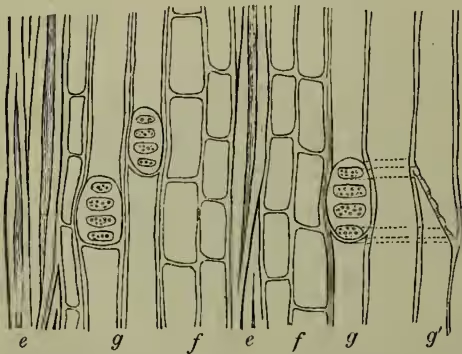
There can be no collateral succession through bastards; for as they cannot be heirs themselves, so neither can they have any heirs but those of their delicacy and transparency of the walls of sieve-vessels and bast parenchyma alike, and by the presence of protoplasmic contents; while in longitudinal section, the characteristic 'sieves' (which are not, however, always very easy to observe) furnish an additional characteristic (see fig.). In the soft bast also there may frequently occur Laticiferous own bodies. A bastard is not entitled to the name either of his reputed father or that of his mother, though he may acquire for himself a surname by reputation; nor can he take property under a will by the mere description of child of his reputed parent, until he has acquired the reputation of standing in that relation to him. Nor does a bastard follow, as legitimate children do, his father's place of parochial settlement under the poor-laws, but he has and follows the settlement of his mother until he attains the age of 16, or until he acquires a settlement in his own right, and after that age his primary settlement is in the parish where he was born. Another peculiarity of the status of bastardy is, that a bastard being filius nullius ('nobody's child'), the consent of his father or mother to his marriage is not required, and is of no avail; but a guardian may be appointed by the Court of Chancery for the purpose, or a license may be granted upon oath made that there is no person authorised to give consent. To this may be added, that although in general a father may by deed or will appoint, in the event of his decease, a guardian for his infant child, he has no such privilege if the child be illegitimate.
In other respects, a bastard is very much in the same position as a legitimate person. Thus, he can hold land in fee-simple, and can dispose of it as he may think proper, and he can make a will bequeathing his whole estate—a privilege which was not conceded to bastards in Scotland dying without lawful issue, till the year 1836. In regard to his personal estate, although the crown is entitled to such in the case of a bastard dying intestate, the royal claim is not strictly enforced; but upon petition, the crown's right will be waived in favour of the bastard's family. In the Scots law also the crown may, by what is called a gift of bastardy, grant not only the personal, but also the real estate of an intestate bastard to the 'donatory,' or person similarly entitled, as in the case of personal property in England. Practically the same effect is produced by royal letters of legitimization during the bastard's life. It is also to be observed that the prohibitions as to marriage which extend to collaterals, and to those related by the half-blood only, also apply although one of the parties be a bastard. Again, the laws relative to incest apply to a bastard. A bastard may be made legitimate by an act of parliament for all purposes, even for that of inheriting land, 'as was done,' says Blackstone, 'in the case of John of Gaunt's bastard children by a statute of Richard II.'
In England, the maintenance of an illegitimate child devolves in the first instance on the mother. She is for this purpose entitled to its custody in preference to its father; and she is bound to maintain it as part of her family while she remains unmarried, or until the child attains the age of 16, or gains a settlement in its own right, or (being a female) is married; and in the event of the mother's marriage, the same liability attaches to her husband. If the mother be of sufficient ability to maintain the bastard while he is thus dependent on her, and neglect that duty, so that he becomes chargeable to a parish, she is liable, by 7 and 8 Vict. chap. 101, sect. 6, to be punished under the provisions of the Vagrant Act. If the mother is dead or in prison, two justices may appoint a person to take the custody of the child. By the Poor-law Act of 1844, as amended by the Bastardy Acts of 1872 and 1873, the putative father may be summoned and compelled to make a proper allowance, not exceeding five shillings a week, for the support of the child till 16. This is called a Bastardy Order. And under the Summary Jurisdiction Act of 1881, proceedings of this kind may be taken in the local courts, by an English mother in Scotland, or by a Scottish mother in England, wherever the father is within the local jurisdiction.
The chief points in which the position of a bastard differs in Scotland are, that he is fully legitimated by the subsequent marriage of the parents, and that the mother has the legal custody only until the age of 7 in males and 10 in females. The decree for aliment is given against the father up till these ages, but recently, in consequence of the restrictions placed on employment of children by the Factory, Mines, and Education Acts, the decree has been given up till the age of 10 in the case of boys also. The rate is 2s. 6d. to 3s. per week. At the age of 10, the father would be entitled to take the child from the mother to his house. In Scotland, the father is at common law bound to contribute to the necessary subsistence of the child. Failure to support is punishable under the Poor-law Act.
Both in England and Scotland the widow of a bastard, whether there be issue or not of the marriage, is entitled to dower, terce, jus relictæ, and all the other legal rights of widows. See AFFILIATION, DIVORCE, HEIR, ILLEGITIMACY, LEGITIMACY, MARRIAGE, SUCCESSION, ULTIMUS HÆRES, VAGRANTS.
In the United States also a bastard is one born of an illicit connection, and before the lawful marriage of its parents; one begotten and born out of lawful wedlock. A man is a bastard if born during coverture under such circumstances as to render it impossible that the mother's husband can be his father; or if born beyond a competent time after the coverture has determined. A bastard has no right of inheritance at common law, and the principal right he has is that of maintenance by his parents. In most states, children born before the marriage of their parents are made legitimate by the subsequent marriage of their parents.
The 'Bastard of Orleans' was the famous soldier Dunois (q.v.). Amongst other illustrious bastards may be named William the Conqueror, the Regent Moray, Don John of Austria, the Duke of Monmouth, the Duke of Berwick, and Marshal Saxe. See FITZ, BATON-SINISTER.