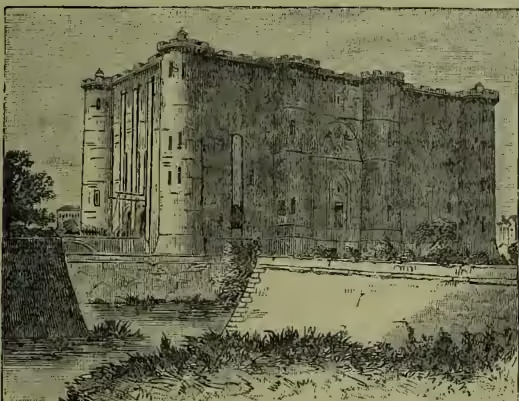
Bastille, a French term for a fortress defended by bastions, was used in this sense in England also after the Norman Conquest. The famous prison to which the name was latterly appropriated, was built by order of Charles V., between 1370 and 1383, by Hugo Aubriot, Prévôt or Provost of Paris, at the Porte St Antoine, as a defence against the English. From the first, however, it was used as a state-prison, Aubriot himself being confined there on suspicion of heresy. During the 16th and 17th centuries it was greatly extended and provided with strong bulwarks. On each of its longer sides the Bastille had four towers, of five stories each, over which there ran a gallery, which was armed with cannon. It was partly in these towers, and partly in underground dungeons, that the prisons were situated. The unfortunate inmates of these abodes were so effectually removed from the world without as often to be entirely forgotten, and in some cases it was found impossible to discover either who they were or what was the cause of their incarceration. The Bastille was capable of containing 70 to 80 prisoners, a number frequently reached during the reigns of Louis XIV. and Louis XV. These prisoners were seldom criminals; they were victims rather of political despotism, court intrigue, ecclesiastical tyranny, or family quarrels, and were lodged here in virtue of Lettres de Cachet (q.v.)—noblemen, authors, savants, priests, and publishers. At the beginning of the French Revolution on the 14th of July 1789, the fortress was surrounded by an armed mob eager to destroy the stronghold of tyranny. The garrison consisted of 42 pensioners and 32 Swiss. The negotiations which were entered into with the governor led to no other result than the removal of the cannon pointed on the Faubourg St Antoine, which by no means contented the exasperated multitude. Some cut the chains of the first drawbridge, and a contest took place, in which one of the besieged and 150 of the people were killed or severely wounded; but the arrival, with four field-pieces, of a portion of the troops which had already joined the people turned the fortune of the conflict in favour of the besiegers. Delaunay, the governor—who had been hindered by one of his officers from blowing the fortress into the air—permitted the second drawbridge to be lowered, and the people rushed in, killing Delaunay himself and several of his officers. The destruction of the Bastille commenced on the following day, amid the thunder of cannon and the pealing of the Te Deum. The event in itself was apparently of no great moment, leading only to the release of three unknown prisoners—one of whom had been there for thirty years—and of four forgers. In that event only the 654 persons whose names now appear on the column in the Place de la Bastille took part, yet it finally broke the spirit of the court-party, and changed the current of events in France. The Bastille had long been regarded as the stronghold and symbol of tyranny, and its destruction was everywhere hailed as the downfall of an evil system. 'But,' said the king when the news was brought him, 'that is a revolt.' 'Sire,' said De Liancourt, 'it is not a revolt—it is a revolution.' See Carlyle's French Revolution, and the Hon. Captain Bingham's Bastille (2 vols. 1888).