Bath, ORDER OF THE. The name of this English order of knighthood is derived from the ceremony of bathing, which used anciently to be practised at the inauguration of a knight, as an emblem of the purity henceforth required of him by the laws of chivalry. The order does not seem to be older than the reign of Henry IV., who, at his coronation in 1399, made 46 esquires Knights of the Bath. Knighthood of the Bath was afterwards from time to time conferred on occasion of great national ceremonials. Charles II. made 68 Knights of the Bath at his coronation, but from that time the dignity fell into oblivion till revived by George I. in 1725 as a military order, consisting of the sovereign, a grand-master who should be a prince of the blood, and 36 knights. At the conclusion of the great war, it was thought expedient, with a view to rewarding the merits of many distinguished officers, both military and naval, to extend the limits of the order, which was effected on the 2d January 1815. But the order was still purely military, and it was not till 1847 that it was placed on its present footing by the admission of civil knights, commanders, and companions. In June 1861 it was further enlarged. The following is its present organisation:
First Class.—Knights Grand Cross (G.C.B.); the number not to exceed, for the military section, 50, exclusive of the royal family and foreigners; and for the civil, 25. The knights of the military section must be of or above the rank of major-general in the army or rear-admiral in the navy.
Second Class.—Knights Commanders (K.C.B.); military, 102, and civil, 50, exclusive of foreigners. These, like the first, have the title Sir, and take precedence of Knights Bachelors. The military knights must be of or above the rank of colonel in the army or captain in the navy.
Third Class.—Companions (C.B.); military, 525, and civil, 200. They take precedence of Esquires, but are not entitled to the distinctive appellation of knighthood. No officer can be nominated to the military division of this class unless his name has been mentioned in the London Gazette for distinguished services in action; and the order has never been conferred on an officer below the rank of a major, or commander in the navy. The number of the second and third classes may be increased under special exigencies.
The officers of the order are the Dean (who is the Dean of Westminster), Bath King of Arms, the Registrar and Secretary, and the Gentleman Usher of the Scarlet Rod. On the revival of the order in 1725, Henry VII.'s chapel at Westminster was made the chapel of the order, where the stall-plates and banners of the knights were placed over their stalls. But since 1815 there has been no installation of a knight, and the stalls do not now afford sufficient accommodation for the increased numbers of the order.
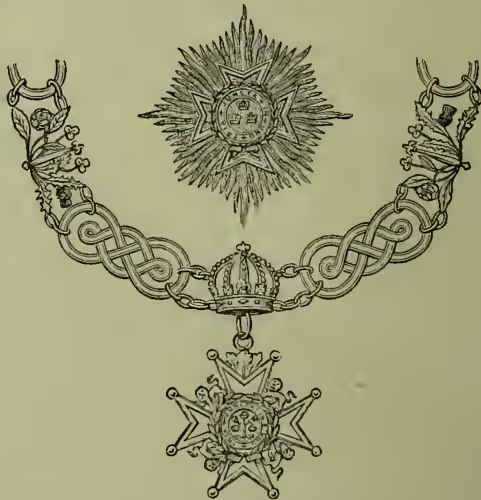
The insignia belonging to the first class are the collar, badge, ribbon, star, mantle, surcoat, under habit, and cap. The collar is of gold, composed of nine imperial crowns and eight roses, thistles, and shamrocks, issuing from a sceptre and ena- melled of their proper colours, all united together with seventeen knots enamelled white. The badge of a military G.C.B. is a gold Maltese cross enamelled white, each of its eight points terminating in gold balls, and in each of the four angles a lion of England; in the centre, on a ground of white enamel, are the rose, thistle, and shamrock, issuing from a gold sceptre between three gold imperial crowns, within a red circle charged with the motto of the order, Tria juncta in uno, and surrounded with two branches of laurel in proper colours, issuing from an escrol of blue enamel, containing, in gold letters, the legend Ich dien. The badge of a civil G.C.B. is an oval entirely of gold, the external fillet containing the motto of the order, and encircling the above device of the rose, thistle, shamrock, sceptre, and three crowns. The badge is suspended from the collar on occasions when the latter is worn; at other times it hangs from a broad red ribbon placed across the left shoulder. The star of a military G.C.B. is formed of rays of silver, thereon a gold Maltese cross charged with three imperial crowns, one and two, within a circle of red enamel charged with the motto of the order in gold letters, and surrounded by two branches of laurel issuing from an escrol like that of the badge. That of a civil G.C.B. has the same circle and central device, with rays of silver in the form of a glory issuing from the centre. The mantle is of crimson silk, lined with white silk, with the star embroidered on the left side, and a lace of white silk on the left shoulder. The surcoat is of the same materials as the mantle. The cap is of black velvet, with a plume of white ostrich feathers.
The insignia of the second class are the badge, ribbon, star, mantle, under habit, and cap. The badges, military and civil, are like those of the first class, but smaller, and the ribbon is narrower. The star of the military K.C.B. differs from that of the military G.C.B. in omitting the Maltese cross, and is in form a cross patée. The star of a civil K.C.B. differs from that just described in omitting the branches of laurel and the escrol and its legend. The mantle and cap are nearly similar to those of the G.C.B.
Companions of the Bath have for insignia only the badge, civil or military, as above described, but of still smaller size. It is fixed to a gold swivel with a bar of the width of the ribbon, and fastened to the coat with a gold buckle.
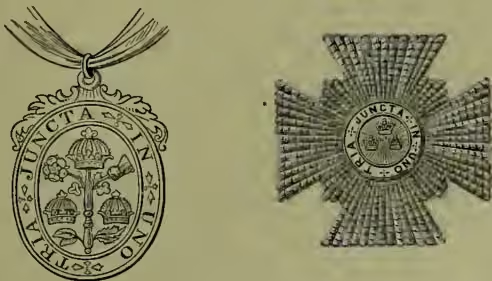
Knights Grand Cross of the Bath are entitled to supporters. Both G.C.B. and K.C.B. place a red circle containing the motto of the order outside their arms, with the badge suspended from it, military knights having outside the circle the two branches of laurel, escrol, and legend, as above. Companions attach the ribbon and badge to the lower part of their shield.