Baton-sinister, a well-known heraldic indication of illegitimacy. It is a diminutive of a Bend-sinister (see BEND), one-fourth of its width, and coupé at the ends—i.e. not extending to the sides of the shield, so as to resemble a marshal's baton or truncheon laid diagonally over the family arms from sinister to dexter. From the 15th century onwards it has been largely assigned in England to the illegitimate issue of the royal family. Heralds say that it may be of metal in the case of bastard descendants of royalty, but in other cases should be of colour, even though placed on colour. In the example represented, the arms of the Duke of Grafton (descended from an illegitimate son of Charles II.), the baton-sinister
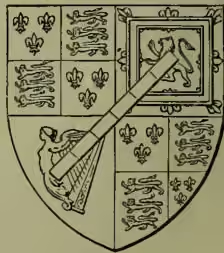
is composed of six pieces argent and sable. The terms 'Bar-sinister' or 'Bastard Bar' are often erroneously used for Baton-sinister; the former, for instance, is of frequent occurrence in Thackeray's Esmond.