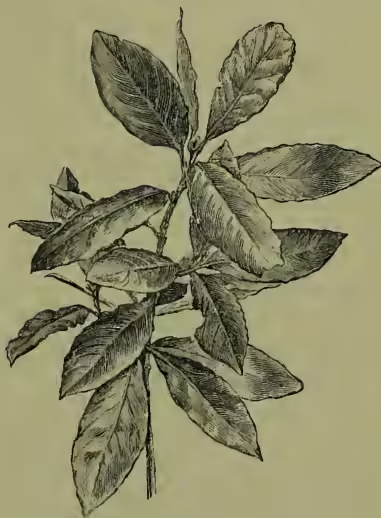
Bay, a name given to a number of trees and shrubs more or less resembling the Laurel or Victor's Laurel (Laurus nobilis), which is also called Sweet Bay (see LAUREL); the name Bay (Fr. baie, from Lat. baeæ, 'berries'), which was once exclusively applied to the fruit, having been extended to the whole plant. The larger-leaved hardy evergreen common in shrubberies, the Common Laurel or Cherry Laurel (Prunus Laurocerasus), is sometimes called Bay Laurel. The true bay-leaves are frequently used for flavouring puddings, &c.; but those of the laurel are sometimes substituted. The fumes of prussic acid given off by the latter when bruised are used by entomologists in killing butterflies and moths. Bay-rum, used by perfumers, is an aromatic liquid obtained by distilling rum in which bay-leaves have been steeped.—The RED BAY of the Southern States of America is Laurus Caroliniensis (see LAUREL).—The WHITE BAY of America is Magnolia glauca (see MAGNOLIA), and the LOBOLLY BAY of the same country is Gordonia Lasianthus. See GORDONIA.
Bay-leaves with other evergreens decked houses at Christmas, were used at weddings, and were worn against thunder. The withering of bay-trees was reckoned a prognostic of evil. This is alluded to in Shakespeare's Richard II. (II. iv.), who is here quoting from Holinshed. The following passage occurs in Parkinson's Garden of Flowers (1629): 'The bay-leaves are of as necessary use as any other in the garden or orchard, for they serve both for pleasure and profit, both for ornament and for use, both for honest civil uses and for physic, yea, both for the sick and for the sound, both for the living and the dead; . . . so that from the cradle to the grave we have still use of it, we have still need of it.'