Bayeux Tapestry, the name given to a panorama of sewed work, representing the invasion and conquest of England by William the Conqueror, preserved in the public library of Bayeux. This is not a Tapestry (q.v.) in the usual sense of the word, but closely resembles sampler work. It is sewed on a band of linen about 230 feet long by 20 inches wide, and is divided into 72 scenes, which are generally separated from each other by a tree or other object. Most of the scenes are described by Latin inscriptions sewed along the upper margin of the tapestry. The work contains figures of 623 persons, 762 horses, dogs, and other animals, 37 buildings, and 41 ships or boats. The figures are worked in worsteds of eight different colours, dark and light blue, red, yellow, dark and light green, black, and buff. The drawing is rude, but vigorous and spirited, and no attempt is made to show local colour; horses, dogs, &c. are blue, green, red, or yellow, as may have suited the convenience of the design. To distinguish objects at different distances from the spectator, different coloured worsteds are employed, with sometimes curious effect: thus, a blue horse may have its off legs red, or a yellow one green, and so on. The method of sewing has been to cover the object with threads laid side by side, and to cross-stitch it at intervals: the faces, hands, and, where bare, the legs are simply outlined in coloured worsted. The persons mentioned by name in the inscriptions are: King Edward the Confessor, Harold, Guy of Ponthieu, Duke William, Conan, Archbishop Stigand, Bishop Odo, Eustace of Boulogne, Robert of Mortain, Leofwine, Gyrth, Turolf, Wadard, Vital, and Ælfgyva.
This pictorial history—for so it may be called, and indeed, in several particulars, it is more minute than any written history we have—opens with Harold, prior to his departure for Normandy, taking leave of Edward the Confessor. Harold is next observed, accompanied by his attendants, riding to Bosham with his hawk and hounds; and he is afterwards seen, successively, embarking from the Sussex coast; anchoring in France and being made prisoner by Guy, Earl of Ponthieu; redeemed by William, Duke of Normandy, and meeting with him at his court; assisting him against Conan, Earl of Bretagne; swearing on the sacred relics never to interfere with William's succession to the English throne, &c.; and finally re-embarking for England. The tapestry then represents Harold narrating the events of his journey to Edward the Confessor, whose death and funeral obsequies we next see. Harold then receives the crown from the English people, and ascends the throne; and next we have the news brought to William, who takes counsel with his half-brother, Odo, Bishop of Bayeux, as to the invasion of England. Then follow representations of the active war-preparations of the Normans; their embarkation; disembarkation; march to Hastings, and formation of a camp there; the battle, the death of Harold, and the flight of the English, with which the tapestry finishes.
As an example of the Latin inscriptions describing the pictures, we reproduce one of the longest of them in reduced fac-simile:
HIC WILLELM:DVX ALLOQVITVR:
SVIS:MILITIBVS:VI:PREPARAREN
SE:VIRILITER ET SAPIENTER:AD
PRELIVM:CONTRA:ANGLORVM
EXERCITV:
It may be translated: 'Here Duke William exhorts his soldiers to prepare themselves manfully and discreetly for battle against the army of the English.' Our illustration gives the concluding portion of this scene, and represents the onslaught of the Norman knights on the English at the battle of Hastings.
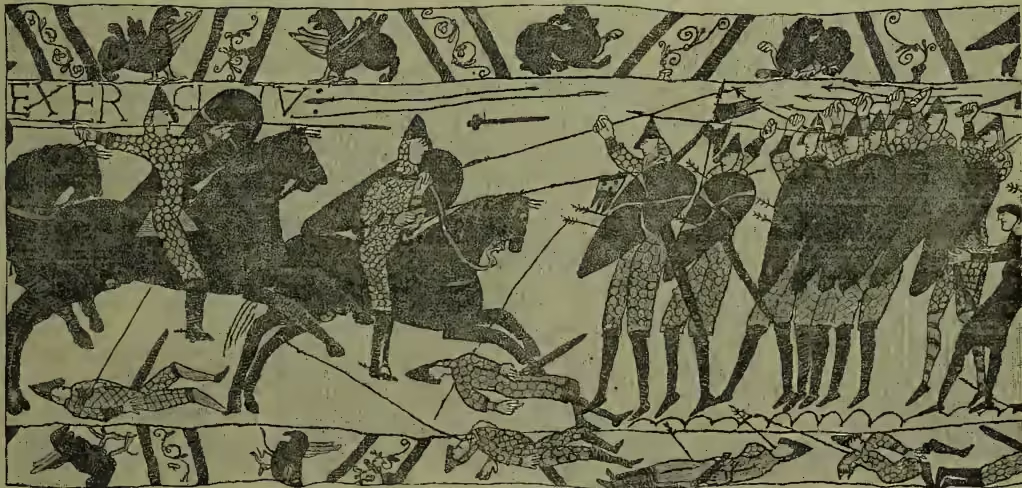
Much ingenious argument has been expended on the question of the authorship of the tapestry. It has apparently been proved to demonstration that it must have been the work of William's queen, Matilda; yet others, with equal force, insist on the authorship of the Empress Matilda, daughter of Henry I. A third party, with perhaps still stronger reasons, consider it to have been executed as a decoration for the cathedral of Bayeux, under the orders of Odo, William's half-brother, who was, in 1048, appointed Bishop of Bayeux, a see which he held for fifty years. He took an active part in the invasion of England, appears as a prominent figure in the tapestry, and was rewarded by William with the earldom of Kent. He lavished much of his wealth on Bayeux, and rebuilt the cathedral in 1077. The fact that the tapestry exactly fitted round the nave of the cathedral, and that, with the exception of a brief visit to Paris in 1803-4, for the inspection of Napoleon I., it has never been out of Bayeux, seems to give strong probability to the Bishop Odo theory.
Whoever may have been the author of it, there is no doubt that strong evidence exists in the tapestry itself of its having been designed at a date, if not exactly contemporary with the events depicted, at anyrate immediately afterwards.
The earliest existing mention of it is made in an inventory of the ornaments of the cathedral in 1476, where it seems to have been used at certain seasons to decorate the nave. There it remained unknown, except to the people of Bayeux, until 1724, when a drawing of a portion of it, which came into the possession of M. Lancelot, a member of the Académie des Inscriptions, finally led to its discovery a few years later. Although it has encountered many dangers from fire, revolution, invasion, and other causes, it has passed unscathed through them all; and it exists now as complete, and with its colours as fresh, as when executed.
It passed out of the keeping of the cathedral authorities towards the end of the 18th century, and was for many years in the hôtel de ville. Here it was barbarously used, being kept on a couple of rollers and exhibited to the curious by winding from the one to the other. A knowledge of its vast value, however, gradually dawned on its custodiers; and in 1842 it was deposited in an apartment built for the purpose, and placed under the care of the public librarian. This gentleman, M. Lambert, not only superintended the relining of the tapestry, but carefully and successfully restored certain portions which had suffered from age and the rollers. In 1871, during the Franco-Prussian war, the Prussians were so near the town that the tapestry was taken from the glass case in which it is displayed, and hidden till all danger was past.
The great importance of the tapestry as a contemporary record of the costumes and manners and customs of a period of such consequence in the history of England was at once recognised on its discovery, and at various times careful drawings have been made of the complete work, and about fifty works and treatises have been published concerning it. The best of these drawings was undoubtedly that made by Mr C. Stothard for the Society of Antiquaries of London. Commenced in 1816, it occupied two years' labour, and was published as vol. vi. of the Vetusta Monumenta by the Society in 1819. In 1872 the English Committee of Council on Education, having obtained the permission of the authorities at Bayeux, commissioned Mr Dossetter to prepare a full-sized photograph of the whole tapestry. A reduction of this photograph, edited and described by M. F. R. Fowke, and published by the Arundel Society in 1875, is the best and most complete accessible representation of this wonderful production. Our illustration has been photographed from one of the plates in this work. See Collingwood Bruce's Bayeux Tapestry Elucidated (Lond. 1885); Notice Historique et Descriptive sur la Tapissserie de la Reine Mathilde (Bayeux, 1873); La Tapissserie de Bayeux, by Judes Compte (Paris, 1878), and also Fowke's work (new ed. on a different scale, 1899), which gives a very complete bibliography.