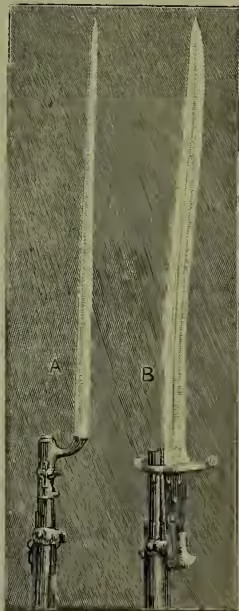
Bayonet, supposed to be named from Bayonne, of which Puységur, its alleged inventor (circa 1650), was a native, is a dagger or small spear fixed at the end of a musket or similar weapon. According to some authorities, the bayonet is just the Malay Kris (q.v.), introduced by Dutch soldiers from the East Indies; anyhow, it is certain that bayonets were manufactured at Bayonne in 1663. These, called bayonets-à-manche, had handles which fitted into the muzzle of the guns; but the bayonet-à-douille, or socket-bayonet, fitting round the barrel, so that the musket could be fired with the bayonet fixed, was invented by General Mackay in 1689, and introduced by Vauban into the French army in 1703. The bayonet with which the rank and file of the British infantry were armed up to the issue of the Lee-Metford magazine rifle (see RIFLES) was triangular in section, fitting round the rifle barrel by means of a socket, was 22 inches long, and weighed 15½ oz. It was only adapted for thrusting. The latest pattern of it is seen in fig. 1, A. The sword-bayonet, which was a cut-and-thrust weapon of about the same weight and 24 inches long, sharpened on its front edge, had a handle by which it could be used as a separate weapon. It was fixed on the rifle as shown in fig. 1, B, and was carried by rifle regiments, gunners, engineers, all infantry sergeants, and scamen, being better adapted to the shorter rifle with which they were armed. As a result of the contract system in the manufacture of these weapons, various rumours got abroad of their quality, and according to The Times of 11th February 1886, 'one-third of the British army is armed with weapons which will fail our soldiers in the hour of need; and this remark was to a great extent verified during the operations in the Soudan in that year, where many bayonets of both patterns were twisted and bent in charging—especially some naval sword-bayonets which had been made out of old cutlass blades. To guard against a repetition of this, all the bayonets in use in the United Kingdom were re-tested early in 1887. The bayonet now issued to all branches of the service in connection with the Lee-Metford rifle is a dagger-like weapon, with a blade 12 inches long, sharpened on both edges, and ground to a point for thrusting. It is shown in fig. 2. It is fastened to the under side

of the rifle barrel, whereas the older bayonets were fastened to the right side. This arrangement, in connection with the order that all shooting is now done with 'fixed bayonets,' is in consequence of the discovery that the bayonet in that position has an attractive effect on the light bullet used. This tends to lower the trajectory, and to a certain extent counteracts the tendency of the soldier to shoot high.
The blades are forged from the finest steel, and after being hardened and tempered are severely tested. The testing-machine is a curved block, with a hole at one end, and covered with a wire guard for the protection of the workman. The point of the blade is placed in the hole, and the blade is bent to the curvature of the block, and must spring back perfectly straight. Very few fail to pass the test, those that fail mostly breaking short off.