Beacon, in maritime affairs, is an erection of stone, timber, wrought-iron, cast-iron, or concrete, placed upon a rock or bank dry at low water, but covered at high water, and lying near the track of shipping, either on the open coast or in navigable rivers or estuaries. All beacons on the open seaboard, or on lochs used as harbours of refuge, are erected in England by the Corporation of the Trinity House, London; in Scotland by the Commissioners of the Northern Lighthouses; and in Ireland by the Ballast Board of Dublin. In navigable rivers they are erected by the improvement trustees. Dues for beacons are not levied upon shipping by the national authorities. On the open coast, beacons are made of a considerable size, to give a chance of their being made out in the dark, and also of great strength, to resist the shocks of the heavy breaking seas which fall upon them.
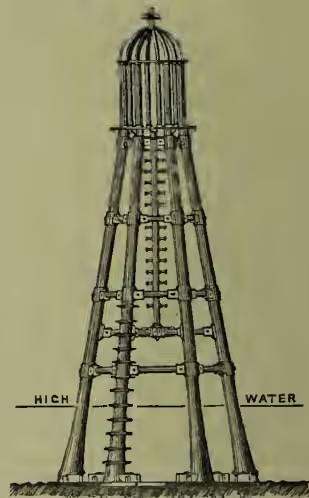
In Scotland the principal examples of stone beacons are those on the South Carr Rock in the Firth of Forth, the North Carr Rock off Fife Ness (which is partly of cast-iron), the Beamer Rock at Queensferry, and the Gantocks in the Firth of Clyde; the two former of these, being exposed to a very heavy sea, are built solid of hard stone joggled together, and are 42 feet in height and 14 feet in diameter at the base. Iron beacons are open pyramidal structures, surmounted by a cage or barrel-shaped top (fig. 1). They cost from £50 to £1200 or £1400, the heavier cost applying to the larger class in exposed situations, and when the rock is low in the water. Belonging to this latter class may be named Cairbulg Brigs, Covesea Skerries, Stroma Skerries, Cantick Head, Lothar Rock, &c. One of the main columns of these large beacons is provided with steps, so that any one cast upon the rock or reef may ascend to the cage on the top, which is capable of holding eight or ten persons.
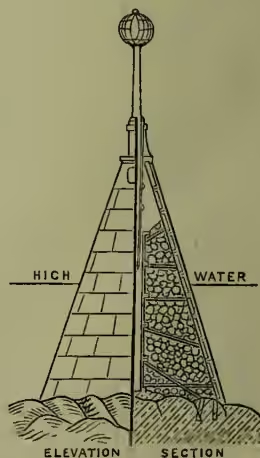
Two principal types are followed by the English authorities. Fig. 2 represents the class of beacon used by them for rock foundations. It consists of strong cast-iron plates, closely fitted and securely bolted together, the interior being filled with Portland cement rubble; and surmounting it is an iron mast, carrying a ball, triangle, diamond, or cone, as its locality may require. As much as £11,000 has been spent in one instance on the erection of such a beacon.
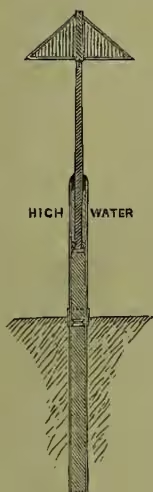
It consists of a wrought-iron tube, 2 feet 7 inches in diameter, sunk into the sand, with a second length of tube added, to carry the beacon above the high-water level. In the latter is secured the mast which carries the distinguishing mark of the position. Other forms also are used. The Monkstone, in Bristol Channel, has an erection of masonry in the form of a tower, with a stair of ascent from the rock to the top, which is protected by an iron railing; and on Old Law, Holy Island, the beacon takes the shape of a lofty obelisk of stone, which forms an important sea-mark. On the Irish coast, simple perch beacons, initialed or otherwise distinguished, are common, as on the Carrick Rocks, near Wexford, and on Foreland Point, at the entrance to Belfast Lough.
Beacon Lighting.—It has been proposed to light up beacons by electricity from the shore, but it has not as yet been successfully accomplished. Experiments conducted with this object by the Northern Lighthouse Commissioners showed that a spark could be produced that was visible in clear weather for a distance of about a mile; but the result did not justify the adoption of the system. There are instances, however, of beacons lighted by gas with perfect success. The Clyde Lighthouse Trustees have erected an iron tower on a bank off Port Glasgow Harbour, to which a gas-pipe has been led under water, and carried up to the lantern on the top. The gas is turned down during the day and raised at night by a stop-cock on shore. Another instance is the beacon erected by the Clyde Lighthouse Trustees on the Gantocks Rock, near Dunoon. The beacon is of stone, surmounted by an iron tank which holds about one month's supply of compressed gas, on Pintsch's principle; above this tank is placed the lantern containing the dioptric apparatus. The light burns day and night. The gas is supplied to the tank from the tender belonging to the Trust; this is fitted with tanks which are charged at their gas-work at Port Glasgow with gas raised to a pressure of ten atmospheres. The gas is passed from the vessel to the beacon by means of a strong india-rubber tube. The tank on the beacon is charged to six atmospheres. Beacons lighted on Pintsch's principle have been erected in many places at home and abroad. Where a beacon is placed near a lighthouse, it may be lighted by a beam of light projected from the lighthouse, which is reflected seaward by an apparatus placed upon the beacon. See BUOY, LIGHTHOUSE.