Bear (Ursus), a genus of large mammals in the order Carnivora. They differ from the related cat and dog types in being much less markedly carnivorous in habit and structure.
General Characters.—The stout body with thick legs and very short tail is covered with long shaggy fur; the entire under surfaces of the naked palms and soles rest on the ground in what is termed plantigrade fashion; the long claws are comparatively blunt, and are not retractile; the more or less elongated head, with short rounded hairy ears, runs out into a blunt somewhat hog-like snout; the bony external ear-bulb (tympanic bulla), so conspicuous on the skulls of most carnivores, is here rudimentary; the teeth have the same number and arrangement as those of the dog, but in association with the omnivorous and largely vegetarian diet the canines remain less developed, the special cutting teeth (sectorials) less sharp, and the molars have flattened and tuberculated grinding surfaces. Compared with the higher carnivores, bears are slow and less aggressive, relying more upon strength than cunning, and more or less contented with vegetable food. Though clumsy and heavy animals, they are thoroughly active, and some of them swim and climb with much agility. Most of them sleep through the winter, when their food is usually scarce, and it is at this season that the young cubs are born.
History.—In the earlier ages of civilisation bears bulked much more largely both in the imaginative and the practical life of men. In Greece the bear was king of the woods and sacred to Diana, though none the less a favourite object of the chase. He is a prominent figure in the mythologies and hero-tales of Northern Europe; and the same mixed reverence for a formidable antagonist is exhibited still by the North American Indians, who excuse themselves for eating it by an elaborate preface of compliment and respect. Bears used to be common beasts of chase in Europe, as many personal and local names abundantly testify. Large numbers were imported to Rome from various quarters, especially towards the decline of the empire, and supplied abundant material for the cruel conflicts of the amphitheatres. It is indeed on record that as many as a thousand bears were on one occasion exhibited. Bear-baiting prevailed to a much later date, and even in the time of Queen Elizabeth and her successor it was a recognised fashionable amusement to go to the bear-gardens, and see the victims worried to death by dogs. The name Bruin playfully given to bears is derived from the old poem Reynard the Fox (q.v.), where the bear has the name of 'Brown;' 'bruin' being the Dutch spelling of 'brown.'
Distribution.—The genus, though not a large one, is widely distributed in cold and temperate regions, and in the secluded uplands of some warmer countries. About ten species frequent various parts of Europe, Asia, and North America, while the African Bear (Ursus erowtheri) of the Atlas Mountains, and the South American Spectacled Bear (U. ornatus) of the Andes, are the only two representatives known to occur on these two continents. Their geographical range has been gradually becoming more and more restricted.
From the Pliocene strata of Europe and the deposits of the Siwalik Hills, two extinct species of bear have been dug up (U. arvernensis and U. etruscus). The Post-pliocene European caves are rich in remains of the Great Cave-bear (U. spelæus), along with those of the still abundant Grizzly. None of the above extinct forms differ markedly from existing species, but related genera like Arctotherium and Hyænarctos lead back to such a primitive form as Amphicyon, which is supposed to be at 'the converging point of the dog and bear family lines.'
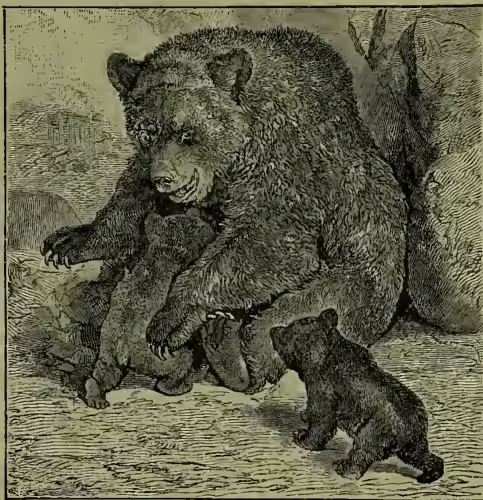
Different Forms.—The common Brown Bear (Ursus arctos), a variable species, inhabiting Europe and Asia, and regarded by some as identical with the black bear of North America. It used to be found in Britain, but seems to have been exterminated in Scotland about the end of the 11th century. It measures about 6 feet in length, and stands 3 feet or so high at the shoulders. The long fur is predominantly dark brown, but very variable in colour. They eat all sorts of things—roots, berries, vegetables, ants, honey, fish, &c., and when these fail, other quadrupeds both small and large. The males and females only meet at pairing time, and the males are said to be more inclined to eat the cubs than in any way to care for them. The mother bear, on the other hand, is devotedly fond of her offspring, is ready to defend them at all costs, and when in their company is a most dangerous animal. In spite of the shuffling awkward gait, the brown bears are agile animals, climbing and swimming with ease, and able to attain a considerable speed in running. Their senses of smell and hearing are very acute. When hunger prompts them to attack large quadrupeds, their usual method is to hug their prey to death within their powerful arms. At the beginning of winter, when food is becoming scarce, but before the bear has had time to get out of condition, it seeks some sheltered nook in a cave or hollow tree, and after making itself snug and comfortable, falls into a winter sleep. During winter the female gives birth to from one to three cubs, which are cherished in the lair until spring. They remain blind for about a month, and are suckled for other two. When the bears reappear after their long rest they are thin and weak, and not unnaturally voracious. They attain a considerable longevity of 40 to 50 years. When kept in captivity they seem apt to sink into a phlegmatic mood, to which they appear to have a natural predisposition; they may, however, be taught to dance clumsily on their broad soles, and are said to have a good ear for music. Numerous stories are told, moreover, of their affectionate disposition when properly treated, though they are generally soured and crossed by confinement. The skins are greatly valued, the flesh of the cubs is very palatable, bears' paws form a special delicacy, and the fat or bear's grease is a well-known unguent. In Kamchatka, different parts of the bear, which is very common, are used in a great variety of ways—e.g. the intestines for window-panes.
The American Black Bear (Ursus americanus) is regarded by some as merely a variety of the former, from which it differs only in a few trivial characters, such as blacker fur, more slender snout, more convex forehead, and the like. It inhabits North America, is even more thoroughly vegetarian than the Eurasian form, and much less dangerous than the Grizzly. If food be abundant in the late autumn, and the bears in consequence in good condition, they fall into a winter sleep in an often snow-covered hiding-place. They are reverenced or almost worshipped, but at the same time hunted and eaten by the Indians. The skins are largely utilised for caps, rugs, &c., and value from £1 to £3. Closely related to the above forms are the Syrian Bear of Lebanon and the Palestine mountains, and the Indian White Bear of the Himalayas. The former species (U. syriacus) is repeatedly mentioned in the Bible, and was much used in the Roman exhibitions. The Himalayan Bear (U. isabellinus) is probably only a variety.
Quite distinct from the above is the Grizzly Bear (U. horribilis, cinecreus, or ferox) of North America (from Mexico to 61° N.), a very large, strong, and fierce animal, chiefly at home on the Rocky Mountains. Though the characteristics of this powerful species are well marked, it was not till the explorations of Lewis and Clarke in 1802-6 that it was known to be a distinct type. The dark brown fur has a good deal of gray about the head, the ears are short and conical, the forehead broad and flat, the tail extremely short, the claws long, curved, and whitish. The adult Grizzly cannot climb trees. It is larger and stouter than the brown bear, more markedly carnivorous, and a very much more formidable beast of chase. It is said to be able to drag a buffalo carcass along, and is by far the most ferocious of bears. Attacked by man, it will pursue the assailant till the last. It is extraordinarily tenacious of life. A case is authenticated of a Grizzly receiving ten balls in its body, four of which passed through its lungs and two through its heart; it nevertheless swam half a mile, and did not succumb for twenty minutes. The skin is less valuable than that of the brown and black bears. The Indian or Tibetan Black Bear (U. tibetanus) and the Japanese species (U. japonicus) do not differ markedly from any of the preceding.
Somewhat different from the bears above described are a few forms for which separate genera are often erected. The Malayan Sun Bear (Helaretos or Ursus malayanus), inhabiting the Malay Archipelago, has a short, broad head, long extensible tongue, short, smooth, black fur, and remarkably long claws. Its maximum length is about 4½ feet. It does great damage to the cocoa-nut plantations. The Sloth Bear (Melursus or Ursus labiatus), which is still more divergent, inhabits the mountainous regions of Southern Asia and Ceylon. The first upper front tooth is absent or shed very early, and the other teeth are very small. Sloth bears are clumsy, uncouth animals, 5 to 6 feet long, with shaggy black fur, and with prolonged snout and lips which are utilised in sucking white ants out of their nests. They are for the most part contented with insects, honey, and vegetables, but often do considerable damage to the plantations. They admit of being readily tamed, and are often led about by Indian jugglers. The Spectacled Bear of the Peruvian and Chilean Andes (Tremaretos or Ursus ornatus) is a small form about 3½ feet long, with black fur, and curious light-coloured rings round the eyes. A closely related species inhabits the island of Formosa.
The Polar or White Bear of the Arctic regions (over the whole Polar zone) (Thalassarctos or Ursus maritimus) has a comparatively narrow head, a pointed snout, small rounded ears, and a long neck.
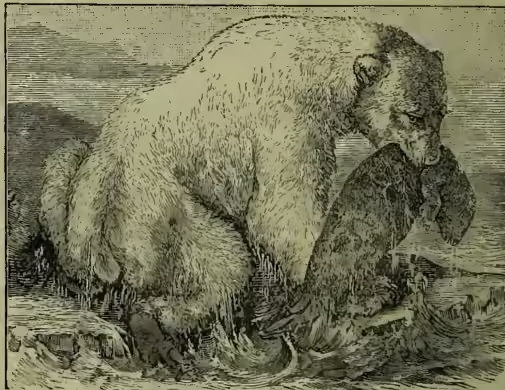
The grinding teeth are smaller and narrower than usual, and the soles of the feet more hairy. They feed principally on fish and seals, rarely attacking terrestrial quadrupeds, and not despising vegetable food in summer. They are the largest bears, often measuring 9 feet in length, and are proportionately strong. They move heavily, but not slowly over the ice, and are able to swim with much swiftness and endurance. They are more aquatic than any of the other species. Tales of polar explorations seem to show that the white bear is more aggressive towards man than any of the other species, and it is certainly the most carnivorous type. As food is abundant in winter, the males at least do not seem to hibernate. The she-bears, however, find sheltered nooks in the autumn, and bear one to three cubs in midwinter. The dwellers in the far north are fond of hunting the polar bear, and use the flesh for food, the fat for burning and curative purposes, the sinews as twine, and the skin for clothing. The genus Ailuropus is of some importance as a connecting link between the bears proper and other carnivores like the Panda (q.v.). See CARNIVORA.