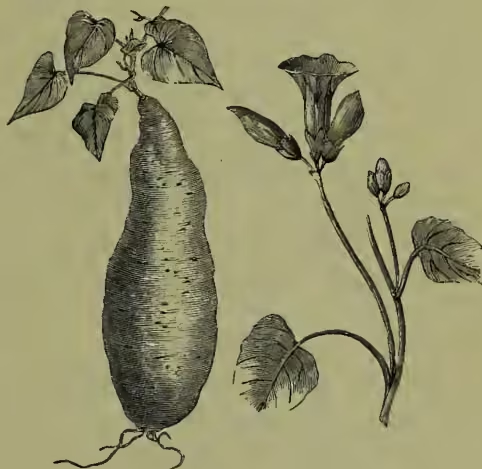
Sweet Potato (Batatas), a genus of plants belonging to the natural order Convolvulaceæ. B. edulis, the true sweet potato, is a twining or climbing plant, with stems 5 or 6 feet long trailing on the ground or clambering over neighbouring shrubs. The leaves are 5 or 6 inches long, heart-shaped at the base; the flowers pale purple, closely resembling those of the common convolvulus or bind-weed. Having been long cultivated in the tropical and subtropical countries of both hemispheres, the native country of the plant is a matter of conjecture. It appears to be first mentioned by Pigafetta, an author of the 16th century, who found the root much used by the Indians of Brazil as an article of food. It was introduced into Spain about 1519, and the roots were known in England some time before the introduction of the potato, with which they were often confounded by the earlier writers on the latter. English supplies in those times were obtained from Spain and the Canary Islands, and the roots, when steeped in wine or made into sweetmeats, were regarded as restorative of failing vigour. The plant is cultivated in India, China, Japan, the Malayan Archipelago, throughout tropical America, and in the southern United States, in southern Europe, the Canary Islands, Madeira, and North Africa. The roots grow to a great size—to as much as 50 lb. weight, according to some authorities, in Java, but the ordinary average is from 3 to 12 lb. In favourable conditions in the United States the yield per acre is from 200 to 300 bushels. The taste of the roots is sweetish and agreeable, and they are considered to be superior to the common potato in flesh-forming matters. B. jalapa, a species of Mexico, though purgative, is not the source of the true jalap of the pharmacopoeia, as its name implies, but is so called on account of its being very common in the vicinity of the Mexican town Jalapa. B. paniculata, which has a very wide geographic distribution, is commonly cultivated for food in western tropical Africa. From the seeds of another species of Batatas the textile material named Natal Cotton is obtained; it has some resemblance to the true cotton.