Swift, a genus (Cypselus) and family (Cypselidæ) of Picarian birds, resembling the swallows in general appearance and habits, but most closely allied by anatomical structure to the humming-birds. They may be distinguished by external characters from swallows thus: 'the swifts have ten primaries, not more than seven secondaries, and only ten tail-feathers, while the swallows have but nine primaries, at least nine secondaries, and twelve tail-feathers.' They have long pointed wings, a short tail, and possess remarkable powers of rapid and prolonged flight. The bill is short, depressed, and weak; the gape wide and fringed by bristles. The legs and toes are short and weak. In distribution the swifts are almost cosmopolitan, but are absent from New Zealand. Two groups are recognised, (a) the Micropodineæ, or true swifts, with the first toe directed more or less forwards, and a reduced number of phalanges in the third and fourth toes, and (b) the Chaeturineæ, with the first toe directed backwards and the normal number of phalanges in the third and fourth toes. The Common Swift (Cypselus apus) is common in almost all parts of the north of Europe and Asia in summer, retiring to tropical or subtropical regions in winter, extending its migrations to the extreme south of Africa. It occurs even in Lapland. Its residence in its summer quarters is much shorter than that of swallows; and it is worthy of notice that the swift is seldom to be seen along with any of the swallows or martins, the different kinds choosing different localities, even although very close together. The swift is easily recognised in its flight by the remarkably sickle-shaped wings, and its slight scream is very different from the twitter of the swallow. It is bronzed blackish brown, with a white throat; bill, toes, and claws black. It makes its nest in holes in rocks and walls, often in the thatch of houses, crevices in sea-cliffs, quarries, chalk-pits, and trees. The nest is formed of bits of straw, dry blades of grass and bents, feathers, and other such substances, which are apparently glued together by a viscid secretion. The eggs are two in number, and as a rule only one brood is hatched in a season. The swift, like the swallow, seems to return to the same place to nest year after year, and repairs the old nest instead of making a new one. Sometimes it robs martins, sparrows, and even starlings of their nests. Its chief food consists of insects, and the undigested remains are ejected in the form of pellets. The Alpine Swift, or White-bellied
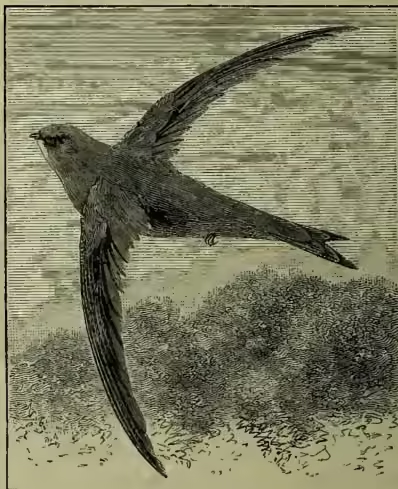
Swift (C. alpinus), is rarely seen in Britain, but is common in summer on all the high mountain-ranges of southern and central Europe. Eastwards it ranges through Asia Minor and Persia to many parts of India and Ceylon. It is supposed to breed in the extreme south of Africa, where it is common. It builds in high rocks, sometimes in steeples, notably in the cathedral at Bern. It is larger than the common swift, and has a louder note and flies more powerfully. The Needle-tailed Swift (Acanthylis caudacuta), an Asiatic species, has been twice found in England, each time in the month of July, but nowhere else in Europe. It is common during summer in south-eastern Siberia, Mongolia, Japan, China, and Tibet; while in winter it migrates as far south as to Eastern Australia and Tasmania. The American Swift (Chaetura pelagica) has the hind-toe directed backwards, and the tail-feathers stiff and pointed, as in woodpeckers. It is a small bird, not above 4½ inches in entire length, but one foot in extent of wing. The general colour is brownish black, with greenish reflections, the throat grayish white, the under parts grayish brown. The nest is made of small dry twigs, which the bird breaks off from the tree, and carries away in its feet; and they are attached by means of a viscid secretion to the rock, wall, or hollow tree where the nest is made. From its frequently building in chimneys this species is known as the Chimney-swift in North America, where it is a regular migrant in many parts, wintering in Mexico. Great numbers often build together, sometimes choosing for this purpose an unused chimney in a town. The Swiftlets, genus Collocalia, found from India to the Malay Archipelago and in many of the Polynesian islands, one species even in Madagascar, are the builders of Edible Nests (q.v.). They breed in deep caves and fix their gelatinous-looking nests, made of mucous unmixed with any vegetable product, to the walls. The nest of one of the true swifts (Panyptila sancti-hieronymi) discovered in
Guatemala is perhaps still more remarkable, being composed entirely of the seeds of a plant secured together and hung from the under surface of an overhanging rock by the saliva of the bird. 'The whole forms a tube 2 feet 2 inches long by about 6 inches in diameter. The entrance is through the lower end of the tube, and the eggs are placed on a shelf at the top. About the middle of the tube, on the external side, is a protruding eave as if overaulting an entrance; but there is no hole, and it has the appearance as if it was placed there on purpose in order to receive some enemy, such as a snake or lizard,' especially during the period of incubation. The Palm Swift of Jamaica (Micropus phoenicobia) is also a remarkable nest-builder, attaching its nest of feathers and silk-cotton, felted together, to the surface of a spathe or of a leaf by means of its salivary secretion.