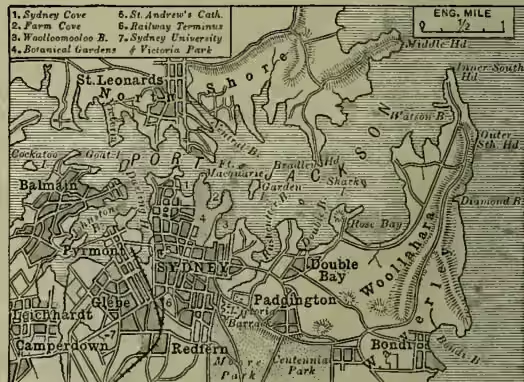
Sydney, the capital of New South Wales, and the oldest city in Australia, is situated on the southern shores of Port Jackson, and was named after Thomas Townshend, first Viscount Sydney (1733-1800), who was then Secretary of State for the Colonies. The first party of British settlers that reached New Holland were landed at Botany Bay (q.v.) on January 20, 1788. The spot which they here selected being found ineligible, it was abandoned a few days afterwards, and the infant settlement was transferred to a point about 7 miles farther to the north, the place where Sydney now stands. The choice of the new locality was chiefly determined by the circumstance of a stream of fresh water being found there, flowing into the deep inlet known as Sydney Cove, one of the numberless bays into which the basin of Port Jackson is divided. This last-mentioned magnificent expanse of water, completely landlocked, and admitting vessels of the largest size, extends for some 20 miles inland, ramifying in every direction. Its bold and rocky shores, covered with luxuriant vegetation, present a succession of picturesque and beautiful landscapes. The hills which form the general outline of the harbour often rise to a height of from 200 to 250 feet. In other points the coast presents a lower level, consisting of a series of terraces and smooth sandy beaches. Perhaps there are few positions on the habitable globe more obviously suitable for the foundation of a great metropolis than are the shores of Sydney Harbour. The narrow entrance of Port Jackson—through the 'Heads,' which are indicated by the Macquarie lighthouse, its electric light visible 30 miles at sea—might easily be made inaccessible to any hostile fleet; whilst the central position of Sydney makes it necessarily an emporium for many of the British dependencies in the southern hemisphere. The immense coal formation of East Australia extends north and south for some 500 miles, with a breadth of from 80 to 100 miles. Sydney stands nearly in the centre of this great carboniferous basin; and at various points within a radius of from 30 to 100 miles large quantities of coal are raised for colonial consumption as well as for export. The sandstone rock upon which the city is erected affords a valuable material for building.
Since the abolition of transportation the growth of Sydney has been rapid, the pop. in 1862 amounting to 93,596, in 1881 to 220,427, and in 1891 to 386,400. For many years Sydney enjoyed a monopoly of the commerce of these antipodean regions, but its trade has now become largely shared by Melbourne, Adelaide, Brisbane, and other colonial ports. It must, however, continue the principal outlet for the productions and commerce of extensive pastoral and mineral districts on the north-west, west, and south-west. The city, which has rapidly increased of late years, extends several miles inland from the waters of Port Jackson, the whole of the water frontages from Fort Macquarie, 8 miles from the 'Heads,' to the head of Darling Harbour, a distance of several miles, being occupied for wharfage purposes, those at Circular Quay being used by the vessels of the P. and O., Orient, and other large ocean steamship companies. In 1895, 1307 vessels, with an aggregate tonnage of 1,669,654 tons, cleared the port of Sydney.
The streets in the older parts of the town are narrow and irregular; in the newer portions care has been taken to avoid these defects; and several of the modern streets, from their breadth and the size and style of the buildings, are not behind those of the principal towns of Europe. The shops, warehouses, and private buildings in the leading streets present long and compact lines of well-built stone edifices, often assuming a very ornate and ambitious style of architecture. The chief thoroughfares are paved, and lighted with gas, several with the electric light, and a system of underground drainage has been carried out at a cost of nearly half a million sterling. There is also an abundant supply of pure water, considerably in excess of present requirements, obtained from the Nepean River, near Penrith, several miles from Sydney. There are numerous parks near the city. The Botanical Gardens, the finest in the colonies, cover 38 acres. Sydney has one shipbuilding establishment. The Fitzroy Dry Dock, originally intended for vessels of the Royal Navy, can take in vessels of the largest size, and has been supplemented by one of the most extensive graving-docks in existence. Steps have been taken to put the city in a state of defence, and forts and batteries armed with powerful Armstrong guns have been erected. Sydney is a first-class, naval station and the headquarters of the Australasian fleet.
Amongst public buildings by far the most important edifice, not only in Sydney but in the whole of the Australian colonies, is the university (1852), which stands on a commanding height, and in the centre of a domain of about 150 acres. The principal façade is 500 feet in length, and is flanked at its western end by the Great Hall, the proportions of which are such that, were it in England, it would rank as the third in point of size. There are three affiliated colleges—Church of England, Roman Catholic, and Presbyterian, besides the Women's College. The university, erected out of public funds, has a subsidy of about £12,000 a year from the state; and each of the affiliated colleges receives aid towards the stipends of the warden and rector. Recently the university funds have become considerably augmented by munificent bequests, which have enabled the work of university education to become considerably extended. It is open to both sexes, and is empowered to confer degrees in arts, law, and medicine; but, so far as the university is concerned, instruction is limited to purely secular teaching. The metropolitan cathedral of St Andrew is a handsome building in the later Perpendicular style of architecture. The Roman Catholic cathedral of St Mary, burnt in 1865, and since rebuilt, is one of the finest ecclesiastical structures in Australia. Many of the city and suburban churches, upwards of 120 in number, are tastefully designed. There are numerous elementary, advanced, and technical schools, and a technical university and technological museum. Amongst the buildings devoted to secular purposes the most imposing and effective, in point of size and architectural design, are the museum, Colonial Secretary's office, lands office, post-office, customs office, town-hall (possessing the largest organ in the world), and public grammar-school. The neighbourhood of Sydney, especially the shores of the numerous bays and the Parramatta and Lane Cove rivers, is studded with elegant villas and snug cottages, surrounded by their park-like grounds, and gardens of orange-trees, bananas, and numberless semi-tropical plants. There are numerous industrial establishments, several on a most extensive scale, but Sydney is essentially a commercial rather than a manufacturing city. Sydney has several theatres, a free library, art-gallery, museum, hospitals, mechanics' institutes, and asylums. Here in January 1901 were held the ceremonies accompanying the inauguration of the Australian Commonwealth. (See AUSTRALIA, NEW SOUTH WALES.)