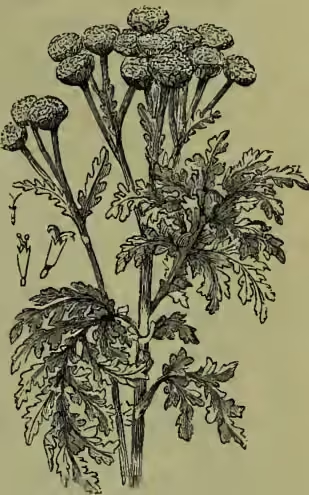
Tansy (Tanacetum), a genus of plants of the natural order Compositæ, sub-order Corymbifere, allied to Artemisia (see WORMWOOD), and having hemispherical heads of flowers, with the florets all tubular, the receptacle naked, the pappus a slight membranous border. The species are pretty numerous, and are natives of the temperate parts of the Old World. Common Tansy (T. vulgare) is a native of Britain and of continental Europe, growing in fields and by roadsides, river-banks, &c. It has long been generally cultivated in gardens. It is now naturalised in many parts of North America. It is a perennial, from 2 to 4 feet high, with great abundance of deep-green, bipinnatifid, inciso-serrate leaves; the flowers in terminal corymbs, yellow, and rather small. The leaves and flowers have a strong aromatic smell and a bitter taste. The young leaves are used for flavouring puddings, cakes, omelets, &c. The plant is also tonic and anthelmintic, and Tansy tea is an old popular medicine. Some curious old customs still linger in many parts of England connected with the use of Tansy cakes and Tansy puddings at Easter, which was originally intended to represent the use of bitter herbs at the Paschal feast.