Tapeworms, a term sometimes used as a popular synonym for Cestoda or Cestoid Worms (q.v.), but especially for those which belong to the families Tæniadæ and Bothrioccephalidæ. In his diagnosis of the Tæniadæ Professor Leuckart notes the following points. The small pear-shaped or spherical 'head' bears, at some distance from the apex, four roundish suckers with powerful musculature. Between these there is usually, near the apex, a simple or manifold circle of claw-like hooks, which are supported and moved by a muscular rostellum. The 'joints' or proglottides are distinctly separated from one another, are usually longer than broad, are almost always provided with marginal generative apertures, and vary in number from three to three or four thousand. These joints are liberated from the host with great regularity, but somewhat late, after the embryos are well developed. The uterus has no direct communication with the exterior, so that the eggs remain inside the proglottides, and are only set free when these are destroyed.
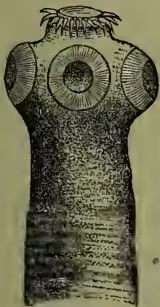
The adult sexual Tæniadæ live for the most part in birds and mammals, the larval 'Bladder-worms' (q.v.) or Cysticerci occur in both higher and lower animals. In this family most zoologists recognise only one genus, Tænia, but there are so many species that Leuckart finds it convenient to recognise several subgenera.
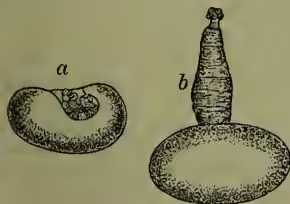
In the Bothrioccephalidæ the head is oval and flattened; the two suckers, devoid of special musculature, lie opposite one another longitudinally; the hooks, if present at all (Trienophorus), are without a rostellum; the 'joints' are indistinctly separate, always broader than long, and detached in numbers; the uterus has a ventral opening through which the embryos escape; these embryos are usually ciliated and able to swim about in water; the development is more direct than in Tæniadæ, for a true bladder-worm stage seems always wanting. The family includes a few genera—e.g. Archigetes, Ligula, Trienophorus, but the most important practically is Bothrioccephalus.
Two Tæniadæ are in their adult sexual state parasitic in man: Tænia solium, with the bladder-worm stage in the pig; T. saginata or mediocancellata, with bladder-worm in the ox; and some others, T. cucumerina, T. nana, T. flavomaculata, and T. madagascariensis, occasionally occur. They infest the small intestine, and there also Bothrioccephalus latus (larval in pike and burbot) may be found. Moreover Tænioid bladder-worms also occur in man, the most important being that of Tænia echinococcus, which lives as an adult tapeworm in the dog.
In the majority of cases man becomes infected with tapeworms through eating the raw or imperfectly cooked flesh of the animal—be it ox or pig or fish—which is the host of the immature stage of the parasite. In other cases filthy habits of living and eating render it readily possible for the bladder-worms—or, in the case of T. echinococcus, the ova—to get mixed up with the food. The presence of tapeworm in the small intestine need not be dangerous—indeed, the Abyssinians regard freedom from the parasite as a disaster; but it is usually troublesome, giving rise to disturbances of digestion, colic-like pains, diarrhoea, or, on the contrary, constipation, besides less local effects, such as anaemic and neurotic states. No certain diagnosis is possible, 'unless the eggs or proglottides of the corpus delicti be observed, and these must always be identified before so radical a cure as treatment with anthelmintics is begun.' Of these anthelmintics—which are intended to expel the parasite from the intestine—there is no lack in the pharmacopœia. But, as Leuckart insists with evident reasonableness, prevention is better than cure.
See Leuckart, The Parasites of Man, trans. by Hoyle (1886); and, for tapeworm in dogs, WORMS.