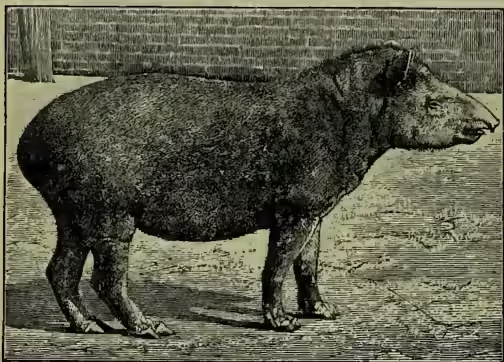
Tapir (Tapirus), a genus of Ungulata, of the section Perissodactyla, having a bulky form, with moderately long legs; the fore-feet four-toed, the hind-feet three-toed; the skin thick, the hair short; the tail very small; the neck thick; the ears short; the eyes small; the muzzle elongated; the nose prolonged into a short, flexible proboscis, which, however, does not terminate in an organ of touch and prehension, like that of the elephant; six incisors, two canine teeth, and fourteen molars in each jaw, the molars separated from the canine teeth by a wide interval. There are certainly four species, of which three are American and one Oriental. The best known is the American Tapir (T. terrestris), which is about the size of a small ass, and is common in almost all parts of South America, its range extending as far south as the Strait of Magellan, although it suddenly ceases to be found at the Isthmus of Panamá. Its colour is a uniform deep brown, but the young are—as in many other animals (e.g. the Puma) which when adult are of all one colour—marked with yellowish fawn-coloured stripes and spots. The skin of the neck forms a thick rounded crest on the nape, with a short mane of stiff hair. The tapir inhabits deep recesses of the forest, and delights in plunging and swimming in water. It feeds chiefly on young shoots of trees, fruits, and other vegetable substances, but is ready to swallow almost anything that comes in its way. Pieces of wood, clay, and pebbles are often found in its stomach. It sometimes commits great ravages in cultivated grounds; a large herd of tapirs sallying forth from the forest by night, trampling and devouring all that they find in the fields. The tapir is a very powerful animal, and, protected by its thick hide, forces its way through the forest where almost no other quadruped can. When assailed by the jaguar it seeks to get rid of him by rushing through thick underwood, and if it can reach water is often successful by plunging in and diving. It is inoffensive, never attacking man, but when hard pressed by dogs makes a violent resistance, and inflicts severe bites. It is very easily tamed, and becomes extremely familiar; but its large size makes it a troublesome pet. Its hide is useful, and its flesh is eaten, although rather dry. The other two American species—viz. T. bairdi and T. doui—are generally regarded as generically distinct from the rest, and have been termed Elastomognathus. The Malayan Tapir (T. indicus) is found in Malacca, Sumatra, &c. It is larger than the American tapir, and its proboscis is rather longer in proportion. The neck has no mane. The colour is glossy black, except the back, rump, and sides of the belly, which are white. The colours do not pass gradually one into another, but the line of separation is marked, giving the animal a very peculiar appearance. The habits of this species are very similar to those of the American tapir, and it is equally capable of domestication. The young are striped and spotted as in that species.
The remains of tapirs have been found in Miocene and subsequent strata. In all about twelve species have been determined. Tapir-like animals are common in Eocene beds. Lophiodon appears to have been the precursor of the tapirs during the Eocene period. True tapirs are found in beds of an earlier age (Miocene) in Europe than in America (Post-Pliocene). Hence it has been argued that the tapir is an Old-World form which migrated to the New World, and ultimately established itself there upon a firmer footing.