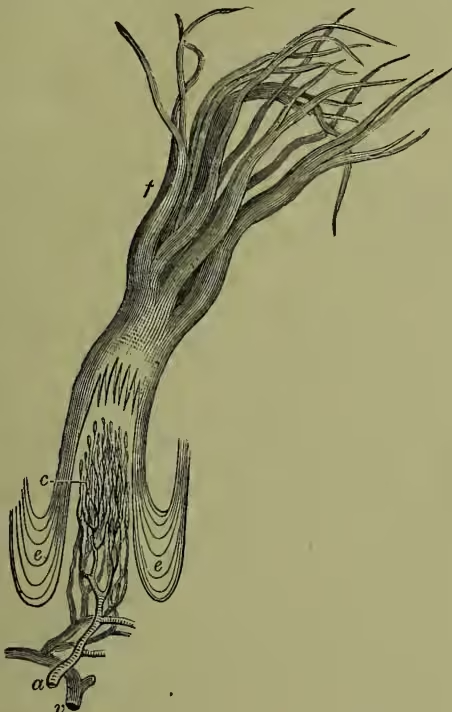
A Filiform Compound Papilla, magnified 300 diameters: a, artery; v, vein; c, capillary loop; e, epithelium; f, hair-like processes at the apex.
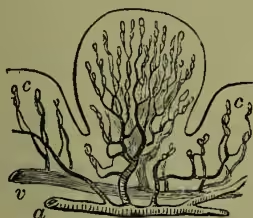
Taste, one of the special senses (see SENSATION). The parts of the mouth affected by sapid substances are the surface and sides of the tongue, the roof of the mouth, and the entrance to the pharynx. The mucous membrane is invested by stratified squamous epithelium, which, over the surface of the tongue, covers little vascular projections termed papillæ. One can see the papillæ of the sides and upper part of the tongue with the naked eye, as little sharp or rounded projections; the latter, thickly clustered at the tip and sides, may appear, if the system is out of order, as little red points like those of a strawberry. In the cat tribe the papillæ are hard and curved backwards into the mouth, so that the animal can use the tongue as a scraper to remove the flesh from the bones of its prey. The pointed papillæ are termed 'filiform,' and one is repre- sented in fig. 1, while a rounded papilla is seen in fig. 2. They are essentially the same in structure, differing alone in shape and size, and, were the figures drawn to some common scale, fig. 2 would have to be three or four times as big as it is. At the back of the tongue are some eight or ten papillæ of quite a different nature, called 'circumvallate.' They are arranged to form a V with its angle pointing backwards. These are hardly papillæ at all, but may be looked upon rather as tiny patches of mucous membrane
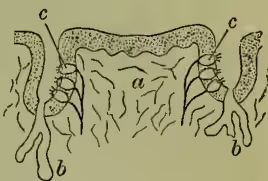
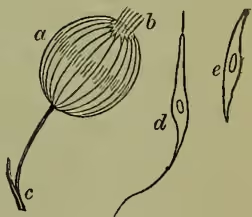
The taste-bulbs open each by a little pore into the trench, and into the deeper part a nerve enters in the way represented in fig. 3. The cask is probably for the protection of the sensory cells which it contains, and one of which is drawn in d, fig. 4. These cells are much elongated, and end each in a tiny bristle which projects with those of their companion cells from the little pore into the trench, and is here moistened by the juice of Ebner's gland and whatever sapid substance may be present. The impressions which these sensory cells receive from the bristles, say by the action of a litter like 'hops,' is carried by the delicate nerve which starts
While it is almost certain that these taste-bulbs are organs of taste, it is not equally certain that other parts are not involved. The reason for this belief is that in the front and sides of the tongue these taste-bulbs are few in number, while in these regions taste sensations are pretty acute. It is therefore not improbable that the nerves which abundantly pass into the epithelium of the tongue end in other ways, but unfortunately we are at present much in the dark concerning their exact method of termination. It is to be noted that the protective layer of the mucous membrane is thin, and might conceivably be permeated readily by the juices of the mouth, which would reach the lower cells into which some of the nerves certainly pass. From the mucous membrane of the mouth the impressions produced by sapid substances are carried probably by fibres belonging to the fifth nerve. These fibres, although they belong to this nerve, are found to run in the greater part of their course in other nerve trunks—viz. the glossopharyngeal, to the back of the mouth and tongue, and the chorda tympani to the front of the tongue.
Having sketched the mechanism concerned in the production of taste sensations, we can now turn to the discussion of the many interesting facts which may be observed when this mechanism is called into play. In the first place, it may be remarked that substances capable of dissolving in the juices of the mouth are alone tasted. Marble, wood, flint, are devoid of taste, and so is pure starch; these are all of them quite insoluble in water. By the aid of various means we can convert the last-named substance into a very soluble 'dextrine,' yet this is tasteless. Another chemical product of the starch is a soluble substance termed 'dextrose,' which has a sweet taste and is commonly termed 'grape-sugar.' These examples will serve to illustrate the general fact that substances to be tasted must be in solution, though not all soluble substances are capable of giving rise to this sensation. It is a matter of general experience that, if a substance like sugar be simply placed in the mouth and allowed to dissolve, its taste is only faintly evident. If, however, the juices of the mouth, sweetened by the sugar, be rubbed into the mucous membrane by moving the tongue against the palate, the sensation is greatly intensified. One invariably 'smacks the lips' in trying to appreciate the qualities of a taste, and obtains in this way its maximum effect.
A fact that is hardly known by the laity is that most of the so-called tastes are really 'smells.' Sugar, salt, quinine, and some acids are devoid of smell; we could not distinguish them except by the tongue itself, and we have in these the prime taste sensations of sweet, salt, bitter, and acid. Meat, wines, and fruit are smelt, not tasted, and a bad cold dulls our appreciation of these articles of diet. To the prime taste sensations already mentioned may be added perhaps alkaline, astringent, and metallic tastes, but when all is told this organ yields us rough results when compared with smell, sight, or hearing, whereby hundreds and thousands of shades of quality are readily perceived in the odour of flowers, the lights from coloured objects, and the sounds from an orchestra. The various taste sensations are not equally produced on stimulating the whole of the gustatory area, and indeed each taste seems to have some special locality at which it is most acutely felt. If we take a piece of quassia or a hop-leaf and chew it, we shall at first be unconscious of taste, and it is only when the juice of the mouth laden with these bitter principles passes to the back of the mouth that the taste is felt at all. This is why we drink beer in the draught, and do not sip it like wine. The sweet or acid wine is tasted best by the front part of the tongue, while the bitter beer is only appreciated as it is going down the throat. As in the other senses, anything that stimulates the gustatory nerve gives rise to a sensation; and although sapid particles effect this best of all, electrical or even mechanical stimuli have some effect. If we place a piece of zinc and copper on the tongue, and join them so as to give rise to a feeble current, or still better, if a slight interrupted electrical current be passed through the mucous membrane of the tongue, metallic saline tastes are produced. These are possibly due to electrolytic changes and not to direct stimulation, though this is less likely to be the case with the induced currents, equally powerful in the production of sensation. It is often stated that a sharp tap on the tongue produces a sweet or saline taste; this is, however, an experiment which often fails. If we rub the back and side of the tongue with the finger tip we shall hardly fail to notice a bitter taste, and it is probable that we shall question the cleanliness of the finger used. A scrupulously cleaned glass rod gives rise, however, in equal measure to the same sensation, and we are forced to conclude that the mechanical stimulus of the rod calls forth that taste which has its seat in the back of the mouth and tongue.
Our knowledge of what really takes place when an external agency affects the senses, sets up a nerve-motion which travels to the brain and there induces a sensation, is very limited. Perhaps in the case of hearing our knowledge is most precise, and there are grounds for believing that the sound-waves mechanically set in motion appropriate structures within the ear, just as a note sung before the piano will cause certain of its strings to vibrate. The light affects the eye in a manner at which we are at present only guessing; but it can be said that our different colour sensations depend upon the stimulation of the retina by ether vibrations of different pitch and complexity. In this respect then sight and hearing are both alike, and we have outside the body media capable of vibrating at different periods, and the kind of vibration determines the kind of sensation produced. As to taste and smell, until lately nothing whatever was known which would explain in any rational way their production. When Newlands, Lothar Meyer, and Mendeleëff discovered what is termed the Periodic Law in chemistry, it occurred to the author of this article to see if this law holds good for taste and smell; this was found to be the case (see Proceedings of the Royal Society of Edinburgh, 1885-86; and Brain, 1886). Newlands found that if we arrange the elements in a series, beginning with that one which has the lowest and passing to that which has the highest atomic weight, a periodic recurrence of function or property is found. There is a general resemblance in physical properties between the first, eighth, fifteenth, &c., and between the second, ninth, sixteenth, &c. Those elements picked out of the series from their resemblance and periodic recurrence Mendeleëff arranged in groups (see ATOMIC THEORY), and the author found that similar compounds of these elements have similar tastes. To take an example (group 1), the chlorides of lithium, sodium, potassium, rubidium, caesium are all salt, while the sulphates of these elements are all saline bitters. It is evident that this group of elements, similar in their physical properties, can also produce similar tastes, and we can correlate taste a physiological effect with some common physical quality.
Carnelly has shown that salts of elements belonging to the same group, if coloured, have colours which are related in this respect, that as we ascend the group the colour always approaches more and more to the red end of the spectrum. This, as it is unnecessary to point out, indicates molecular vibration of similar and related pitch, and in this case, alike in taste, smell, hearing, and sight, we have this common fact, that the stimulus is vibratory, and associated with the kind of this vibration is the quality or kind of sensation produced. Another very curious point is that, as in the case of hearing and smell, both very high and very low vibrations are unfelt. Bodies like albumen and starch are devoid of taste, even when converted into very soluble peptone and dextrine. When these molecules are broken up, then sapid substances may be produced such as sugar. Substances such as water and watery solutions of gases, like high-pitched notes or the ultra-violet rays of the spectrum, are incapable of producing sensations, and sulphuretted hydrogen on the border-land has a faint acid taste. Like smell, the sense of taste is placed at the entrance of the alimentary canal, and affords us knowledge of the nature of the food about to be eaten. We have so far adapted ourselves to our environments that, as a rule, those substances which please these senses are salutary foods, and the converse is equally true. This is, however, a rule with many exceptions, and it is perhaps one of the most anxious parts of a child's training, that of teaching by the eye those natural products which are injurious or even of a poisonous nature.