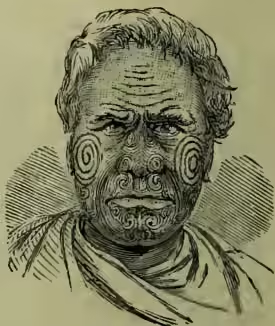
Tattooing, the custom of marking the skin with figures of various kinds by means of slight incisions or punctures and a colouring matter. The word itself is Talitian (ta, 'a mark'), but the practice is very widely spread, being universal in the South Sea Islands, and also found among the North and South American Indians, the Dyaks, the Burmese, Chinese, and Japanese, and common enough still among civilised sailors. The absence upon the claimant of tattooed marks known to have been upon the body of Roger Tichborne was a point of much importance in the famous Tichborne trial. It is expressly forbidden in Scripture (Lev. xix. 28), from which we may conclude it was common amongst the neighbouring nations. Undoubtedly the main cause of its origin was the desire to attract the admiration of the opposite sex, but this fundamental human desire does not of course exclude motives for tattooing for religious or other ceremonial purposes, or for mere ornament apart from sexual considerations. Among the Polynesians the operation is attended with circumstances of ceremony, and the figures represented are often religious in signification or symbolic of rank, not seldom the totem or special tribal badge. The New Zealanders were distinguished by elaborate tattooing of the face, and many of their heads are preserved in European museums. As it was formerly a common custom for shipmasters to purchase these on visiting New Zealand there is little doubt that the demand stimulated the supply. Dr Wuttke labours to prove that tattooing is a kind of writing, but, whatever may be the case elsewhere, its origin in Japan, where it reached its greatest perfection, is neither ceremonial nor symbolical, but merely cosmetic. Its end is to take the part of a garment or decoration, those parts of the body only being tattooed which are usually covered, and only in the cases of such workmen as runners, groomers, bearers, who work in a half-nude state. Still further, this is found only in large and civilised towns where nudity might have been objectionable. It was a substitute for clothing, but now that clothing is compulsory in Japan it has lost its meaning, and may be expected to disappear. Dr Baelz, writing in 1885, estimated that a few years before there were in Tokio alone as many as 30,000 men who were tattooed. The head, neck, hands, and feet are never tattooed, and it is found among the lower classes alone, and very seldom amongst women, and these only the dissolute. The usual objects illustrated are large dragons, lions, battle scenes, beautiful women, historical incidents, flowers—never obscene pictures. The colours employed are black, which appears blue, derived from Indian ink, and various shades of red, derived from cinnabar. The artist uses in his work exceedingly fine sharp sewing-needles, fixed firmly four, eight, twelve, twenty, or forty together, and arranged in rows in a piece of wood. The points are quite even, except when it is desired to produce a light or dark shading. A skilful artist can cover the whole back or breast and belly of a grown man in a day, and that with excellent pictures with various degrees of shading. These punctures are not very painful, and as soon as the operation is over the patient is bathed with hot water, which brings out the colour more clearly. Among the Ainos again the tattooing is done on the exposed parts of the body, and largely practised by women. The Igorotos in the mountainous region above Luzon tattoo elaborately, but in series of lines and curves. They ornament the hands, arms, breast, and part of the legs, the back only in one tribe, and a favourite form is a picture of the sun as a number of concentric circles on the back of the hand. According to the Archduke Joseph of Austria, tattooing is unknown amongst the Gypsies, but this is questioned by Bataillard and MacRitchie.
Many savages paint their skins as a means of protection against cold, or against the sun's heat or the bites of insects; others again attempt thus to make their aspect more terrible in war, as Cæsar tells us did the ancient Britons. Tattooing has often been employed as a badge of brotherhood in some cause, and more often still as a means of identification for slaves and criminals. The so-called branding of the letters D. and B.C. on military deserters and incorrigible characters, only given up in 1879, was merely tattooing with needles and Indian ink. Among the relics of the ancient cave-men of Europe are hollowed stones in which were ground the ochre and other colours for painting themselves. The war-paint of the ancient Briton and Red Indian braves still survives in the paint-striped face of the circus-clown; and the rouge of the faded London beauty is merely the civilised equivalent of the Maori women's tattooing round the mouth, or the beautiful flower-patterns on the backs and bellies of the Formosans. Amongst the lower-class criminal population in Europe the practice of tattooing is still common, but almost exclusively amongst males, more than twenty designs being sometimes found on the same individual—transfixed hearts, swords, serpents, flowers, initials, a woman's figure, and occasionally obscenities. Among 800 convicted French soldiers Lacassagne found 40 per cent. tattooed, many with inscriptions which gave an index to the criminal's attitude to the world.
See Wuttke, Die Entstehung der Schrift (1872); Lacassagne, Les Tatouages (Paris, 1881); Baelz, in Mittheilungen der deutschen Ges. für Völkerkunde (1885); W. Joest, Tätowiren (Berlin, 1887); and General Robley, Moko or Maori Tattooing (180 illustrations, 1896).