Tea (Camellia theifera, Griff.) is a plant of the genus Camellia (q.v.), natural order Ternstrœmiaceæ, of which there are two well-known varieties: (1) C. theifera, var. assamica, or Assam tea; and (2) C. theifera, var. sincensis, or China tea. There is no evidence that tea is wild in any part of China. The only part of the world where tea is really known to grow wild is in the forests of
Assam. The Assam variety, known as 'indigenous' tea, is a tree of vigorous growth attaining a height of 30 to 40 feet, with a leaf from 8 to 10 inches in length. The China variety is a comparatively stunted shrub, though hardier, growing to a height of 12 to 15 feet, with a rounder leaf about inches in length, and calyx covered with soft short hairs. These two varieties have resulted in a hybrid which combines the hardy character of the China with the other features of the indigenous, now largely cultivated on the hills of India and Ceylon, and known as 'hybrid-Assam.' At low elevations where the climate is tropical the indigenous, or a hybrid nearly approaching it, is preferred. It is probable that the Chinese variety is the indigenous, changed by climate and cultivation. The hybrids vary much in productiveness, and the planter is careful in selecting a good strain, which grows and foliates freely without seeding. The branches are smooth.
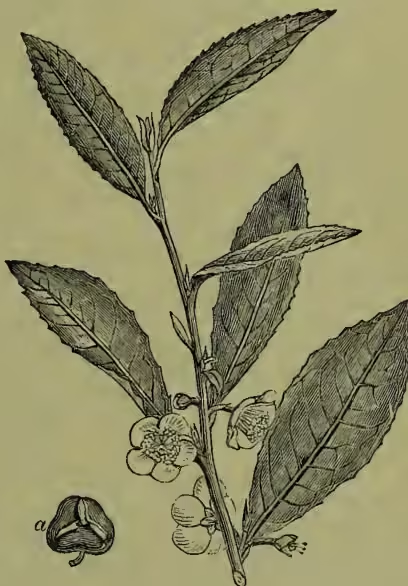
The leaves are serrated and have a bright shining surface, are rather thin, but often tough and leathery. The flowers are often handsome, usually white, and are about in. in diameter; sometimes solitary, sometimes clustered in masses; they have very short flower-stalks or no stalks at all. The fruit is rather short, of a leathery or woody consistency; dry, not fleshy. Inside it is divided into three to five three-celled chambers. Linnaeus gave the name Thea sinensis to the Chinese variety of the tea-plant, but afterwards made two species, T. bohea and T. viridis, under the impression that black and green tea were the products of different plants. Mr Fortune was the first to show that both kinds of tea were made from the same shrub. The Chinese name for tea is tcha, in the Fuh-kien dialect té or teh.
The tea-plant will flourish in all parts of the tropical and subtropical zones where the rainfall is over 60 inches and evenly distributed throughout the year. In Ceylon (lat. N.) it grows from sea-level to an altitude of 7000 feet. At a low elevation the growth of the plant is more rapid, but in time the high-grown tea seems to produce as much leaf as the average of low-country estates, while the tea is of more delicate flavour, though inferior in strength. At Darjeeling ( lat.) it grows at 7000 feet above sea-level. In China and Japan it is cultivated to the 40th degree lat. At Auckland, New Zealand ( lat.), it grows in the Domain gardens. At Natal ( lat.) it is regularly cultivated, and the tea is of good flavour and strength. One circumstance, however, rules the successful production of tea—the price of labour. Roughly speaking, it may be said to take the labour of one man a day to produce a pound of tea. In Ceylon the daily pay of a coolie man is 8d., children and women being paid from 4d. to 6d. Hence it is evident that no country where labour is dear can compete with countries like India, Ceylon, Java, and China, where labour is cheap.
The tea-plant is not particular as to soil, but it succeeds best on new forest-land containing plenty of humus. Belts of forest should be left for shelter in windy situations, and a reserve of forest for firewood and timber for chests is most important. If the machinery in the tea-factory can be driven by water-power a great economy is effected by saving fuel. As is the case with cacao, coffee, and other economic plants, tea grown on rich alluvial soil is stronger than tea grown on poorer land, though the latter is often of more delicate flavour. Tea-factories range in value from £200 to several thousand pounds; some are lighted by electric light. Tea-making goes on night and day in the busy seasons.
Cultivation.—The clearing is made by cutting the undergrowth with heavy socket-knives, after which the forest-trees are felled and the largest branches lopped; six weeks afterwards the wood is burned. In Ceylon this is done by contract for 20 rupees per acre. Tea is planted in rows from to 5 feet apart, with a similar distance between the plants; feet being a favourite distance, which gives 2722 plants to the acre. The tea-seed is soaked in water, and planted in shaded nursery beds; when the plants are about 4 inches high they are transplanted to the holes in wet weather during the monsoons. When plants are scarce the seed may be sown at stake in the holes, but nursery plants are generally preferred. The clearing is roaded and drained as soon as possible. On the rich deep soils of Assam manuring is not practised. In Ceylon the favourite manures are cattle-dung, castor-cake, bones, nitrogenous manures, and those which contain potash. When the plants have been in the ground about fifteen to eighteen months they are cut down to 10 or 12 inches; this makes them spread, and strengthens the growth of the branches. In about two months the more vigorous shoots are nipped back below the second leaf, thus taking off the terminal leaf-bud and first and second leaves, which makes the axillary bud at the base of the third leaf develop a fresh shoot. At first plucking is rather a matter of pruning than of gaining leaf, but as the trees become stronger the plucking becomes more regular and heavier. At about three years the bush is again cut down to some 15 inches flat across, so as to leave two joints of new wood above the last pruning. In subsequent prunings all bark-bound wood must be removed, along with whippy branches which do not 'flush' or develop fresh shoots. The plucking is done with the thumb-nail, and the leaf must on no account be torn off. Only the youngest and most tender leaves are plucked; and the younger the leaf, the finer the tea. The largest leaves used are never more than inches long. The estate must be plucked in regular rotation every ten days or a fortnight. When tea is flushing well a good coolie can bring in from 20 to 30 lb. of green leaf in a day.
In China the cultivation of tea is very different from the Indian and Ceylon system. There are no large gardens, the tea being grown in small fields and on hillsides. The leaf is plucked from the latter part of April to the end of October. The small farmer imports coolie labour for the purpose from the more populous districts. The grower does not manufacture the leaf himself, but sells it green in the local market at the nearest head village. The green leaf is bought by the agents of Chinese capitalists, who have hongs where they manufacture and pack the leaf. The finest pickings are described as first chop, the next as second chop, and so on. The hong-man ships the tea in boats, and sends it down the rivers uninsured. Before the tea is exported it has to pay the imperial Chinese customs export duty, which amounts to 14d. the pound; the lekin duty is nearly as heavy.
Chinese teas may be classified thus: Monings or black leaf teas are grown in the north of China, and shipped from Hankow and Shanghai. They come from the following districts: Ningchow (mostly bought for Russia), Kintuck, Keemun (shipped chiefly to England), Kutoan, Ichang, Oopack, Onam, Oonfa, Ly Ling, Cheong-sow-kai, Hohow, Siangtam. Green teas are shipped from Shanghai, and consist of Gunpowder, Imperial, Hyson, Young Hyson, and Twankay. Kaisows or Red-leaves are grown farther south, and are shipped from Foo Chow. The different kinds which take their names from the districts in which they are grown are Seumoo, Panyong, Paklum, Pakling, Padrae, Saryune, Sucey Kut. From Foo Chow are also shipped Souchongs, which are a distinct kind from Congous, and are principally drunk in Germany and Austria. Fancy teas, consisting of Oolongs, Flowery Pekoes, and Scented Orange Pekoes, are exported from Foo Chow. Canton exports Congous called New-makes, Scented Capers, and Scented Orange Pekoes.
The United States and Canada consume nearly all tea exported from Japan, the estimated supply in 1891 being 47,000,000 lb. The teas exported from Japan are of light character, mostly Oolongs and greens. The total quantity of tea imported into the United States was, in 1888-89, 79,575,984 lb., and in 1889-90, 83,886,829 lb.
Manufacture.—The first process is to spread the green leaf thinly on hessian trays in the withering house, where it is exposed to a free current of air—a very important operation, which takes from 12 to 48 hours. When the leaf is tough and flaccid, like an old kid glove, it is ready for rolling. Withering is assisted by fans which circulate currents of dry air. The old or Chinese system of rolling was to place the withered leaf on a table where it was rolled by hand to and from the coolie till the juice was expressed and the leaf well twisted; this took about 20 minutes to do. The Chinese accomplish this partly by the dirty process of treading. Now this process is performed by machinery, and in India and Ceylon tea is not manipulated after plucking. In Jackson's 'Excelsior' and 'Rapid' tea-rolling machines in general use in India and Ceylon the leaf is rolled between two superposed plates of hard wood or polished granite, actuated by cranks which give them a compound circular or eccentric motion. These machines are driven by steam or water power, but there is a smaller roller for hand power. Both the 'Excelsior' and 'Rapid' rollers are capable of taking a charge of from 240 to 300 lb. of withered leaf, they effect a great saving in labour, do the work far more thoroughly than by hand or foot pressure, and ensure perfect cleanliness. Some planters sift the rolled leaf through sieves with -inch meshes and re-roll the leaf which is too large to pass through. Considerable diversity of opinion exists as to whether tea should be rolled lightly or hard : the former gives a prettier tea with more of the golden 'tip ;' the latter gives a stronger liquor, and the tea keeps better. The rolled leaf is now ready for fermentation, an operation requiring close attention. It is placed in drawers or on tables and covered. The state of the weather hastens or retards the process ; in hot dry weather the leaf will be sufficiently fermented or oxidised in 20 minutes, in cold wet weather it may take hours. Whenever the leaf assumes a bright copper colour it must be fired ; over-fermentation is a fatal error. The difference between black and green teas is simply this : if the tea is fired immediately after rolling it is green tea, if it is fermented it becomes black tea. The old system of firing was to have iron gauze trays fitting over V-shaped chula furnaces about 30 inches high, and to dry the tea over charcoal fires. Now drying is done quicker and better by machines for the purpose, such as the 'Sirocco,' consisting of a stove portion and drying chamber, through which a powerful air-current passes ; and by this means the wet leaf is dried thoroughly in 6 to 8 minutes. Other machines are known as the 'Britannia' and the 'Desiccator.' Jackson's 'Victoria' and 'Britannia' driers are highly recommended, and Brown's desiccator is well spoken of in Ceylon. After firing the manufacture is complete, and the tea is what is known as 'unassorted,' which contains all the different grades into which tea is usually separated. In this state it is a most excellent tea for drinking, but it is customary to sort it into different grades before sending it to market. The old system of doing this was by using hand sieves of different sizes. The 'dust' was taken out by the finest sieve ; the 'broken pekoe' or finest and youngest leaf by the next ; the 'pekoe' by a sieve with wider meshes ; the 'pekoe souchong' by the next larger ; if 'souchong' is made a still larger meshed sieve is employed. Sorting by hand sieves is still done in small factories, but in large factories machinery is used. Jackson's 'Eureka combined tea sorting and cutting machine' is in general favour. Before the final packing the tea is taken from the bins in which it is kept and re-dried to expel any moisture which it may have absorbed from the atmosphere. It is then weighed into lead-lined chests, half-chests, or boxes, and soldered up, the name of the garden is stencilled on the packages, and it is ready for export. Chests usually contain 100 lb. of tea, half-chests from 45 to 50 lb., and boxes 20 lb. The 'brick tea' prepared at Hankow for overland exportation to Russia is made of tea-dust steamed and pressed into cakes, which occupy only one-sixth of the bulk of loose tea. A coarser kind, made of tea-leaves, stalks, and refuse of the tea-dust cakes, is sent to Mongolia, where for use it is boiled with mutton fat and butter. The Burmese eat pickled tea with fish, &c.
History.—De Candolle states that tea was known to the Chinese before 519 A.D. ; a Chinese legend says tea was introduced into China by Djarma, a native of India, about 500 A.D. Tea first became known to Europeans about the end of the 16th century. Small quantities were brought to England early in the 17th century, but it was not till about the year 1657 that it began to be used as a beverage, when Garraway opened a tea-house in Exchange Alley ; the price then was from £10 to £5 per lb. Pepys, writing on 28th September 1660, says : 'I did send for a cup of tee (a China drink) of which I had never drank before.' Two years later he writes : 'Home, and there find my wife making of tea, a drink which Mr Pelling the Pothicary tells her is good for her cold and defluxions.' In 1678 the English East India Company imported 4713 lb. ; in 1725 370,323 lb. were drunk in England ; in 1740 the prices ranged from 7s. to 24s. per lb. ; in 1775 the consumption was 5,648,000 lb. ; in 1801, 23,730,150 lb. In 1840-90 the consumption in the United Kingdom has been (1840) 32,000,000 lb., (1850) 51,000,000, (1860) 77,000,000, (1870) 110,666,390, (1880) 158,571,000, (1890) 194,008,000 ; and it has increased from 1-22 lb. per head in 1840 to 5-07 lb. in 1890. In 1840 the duty was 2s. 2½d. per lb. ; in 1858, 1s. 5d. per lb. ; in 1865, 6d. ; and in 1890, 4d. per lb.
About 1820 the plant was discovered wild in Assam, and was again noticed in 1823. The attention of the East India Company having been called to the expediency of introducing tea into India, a commission was sent to China in 1834 for this purpose. It was, however, recalled when Dr Griffith and Dr Wallish proved tea to be growing wild in Upper Assam between the Naga and Mishmee mountains on the upper part of the Brahmaputra River. The same year the Company commenced the industry at Kumaon with plants brought from China. In 1835 the first garden in Assam was opened at Luckimpore, from which a small quantity of tea was sent to England in 1838. In 1840 the Assam Tea Company was started, and in 1843 Indian tea offered for sale in London fetched from 2s. 6d. to 3s. per lb. The first garden of indigenous tea was planted by the Assam Company in 1840, and the value of the variety was gradually recognised ; though large quantities of China plants and seed were imported in 1848 and 1851. The industry in its early days passed through many vicissitudes, but the perseverance of those engaged in the cultivation was attended by success. There are now about 312,000 acres under tea cultivation in India, the leading districts being Assam, Cachar, Sylhet, Darjeeling, Dooars at the foot of the Darjeeling Hills, Dehra Dun, Kumaon, and Kangra, Chota Nagpore, Chittagong, the Neilgherry Hills, and Travancore. Export of tea from India (year ending 31st March 1886), 69,666,116 lb. ; (1887) 80,557,329 lb. ; (1888) 88,982,346 lb. ; (1889) 99,339,868 lb. ; (1890) 105,609,533 lb. ; (1891) 101,903,655 lb.
Tea was introduced into Ceylon in 1839. In 1867 Mr James Taylor opened the first clearing on Loolcondura for Messrs Keir, Dundas, & Co., but it was not till 1874-75 that the cultivation became common. On the failure of coffee from the 'leaf disease' fungus about 1881 and onwards there was a rush into tea, and the staple cultivation of the colony was changed. In 1867, 10 acres were under tea ; in 1877, 2720 acres ; in 1887, 170,000 acres ; in 1891, 223,000 acres. The exports were (1873) 23 lb. ; (1877) 2105 lb. ; (1880) 162,575 lb. ; (1884) 2,392,973 lb. ; (1888) 23,820,723 lb. ; (1889) 34,346,432 lb. ; (1890) 45,390,086 lb. ; (1891) 68,274,420 lb. As in Southern India, there is no winter in Ceylon and vegetation receives no check, hence tea is made more or less in every month of the year. The crop in Natal is about 300,000 to 400,000 lb., and is consumed in the colony, Free States, and Transvaal. The tea is of fair quality when made by experienced planters, having something the character of Ceylon. Java slips tea of taking appearance but often of weak liquor. In 1888-89 the export was 7,659,000 lb., and in 1889-90 7,056,000 lb. About 70,000 acres are planted. China teas were formerly much adulterated with foreign leaves, various mineral substances, sand, quartz, magnetic oxide of iron, soapstone, &c. These were cleverly made up so as to resemble the various kinds of tea with starch, and were known as 'lie tea.' Dr Hassall found from 8-32 to 24-94 per cent. of mineral matter in caper ; in siftings, 15-32 per cent. ; in gunpowder, 8-49 to 33-49 per cent. Infused tea-leaves, redried, were also commonly used. Thanks to the care taken in the laboratory at the London Custom
House, adulteration may be said to be a thing of the past to the English consumer, as the detected teas are not allowed to pass into use in Britain, though they may be again shipped abroad. Mineral matters are, however, still allowed for facing purposes to the extent of 2 per cent., the object of facing being to improve the appearance of inferior tea. The substances used are generally Prussian blue, indigo, soapstone, and plumbago. The capper tea much used in the midland counties is faced with plumbago. Spurious leaves are easily detected by macerating in hot water and examining under the microscope. Although, owing to the increasing cultivation of tea in India and Ceylon, the amount grown in China has decreased, it is still a most important industry. In 1885 the total amount of tea exported from China was 283,833,466 lb.; in 1897 it had fallen to 204,288,500 lb., of which 30,029,666 lb. went to the United Kingdom, 108,485,866 lb. to Russia, 27,718,366 lb. to the United States, 15,952,016 lb. to Hong-kong, 4,433,600 lb. to Australia, &c. In India in 1897 there were under tea-cultivation 423,932 acres, and the value of the tea exported to the United Kingdom alone amounted to £5,450,541. In Ceylon in the same year the acreage under tea was 404,574, and the value of its exports to the United Kingdom was £3,728,166, while in 1878 the total value of the Ceylon tea-crop was only £120.
While in 1864 all the tea imported into the United Kingdom (85,799,253 lb.) came from China, except 2,800,000 lb. from India, and Ceylon tea was unknown till 1880, in 1897, of a total of 231,399,778 lb. imported and entered for home consumption, 17,242,274 lb. only were from China. Of the remainder, 124,534,194 lb. were from India, and 85,493,534 lb. from Ceylon. It is satisfactory to know that markets for Indian and Ceylon tea are gradually being developed with Australia, Russia, North America, and other places. The largest consumers of tea are, in the order named, Great Britain, United States, Russia, Australian colonies, Canada, followed a long way behind by Holland, Germany, France, Austria-Hungary, and Denmark.
Chemistry.—As a beverage, the refreshing qualities of tea are well known. It exhilarates the system, dispelling fatigue and sleepiness, and stimulates the mental powers. These properties are generally believed to be due chiefly to the active principle theine, though the evidence on this point is not clear. We find tea in great favour with weak and old persons, also among the poor, who find that by using tea they consume less solid food. But if tea is used to excess it produces flatulent indigestion, increased pulsations of the heart, and nervousness; the imagination is excited, and sleeplessness follows. These conditions cause a certain degree of fatigue, which induces the patient to have recourse to tea again to brace up the system, as drunkards resort to spirits in the morning for a similar purpose. It is difficult to determine how much tea can be safely drunk daily, the effects on different constitutions being unlike. Johnston considered that 3-4 grains of theine may be taken daily without bad effects, but that double this quantity may be injurious. Dr Bennett (British Medical Journal, 1874) found theine was poisonous for cats and rabbits in doses of rather over one grain for every pound-weight of the animal. In medicine theine is used in cases of opium-poisoning, for nervous headaches, to relieve stupor in fevers, and as a sedative of the vascular system; it has also a considerable diuretic action. Theine can be obtained from the infusion of manufactured tea by crystallisation. It is odourless, white, and has a slightly bitter taste. It is generally considered to be identical with caffeine, though this has lately been questioned. It occurs very irregularly in tea, but is found to a greater degree in Indian and Ceylon than in China and Java teas, as is shown in analyses by Dr Paul and Mr Cownley (Pharmaceutical Journal, November 19, 1887, and July 26, 1890). From these analyses it appeared that the theine in different kinds of dry Ceylon tea varied from 4.89 to 2.57 per cent., in Indian tea from 4.89 to 3.86, and in Chinese tea it ranged from 3.78 to 2.42.
Tannin is an important constituent of tea, which gives the astringent properties to the infusion. It is generally admitted by chemists that tannin to a great extent regulates the commercial value of tea. Those teas which are rich in tannin give a stronger and darker liquor, and are consequently in greater demand. Tannin precipitates both albumen and peptone, and in this way doubtless hinders digestion. It also stops secretion from the mucous membrane, and so retards the pouring out of the digestive products; otherwise it probably has no effect, when given in small doses as in infusions of tea, on normal persons. When tea is allowed to stand five minutes before pouring off the infusion, which is the time allowed by tea-tasters, probably only one-fifth of the tannin is extracted. But when allowed to stew a long time, as is too often the case in poor households, a much larger percentage of tannin is extracted. Though Indian and Ceylon teas contain more tannin than China teas, it does not follow that the drinker of the former absorbs more tannin into his system than the drinker of the latter, as much less Indian tea is required to make a cup of tea. The percentage of gluten in tea is of little importance. Sometimes the results of analysis are stated for gluten and at other times for albumen, of which it is a form. Albumen (and gluten) is, however, rendered insoluble by boiling water, and so probably remains entirely in the tea leaves. If any were dissolved in the infusion it would probably become a food, like white of egg, fibrin, and other albumens. As yet chemistry throws but little light on the volatile oil contained in tea. Nor is it definitely known whether any of the ordinary effects of tea are due to it. It is possible that it may have something to do with the peculiar flavour of certain teas. The following plan of tea-making for household use is worth attention. Bring the water to the boil, but do not let it boil longer or the water hardens. Use a liberal quantity of tea, and pour over it as much water as you consider will make all the tea you require. Let it stand for three minutes and pour into a fresh (warmed) tea-pot. Five minutes is the longest time the water should remain on the tea.
See The Tea Cyclopædia (1881); Colonel E. Money, Cultivation and Manufacture of Tea (Lond. and Calcutta, 1878); Johnston's Chemistry of Common Life (new ed. 1879); the present writer's Subtropical Cultivations (1886); W. G. Stables, Tea, the Drink of Pleasure and Health (1883); Owen, Tea-planter's Manual (Colombo, 1886); A. M. and J. Ferguson's Tropical Agriculturist, Tea Culture and Preparation, Tea-plucking Illustrated (Colombo, various years); and Rutherford's Ceylon Tea-planter's Note-book (1889).