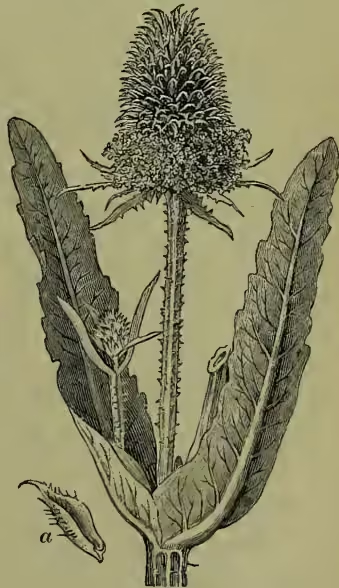
Teasel (Dipsacus), a genus of plants of the natural order Dipsaceæ. This order consists of herbaceous and half-shrubby exogenous plants, with south of Europe, naturalised in some parts of England. It is a biennial, several feet high, with sessile serrated leaves, the stem and leaves prickly; and with cylindrical heads of pale or white flowers, between which are oblong, acuminated, rigid bracts, hooked at the point. The heads are cut off when the plant is in flower, and are used in woollen factories, and by fullers and stocking-makers, for raising the nap on cloth. No mechanical contrivance has yet been found to equal teasel for this purpose, to which the hooked points, the rigidity, and the elasticity of the bracts are admirably adapted. The heads of teasel are fixed on the circumference of a wheel or cylinder, which is made to revolve against the surface of the cloth. Teasel is cultivated in many parts of Europe, and is imported into Britain, but is cultivated to some extent in England, particularly in Somersetshire and Yorkshire. The seed is sown in March, on well-prepared, strong, rich land, and the plants thinned out to a foot apart; in August of the second year the heads are ready to be cut. The flowers of teasel abound in honey, and the seeds are used for feeding poultry. The root was formerly in use as a diuretic and sudoric.