Temperature is the thermal condition of a body which determines the interchange of heat between it and other bodies. Our first ideas of temperature are derived from our sensations of hot and cold. As explained under Heat (q.v.), the effect of adding heat to a body is to make it hotter, unless it is at its melting or boiling point. This rise of temperature is accompanied by volume changes, on which all our practical methods of measuring temperature depend (see THERMOMETER). Now, although the idea of temperature is familiar enough, its true significance is difficult to understand. So-called thermometric measurements of temperature are not measurements in the strict scientific sense of the term. They are simply the comparison of certain other effects which accompany change of temperature in special bodies. A scientific measure of temperature should be independent of any particular substance, and should depend solely upon the fundamental properties of heat itself. This absolute measure of temperature was first given by Lord Kelvin (Sir W. Thomson), who based his system on Carnot's thermodynamic cycle (see THERMODYNAMICS). The kinetic theory of Gases (q.v.) has given us a definition of temperature in terms of the kinetic energies of the molecules. The assumption is that the molecules are free from molecular forces; the conclusion is in agreement with Boyle's, Gay-Lussac's, and Charles's laws. As no gas obeys these laws rigorously, the inference is that intermolecular actions come into play, so that only part of the temperature can be expressed in terms of the kinetic energies of the molecules. The same is true, but in a much greater degree, for liquids and solids, for which as yet no kinetic theory has been formulated.
From experiments made by Kelvin and Joule, the absolute zero of temperature was found to be 274 centigrade degrees below the freezing-point of water, or on the Fahrenheit scale. This
agrees almost exactly with the value deduced from the kinetic theory of gases. From our present standpoint, therefore, we cannot expect to get a colder temperature. The coldest natural temperature hitherto registered on the earth's surface is F., which was observed in January 1886 at Verkhoiansk in Siberia ( N. lat. and E. long.). Olszewski has, in his experiments on the liquefaction of the gases, measured temperatures as low as F. by means of a hydrogen thermometer. Guesses have been made from time to time as to the temperature of space, Pouillet, for example, putting it at F. and Fourier at . From our present physical outlook, however, the phrase 'temperature of space' is meaningless. Only where matter is can a true temperature exist. A thermometer placed in space will receive radiations from all sides, and the temperature indicated will depend on the power it has to transform these radiations into the irregular motions which constitute heat in a body. An ideal thermometer, transparent to all radiations, and capable only of receiving heat by contact with other bodies, would remain unaffected if isolated in space.
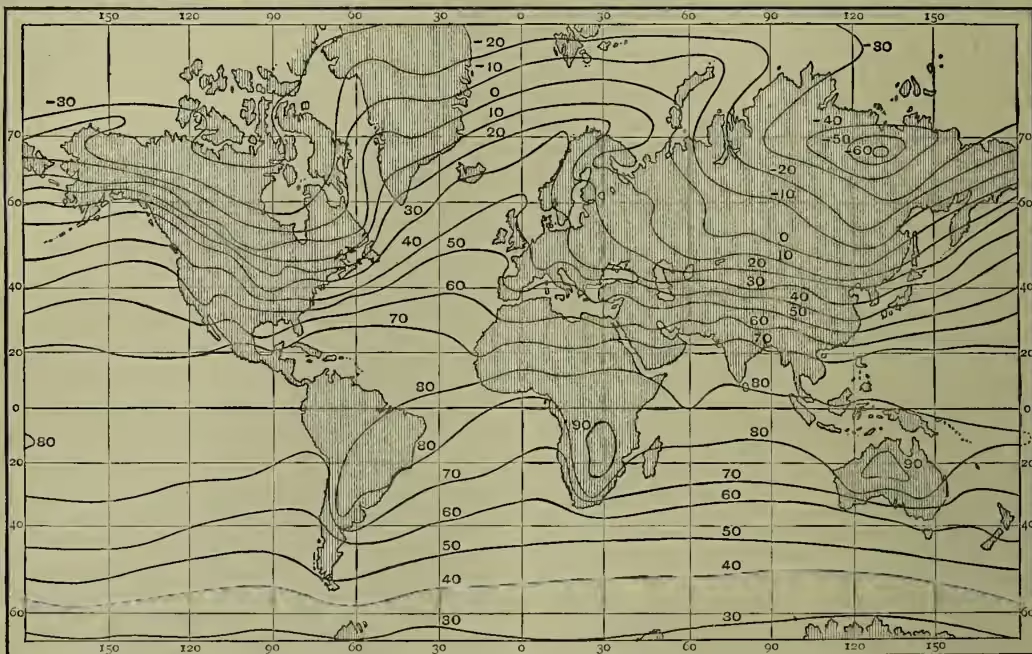
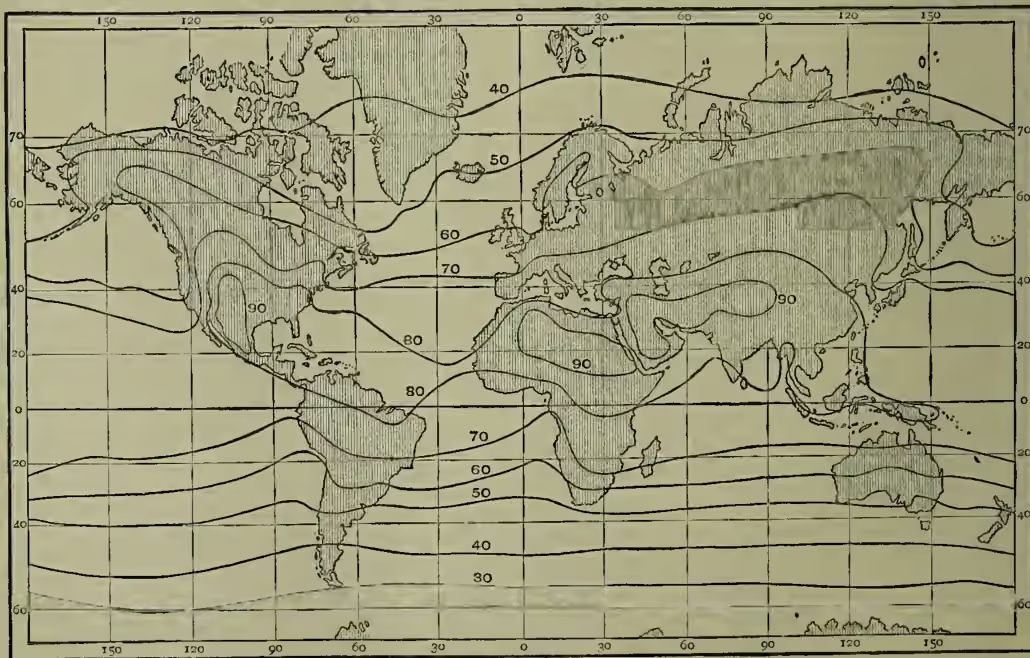
In meteorology the distribution of atmospheric temperature is one of the most important problems calling for discussion. The mean annual temperature over the whole surface of land and sea is perhaps about F. At Verkhoyansk the lowest monthly mean averages F. The highest monthly mean averaged over several years may be set down at fully F., and is experienced in the north-western parts of India, where the thermometer in free shaded air not infrequently touches F. Loomis in his Meteorology gives F. as the highest authentic reading, made in the Great Desert of Africa. Exceptionally high readings made by travellers in Arabian and African deserts must, however, be accepted with great caution. It is indeed no easy matter satisfactorily to measure air temperatures, especially when they are high. It is not enough to shade the thermometer from direct sun rays. It must be shaded as effectually from reflected radiations from earth and sky; and at the same time the air must be free and not confined. To facilitate the study of the distribution of temperature at the earth's surface, it is usual to construct charts of isotherms. These are lines, each of which is drawn through all places having the same mean monthly, mean seasonal, or mean annual temperature. The most recent and complete charts of this character are those prepared and published by Dr Buchanan in his Challenger Report on Air and Ocean Temperatures (1890). Two of these charts are reproduced here on a diminished scale. They show the mean temperature (Fahrinheit) of the globe for January and July, the typical winter and summer or summer and winter months for all regions on the earth's surface. A glance will indicate how greatly the distribution of land and sea influences the distribution of temperature. In January the great land-areas in the northern hemisphere are much colder than the ocean-areas at the same latitude; in July this relation is reversed. For a full discussion of the facts embodied in these and the charts for the other months of the year, as well as of the related facts referring to barometer pressure, rainfall, humidity, diurnal changes, &c., see the elaborate Report mentioned above. A concise abstract, given by Dr Buchanan himself, will be found in the Proceedings of the Royal Geographical Society (March 1891).
The periodic changes of atmospheric temperature are due to the sun. The earth itself has, however, a distinct temperature, which increases at the rate of F. for every 50 or 60 feet of descent through the few miles of crust accessible to us. Upon this real earth temperature the mean annual temperature of the air must to a large extent depend. According to Professor Langley, the surface of the moon with its long 'day' of a fortnight never gets hotter than the freezing-point of water, however brightly it may be shone upon. This shows that the moon is intrinsically much cooler than the earth. See also EARTH, CLIMATE, SEASONS, SEA.
TEMPERATURE OF THE BODY.—In the article ANIMAL HEAT the general principles of the subject have been discussed; it remains to consider more in detail the variations of temperature in health and disease. The temperature differs in different parts of the body; it is lower and more variable on the surface of the skin than in internal organs or closed cavities. Observations are usually made with the thermometer held either in the armpit or under the tongue; the latter gives results less than half a degree (F.) higher than the former. In the healthy adult in temperate climates the average temperature in the armpit is about F., but undergoes periodical daily variations of nearly a degree in each direction from the mean, being lowest between 2 and 6 A.M., highest between 5 and 8 P.M. A slight rise takes place during the digestion of each meal. In the tropics the temperature is a little higher (less than ); it is less diminished in very cold climates. It is slightly higher in childhood, and slightly lower in old age. A persistent elevation or depression of the temperature of more than a degree beyond the limits thus indicated is good evidence that there is some departure from health. In some chronic diseases, especially chronic Bright's disease, diabetes, and myxedema, the temperature is persistently lowered; in the last it may be as low as . But elevation of temperature is of much more common occurrence and much more important. It occurs in connection with all acute inflammations and all febrile diseases; and careful observations of its degree and its changes from day to day or hour to hour afford one of the most reliable guides to the diagnosis of many diseases, and the estimation of their severity and probable result. Generally speaking, a temperature of — F. may be regarded as slightly febrile; up to F. as moderately febrile; up to F. as highly febrile; and above that as hyperpyretic, and, with rare exceptions, as indicative of great danger.
See Wunderlich's Medical Thermometry, and Aitken's Science and Practice of Medicine.