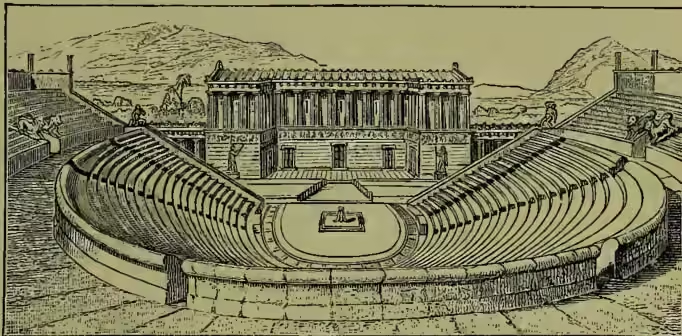
Theatre (Gr. theatron, 'a place for seeing,' from theaomai, 'I see') means literally any building used for purposes of exhibition; but, Copyright 1892 in U.S. by J. B. Lippincott Company. popularly, it is generally taken to mean a place devoted to dramatic and musical performances. The classical theatre arose among the Greeks. Its germ was the ring in which dithyrambs and phallic songs were performed by choruses in honour of Dionysus. These were performed in an orchestra or circular dancing place, on all sides of which the spectators were ranged. Later a table was introduced, on which the leader of the chorus stood while he carried on a dialogue with the rest of the choreutæ in the intervals between the choral odes. This was the rudimentary form of the stage. Next an actor, a single actor, was introduced by Thespis, and, as he played many different parts, a tent had to be erected in which he should be able to change his mask and dress. Out of this tent arose ultimately the stage-buildings of the Greeks, which, even after they became elaborate structures of stone, retained the name skênê, 'a booth or tent.' From the remains of various Greek theatres which have been excavated it is possible to reconstruct, at least in its main features, one of these edifices. Fig. 1 shows the design of the theatre at Segesta. The central circle is the orchestra, in which the choros sang and danced, and in the middle of which the altar of Dionysus probably stood. In the oldest theatres the orchestra formed an exact circle, but ultimately the circle was cut on the side next the stage, as is shown in the figure. Round the orchestra, in size rather more than a semicircle, the stone seats for the audience rose tier above tier like a large flight of steps. As the theatre was intended to accommodate practically the whole population of the city in which it stood, these rows of seats were of enormous size, the theatre of Dionysus at Athens holding nearly 30,000 persons, and that at Megalopolis being computed to seat 44,000. In order to obtain the necessary slope for the tiers of seats, the Greeks always chose some natural hollow, where the shape of the ground aided the design of the architect. Between the auditorium and the stage were the passages of entrance (parodoi), which, in the theatre at Segesta, seem to have been of unusual breadth.
The stage (logeion) was a long, narrow platform, standing, according to the latest theories, about 12 feet higher than the orchestra, and was used by the actors, as distinguished from the chorus. It was bounded at the back and on each side by the wall of the buildings which contained the dressing-rooms of the actors and the other necessary apartments. The stage and back wall were called the proskénion; the side walls, or wings, in each of which was an entrance door, being named paraskénia. A flight of steps connected the stage with the orchestra, and these steps, continued out of sight, were the means by which apparitions from the lower world ascended. The wall of the dressing-rooms, &c., which formed the back wall of the stage, was ornamented with columns, and represented the front of a temple or other building, before which the action of the play was supposed to take place. It had three doors in it, by which entrances and exits were made. When the action of the play required a different scene, the back of the stage was covered with painted curtains or boards, which were practically never changed in the course of a play. At either end of the stage were the periaktói, large, revolving triangular prisms, each side of which bore a different scene, thus providing, as it were, three sets of wings. For machinery there was the ekkyklēma, a platform on which a tableau, depicting an incident which could not be shown on the stage, was rolled forward from one of the doors of the proskénion, exhibited to the audience, and rolled back again. There was also the mechane (machina), by which a god could be lowered from heaven to earth, which was probably some sort of crane. From it we derive the phrase of a Deus ex machinā. The curtain, which was not an invariable feature in a Greek theatre, rose from below, instead of falling from above as in modern times. In dealing with the early Greek theatre it must always be remembered that the stage was only of secondary importance, the orchestra being deemed the chief point of interest. The Romans, whose theatres were founded in most respects on Greek models, differed in this point. They transferred all the singing and dancing to the stage, and gave up the orchestra to the most important section of the audience. The most perfect existing specimens of the early Greek theatre are to be seen at Epidaurus, at Aspendus in Pamphylia, and at Athens, where the remains of the theatre of Dionysus, on the rising ground at the foot of the Acropolis, are most interesting and full of information. At Orange, in the south of France, there is a splendid specimen of an ancient Roman theatre.
During the middle ages, when the drama existed only in the form of mysteries and miracle-plays, and was under the management of the church, theatres were not required. Plays were represented generally in cathedrals or monasteries, and the most elaborate scenery ever used was a three-story scaffold to represent heaven, earth, and the nether world. But it would seem that at a very early period there were in England open-air theatres of some sort; for in Perran Round, near Perranzabuloe (q.v.) in Cornwall there exists what must have been a theatre of large extent, with raised seats all round, somewhat after the Greek fashion. With the revival of learning in the 16th century came also a revival of the drama, and theatres began to be built. The earliest was probably a play-house of some sort in the Hôtel de Bourgogne, Paris, which was built about 1548 for the Confraternity of the Passion; but the first regular theatre was that which Bramante constructed at Rome in the Grand Court of the Vatican about the year 1580. Then came the Teatro Olimpico at Vicenza, designed by Palladio, and finished in 1584; while the earliest theatre built on modern lines was constructed by Aleotti at Parma in 1618. In all the early Continental theatres the construction was founded on Greek models, but in England a simpler idea served. Here the earliest dramatic performances took place in booths, in tennis-courts, or in the open court-yards of inns; and it was not till the end of the 16th century that the first permanent building was erected for theatrical purposes. This was 'The Theatre,' built by Burbage in Shoreditch in 1576, which was founded, not on any classical model, but on the inn-yards in which the actors had been accustomed to play. The stage was literally a stage—a platform erected against one side of the building—and on three sides of this platform the spectators stood or sat in the pit (then called the yard), while all round it ran the galleries or boxes (then called rooms) exactly like the galleries of an inn-yard. There was no provision for scenery. The door at the back of the stage, which communicated with the dressing-rooms, &c., and was the general entrance for the actors, was hung with curtains, and there seem to have been 'traverses,' or curtains running on rods, some distance up the stage, which could be drawn and undrawn to indicate an inner apartment; but the locality in which the scene was laid was indicated only by a ticket stuck up bearing such an inscription as 'A Garden,' 'Thebes,' or 'Rhodes.' Properties were, however, largely used to give verisimilitude to the action. For instance, the first items of one of Henslowe's inventories include 'one rock, one cage, one tomb, one hell-mouth, one bedstead.' These properties seem to have been pushed on the stage in the calmest fashion. Thus, in Middleton's Chaste Maid in Cheapside, one of the stage-directions is, 'A bed is thrust out upon the stage, Alwit's wife in it;' and a similar action is indicated in the stage-direction, 'Enter Anne in bed,' in Davenport's New Trick to Cheat the Devil. In the stage there were traps apparently to a considerable extent; while behind and on a higher level was a platform which did duty for any elevated part of the supposed scene. Thus, it would represent the walls of a city, a tower, or Juliet's balcony. Malone supposes that, in the play-scene in Hamlet, the king and courtiers sat on this raised platform, while the players occupied the regular stage, and acted with their backs turned towards the pit. It seems, however, quite as probable that the arrangement was exactly the reverse, the mimic play being acted on the platform. In the Elizabethan theatre the stage was strewn with rushes, or, upon very special occasions, was matted; and on it the gallants sat on stools, showing their dress and figure to the audience, and destroying, as it seems to us, anything resembling dramatic illusion. The only existing contemporary drawing of the had been acted by a beardless boy; while the older female characters were represented by full-grown men. Strange though it seems, great reputations were made by actors in both lines, notably by Edward Kynaston, as a boy-actress, and James Nokes, as an old woman. Movable scenery, which was invented by Baldassare Peruzzi early in the 16th century, had long been used in masques, but it was not till 1661 that it was used to illustrate a regular stage-play in England. It has steadily grown more and more elaborate—a new development of 'set-scenes' being made by Garrick's scene-painter, De Loutherbourg, in 1777—until it has threatened to overshadow the play; and indeed it has been gravely argued that with the introduction of scenery and spectacle began the decay of the drama.
The arrangements of the auditorium of a theatre have changed little during the last two centuries, the chief alteration being the curtailing of the space occupied by the pit. At the Restoration, and all through the 18th century, the whole floor of the house, from the back wall to the rail of the orchestra, was devoted to the pit; but about 1833 Alfred Bunn introduced stalls, which have gradually encroached farther and farther, until in very fashionable theatres the pit is restricted to a few benches far away under the dress-circle, or is abolished altogether, as is the case in opera-houses. In all theatres the floor, whether used for stalls or pit, or both, slopes considerably towards the stage. The various tiers of galleries do the same, except in those theatres where they are not seated with benches, but divided into private boxes. The orchestra, which is now generally located immediately in front of the pit or stalls, was in Shakespeare's time placed in a gallery above the stage. In some theatres the musicians are placed under the stage, whence they discourse muffled music.
In order to realise the modern arrangements behind the scenes, let us imagine ourselves on the stage of a large theatre. Entering by the stage door, we thread our way through narrow passages, blocked by pieces of scenery, until we find ourselves in the wings, as the spaces on each side of the stage are named, from the wings or narrow side-scenes which mask the entrances to the stage and continue the picture which the main scene presents. Going forward until we reach the wall which divides the stage from the auditorium, we find, close to the opening through which the stage is seen by the audience, and which is called the proscenium opening, the little corner where that important official, the prompter, sits. Close to his hand is an elaborate arrangement of bells for signalling to the various parts of the theatre the exact moment when the curtain is to rise, when the orchestra is to cease playing, when the scenes are to be changed, when the traps are to be worked. Beside him is also a brass plate, covered with handles, for lowering or heightening the gas in footlights or elsewhere. The prompter generally, though not invariably, sits on the left of the stage—i.e. the left facing the audience; for right and left are calculated from the actor's point of view, which is naturally the reverse of the spectator's. The side which the prompter occupies is always known as the P.S. or prompt side, and the other as the O.P. or opposite prompt. Passing now through one of the entrances, as the spaces between the side-scenes are named, we find ourselves on the stage, and realise that we stand, not on a level surface, but on an inclined plane, the slope of which is towards the audience. In front of the stage we see the footlights, sometimes also called the floats, a row of gas-jets, with strong reflectors, which supply the chief illumination of the actors' figures. For moonlight and other effects they are provided with
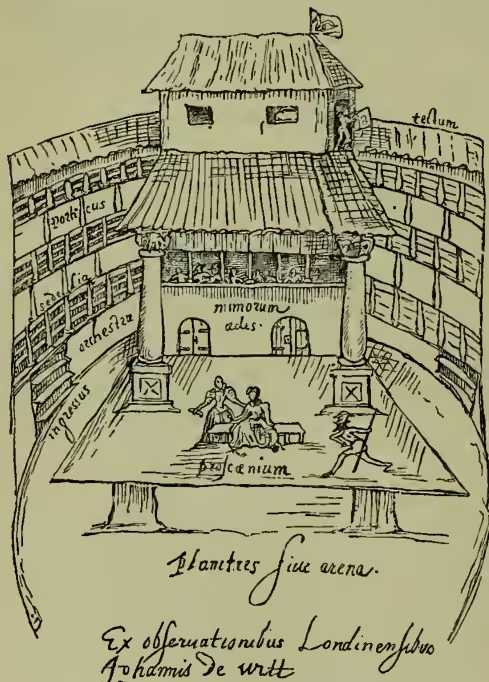
Elizabethan stage is here reproduced (fig. 2). It is taken from Dr Gaedertz' book on the Old English Stage (Bremen, 1888), and represents the Swan Theatre in 1596. The drawing was made by one John de Witt, who visited London in 1596, and whose manuscript diary Dr Gaedertz discovered in the Royal Library at Berlin. As a picture of the stage in the time of Shakespeare it is of infinite value.
After the Restoration, under the supervision of Charles II., who was familiar with the French stage, the English theatre came more into line with the Continental. The stage was gradually withdrawn closer and closer to the proscenium opening, until, by the middle of the 18th century, the appearance of the interior of Drury Lane was not seriously different from that which it presents at this day. In the years immediately following the Restoration many important changes were made in the conditions of the English theatre, the two greatest being the introduction of elaborate scenery and the playing of female parts by women. Up to this time Juliet, Ophelia, and Desdemona movable screens of coloured glass or coloured cloth, called mediums. Within the last few years electric lighting has supplanted gas in many theatres, and great expectations are entertained of the effects which may ultimately be obtained from the new mode of illumination. In 1892, at the Electrical Exhibition at the Crystal Palace, some very wonderful effects of the electric light as applied to the stage were shown. Turning our back on the footlights, if no scenery is set we see, away in the darkness at the back of the stage, the scene-dock, a large space for storing scenery when not in use. By clearing this dock a great addition can be made to the depth of the stage when spectacular plays demand it. Looking up above our heads we see rows of lights suspended, which are technically called battens, and beyond these a wilderness of canvas and ropes and pulleys. But the prompter rings his bell, and a great expanse of painted canvas, called a cloth, swings into sight from the regions above the stage; wings are pushed forward to conceal the edges of the cloth: and narrow slips of painted canvas are dropped to mask the top of it. These are called borders, and may represent a ceiling, the sky, branches of trees, or whatever is necessary to aid the illusion of the scene. In the modern theatre the cloth has supplanted in a great measure the old contrivance known as a pair of flats. These were two frames of stretched canvas, which were run on in grooves fixed over the top of the stage and met in the middle, forming two halves of a scene. So seldom are these used now that grooves are not often met with in new theatres, except the short grooves in which the wings run, which are technically known as forks. In all first-class theatres the scene generally used is a set-scene, which is built so solidly, and reproduces the conditions of nature with such completeness as scarcely to make any demands on the imaginative faculty of the spectators. If a room is represented, the walls and ceiling are built with marvellous solidity; a chandelier hangs from the centre of the ceiling; the doors shut with an unmistakable bang; the windows open and close better than they sometimes do in actual life. In elaborate spectacular plays whole pieces of scenery are raised through large transverse openings in the stage by means of platforms, which are termed bridges. These work in and out of the well, or cellar, a space under the stage nearly as deep as the proscenium opening is high. There is an intermediate floor running round the well, which is called the mezzanine. It is about 8 feet below the stage, and from it the star trap and the vampire trap are worked. These are contrivances for the sudden appearance or disappearance of demons in pantomime. In the vampire trap the actor throws himself against a couple of shutters in the stage, which open to let him through and immediately close again with great force, he landing on a mattress placed to catch him on the mezzanine. The star trap is cut in the stage like a star, with the points meeting in the centre. The actor stands on a little platform on the mezzanine, which is run up with tremendous force by counter weights against the stage. The actor's head opens the points of the star, through which he shoots like an arrow, and before he reaches the stage again the star has closed and is kept solid by the platform on which the actor came up. Farther 'up' the stage—i.e. nearer the back scene—is the grave trap, used, for instance, at Ophelia's funeral. These are the chief traps, but the whole stage of a theatre is practically movable, the only immovable parts being the narrow joists, which are called runners or fillets. Above the stage are the flies, large lateral galleries, in which the scene-men work their ropes and pulleys, and from which the lime-light which plays so important a part in the effects of a modern theatre is managed. Higher still is the gridiron, an open line of strong beams, from which the various cloths are suspended; and above it again is the barrel-loft, in which are placed the windlasses and drums by which the curtain and cloths are worked. At the very top of the theatre, and at the extreme back of the stage, is generally the paint-room, in which the scenic artist works. His canvas is stretched on a movable frame, which he drops or raises as he requires, and when a scene is finished it is lowered directly to the stage.
Among famous theatres are the Scala at Milan, the San Carlo at Naples, the opera-houses of St Petersburg, Vienna, and Berlin, and the Court Theatres of Munich and Dresden. Most notable of all architecturally is the Grand Opera-house in Paris, completed in 1875 at a cost, exclusive of site, of £1,120,000; and in Paris also is the most famous theatre in the world for its history and traditions, the Théâtre Français. At Bayreuth is the grand theatre constructed by Wagner to carry out his views on the dramatic art. It is a huge structure, practically all on one floor, with a slightly fan-shaped auditorium, perfectly adapted both for seeing and hearing. But it is practically defective in the important respect that it occupies an enormous space in proportion to the number it holds. The problem of the theatrical architect everywhere is now how to contain the greatest number in the smallest space. A curious expedient is that of a double stage, which is used in the Madison Square Theatre, New York. While an act is in progress the scene required for the succeeding act is set on the second stage, which is above the first; then the stage sinks, and the new scene is in its place ready for the next act.
The art of acting, as understood by the Greeks, had little in common with our present-day theories. The first qualification for the ancient actor, especially in tragedy, was voice, for by that chiefly could he affect his audience. He could get no effects from facial expression, for his features were concealed by a mask, which was of course immovable. He could not get sudden effects of terror or surprise by active motion and gesture, for he was hampered by a 'make-up' which must have been burdensome in the extreme. First, he wore the cothurnus. This tragedy-boot had an enormously thick sole, which raised the hero a considerable height above his fellows, and on which he must have 'clumped' about the stage in the ungainliest fashion. He had to walk with the greatest care to avoid stumbling, and, if he fell, apparently had to be lifted on his legs again in somewhat undignified fashion; an accident which, Lucian records, happened to Æschines when acting the part of Ænomaus. To increase his height still further his mask had a high top to it, called the onkos; and to prevent his looking lanky he was padded out to a suitable proportion to his height. His dress was almost the ordinary Greek costume, but of very brilliantly coloured material. The comic actors wore masks both in the old and the new comedy, but their costumes were probably less burdensome, although they appear to have been padded in ludicrous fashion. Thus Greek acting must have been in the last degree conventional and unnatural, differing therein very widely from the Roman, which appears to have been highly emotional. In England even up to the time of the Restoration acting must have been, like the Greek, more rhetorical than emotional. This is implied by the position of the stage, with spectators on three sides and an audience of gallants actually seated on it; but after 1660, as the stage gradually came nearer its present condition of a picture framed by the proscenium, acting became more in accordance with our modern ideas of dramatic representation.
Licensing of Theatres.—Up to 1843 the only theatres entitled to act regular plays were those which held royal patents—in London, Drury Lane, Covent Garden, and the Haymarket (in summer)—but in that year Bulwer's Act (6 and 7 Vtt. chap. 68) established practically free trade in theatricals. By it the Lord Chamberlain was made licensing authority in London and Westminster, Finsbury, Marylebone, Tower Hamlets, Lambeth, and Southwark. Outside his domains the power vested in the justices of the peace. By the Local Government Act, 1888, the authority of the justices was transferred to the county councils, wherever such existed; but in a very great majority of cases these took advantage of a clause in the act which authorised them to delegate back to the justices their licensing powers. In London at present the Lord Chamberlain licenses thirty-seven theatres, as against six licensed by the county council in parts of the metropolis outside his jurisdiction. The Select Committee on Theatres (see Report published in Times, 3d June 1892) recommends that the Chamberlain's jurisdiction should in future extend over all theatres in all parts of London.
The following are among the best-known actors in Italy, France, Germany, England, and America:
| ITALY. | GERMANY—continued. |
|---|---|
| Modena. | Seydelmann (1793–1843). |
| Ristori, Adelaide (b. 1821). | Devrient, Emil (1803–72). |
| Rossi (b. 1827). | Dawison, Bogumil (1818–72). |
| Salvini (b. 1830). | Haase, Friedrich (b. 1827). |
| Wolter, Charlotte (b. 1834). | |
| Barnay, Ludwig (b. 1842). | |
| FRANCE. | ENGLAND. |
| Molière (1622–73). | Burbage, Richard (c. 1567–1619). |
| Poisson, Raymond (died 1690). | Alleyn, Edward (1566–1626). |
| Champmélé, Mlle. (1644–98). | Taylor, Joseph (1585–1653). |
| Baron (1653–1729). | Mohun, Michael (died about 1684). |
| Lecouvreur, Mlle. (1690–1730). | Hart, Charles (d. 1683). |
| Le Kain (1729–75). | Betterton, Thomas (1635–1710). |
| Grandval (1710–84). | Barry, Mrs Eliz. (1658–1713). |
| Preville (1721–99). | Pritchard, Mrs (1711–68). |
| Clairon, Mlle. (1723–1803). | Garrick, David (1717–79). |
| Dumesnil, Mlle. (1713–1803). | Jordan, Mrs (1762–1816). |
| Monvel (1745–1812). | Kemble, John P. (1757–1823). |
| Talma (1763–1826). | Siddons, Mrs (1755–1831). |
| Mars, Mlle. (1778–1847). | Kean, Edmund (1787–1833). |
| Georges, Mlle. (1787–1867). | Macready, Wm. C. (1793–1873). |
| Rachel, Mlle. (1821–58). | Faucit, Helen (Lady Martin, 1820–95). |
| Lemaitre (1798–1876). | Irving, Sir Henry (b. 1838). |
| Regnier (1807–85). | |
| Got, François (b. 1822). | AMERICA. |
| Delaunay, Louis (b. 1826). | Cooper, Thos. A. (1776–1849). |
| Coquelin (b. 1841). | Booth, Junius B. (1796–1852). |
| Bernhardt, Mdm. (b. 1844). | Duff, Mrs (1794–1837). |
| Burton, W. E. (1804–60). | |
| GERMANY. | Forrest, Edwin (1806–72). |
| Neuber (1692–1760). | Cushman, Charlotte (1816–76). |
| Eckhof (1720–78). | Jefferson, Joseph (b. 1829). |
| Schönemann (1704–82). | Booth, Edwin (1833–93). |
| Fleck (1757–1801). | |
| Iffland (1759–1814). | |
| Schröder (1744–1816). | |
| Devrient, Ludwig (1784–1832). |
See AMPHITHEATRE, ART, ATELLANE, BASQUES, DRAMA, FIRE (Vol. IV. p. 634), MASQUE, MIMES, MYSTERIES AND MIRACLE-PLAYS, OPERA, PANTOMIME; also J. W. Donaldson, Theatre of the Greeks (1849; new ed. 1875); Haigh, Attic Theatre (1889); J. Payne Collier, History of English Dramatic Poetry, and Annals of the Stage (1831; 2d ed. 1879). The statements in this work must be accepted with some degree of caution; Genest, Account of the English Stage, 1660–1830 (Bath, 1832); Doran, Their Majesties' Servants (1864; 3d ed. 1888); Ward, History of English Dramatic Literature (1875); Fleay, Chronicle History of the English Stage, 1559–1642 (1890); Hawkins, Annals of the French Stage to the Death of Racine (1884), and French Stage of the Eighteenth Century (1888); Parfait, Histoire du Théâtre Français (1745–49); Lucas, Histoire Philosophique et Littéraire du Théâtre Français (1847–63); Devrient, Geschichte der Deutschen Schauspielkunst (1848–61); Dunlap, History of the American Theatre (1833); George P. Seilhauer, History of the American Stage before and after the Revolu- tion (3 vols. 1888–91). Full lists of works relating to the English, Scotch, and Irish theatres will be found in the present writer's Bibliographical Account of English Theatrical Literature (1888).