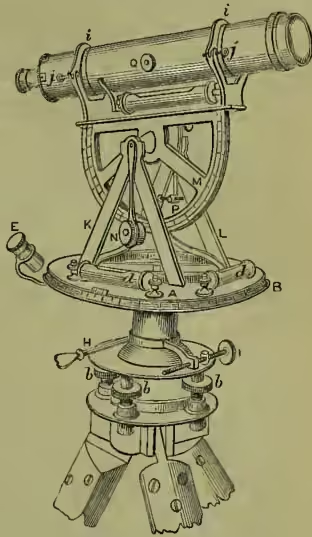
Theodolite, an instrument much employed in land-surveying for the measurement of angles horizontal and vertical, is neither more nor less than an altitude and azimuth instrument, proportioned and constructed so as to be conveniently portable. As in all instruments in very general use, the variations in its construction are almost numberless; but its main characteristics continue unaltered in all forms. It consists essentially of two concentric circular plates of copper, brass, or other material (the upper plate, or upper horizontal, either being smaller, and let into the lower, or lower horizontal, or the rim of the lower raised round the outside of the upper), moving round a common axis, which, being double, admits of one plate moving independently of the other. Upon the upper horizontal rise two supports, bearing a cross bar, which is the axis of a vertical circle moving in a plane at right angles to the former. This latter circle either has a telescope fixed concentric with itself, or a semicircle is substituted for the circle, and the telescope is laid above and parallel to its diameter. The circles, as their names denote, are employed in the measurement of horizontal and vertical angles. For these purposes the outer of the horizontal circles is graduated, and the inner carries the index-point and the Verniers (q.v.); the vertical circle is also graduated, and the graduations are generally read off by an index-point and vernier firmly attached to the supports. The upper horizontal is furnished with two levels placed at right angles to each other, for purposes of adjustment, and has a compass-box let into it at its centre. The stand consists of a circular plate supported on three legs, and connected with the lower horizontal by means of a ball-and-socket joint; the horizontal adjustment of the instrument being effected by means of three or four (the latter number is the better) upright screws placed at equal distances between the plates. The telescope is so fixed as to be reversible, and the adjustments are in great part similar to those of other telescopic instruments, but are too numerous and minute to be here detailed. Both horizontal plates being made, by means of the screws and levels, truly level, the telescope is pointed at one object, and the horizontal angles read off; it is then turned to another object, and the readings off from the graduated circle again performed; and by the difference of the readings, the angular horizontal deviation is given; and when vertical angles are required, the readings are taken from the vertical circle in a similar manner. For the much-disputed etymology, see Notes and Queries for 1884, &c.