Thermometer is a name which, though applicable to any instrument for measuring change of temperature, is usually restricted to such instruments as measure by means of the expansion of substances, and more especially of liquid sub- stances. The ordinary thermometer consists of a glass tube of very narrow bore, which opens out into a bulb at one end. This bulb and part of the capillary tube are filled with the thermometric substance, generally mercury, sometimes alcohol or other liquid, but never water. Mercury is pre-eminently suitable for thermometric purposes. Its freezing-point is lower than the temperatures with which we have usually to deal; and its boiling-point is much higher than that of any other substance which is liquid at ordinary atmospheric temperatures. Throughout a long range it expands very steadily as heat is applied to it. By defining degrees of temperature in terms of equal successive increments of volume of mercury, we get a very serviceable scale, differing but slightly from the scale of degrees as defined thermodynamically by Lord Kelvin (see TEMPERATURE, THERMODYNAMICS). Mercury again is opaque, and does not wet the surface of the glass with which it is in contact. Alcohol and water, on the other hand, are transparent, so that when the former is used as the thermometric substance it has to be coloured. The peculiar behaviour of water near its freezing-point quite condemns its use in thermometry, even if it were suitable in other respects (see HEAT). It would, however, be highly inconvenient otherwise, inasmuch as its freezing and boiling points lie well within the range of easily attainable temperatures. As regards its boiling-point, alcohol has the same disadvantage. It is in the measurement of very low temperatures that alcohol and ether thermometers are particularly valuable. These substances have also the further merit of having a high expansibility.
When the capillary tube and bulb have been constructed, the first operation is to fill in a sufficient quantity of liquid. This is effected by first heating the bulb to expand the air contained in it, and then plunging the open end of the tube into the liquid, which gradually rises through the bore as the air in the bulb cools. The tube is then set with the bulb down and tapped until most of the liquid is shaken out of the tube into the bulb. A second heating of the bulb until the liquid boils still further diminishes the amount of air inside; and more liquid is introduced as in the first operation. The manipulation requires great skill; and the first stage is reached when at ordinary temperatures the required quantity of liquid fills the bulb and part of the tube. The next stage is to seal hermetically the upper end of the tube when it is quite free of air, a condition which is attained by heating the upper surface of the liquid to the boiling-point and so driving out the air. When the sealing is effected the tube and bulb are filled almost entirely with the thermometric substance and its vapour. Probably no thermometer is quite clear of air, for it is difficult, if not impossible, to get rid absolutely of the air held in solution in liquids; but the quantity mingled with the liquid or its vapour is excessively minute in the best thermometers.
It now remains to graduate the instrument so that its indications may be capable of interpretation. The most delicate thermometers have an arbitrary scale engraved on the tube before the operation of filling is begun; and afterwards certain definite and known temperatures are measured in terms of it, so that its indications become known. For all ordinary and most scientific purposes it is sufficient to engrave the scale on the stem after the positions of the liquid column have been determined for the two chosen standard temperatures. Thermometers with attached scales engraved on ivory or brass are useless for other than the roughest determinations.
The two standard temperatures universally used in graduating a thermometer are the freezing and boiling points of water. Previous to the discovery that these, under given conditions, correspond to definite temperatures, thermometry could hardly be said to exist. In Newton's scale of temperature (Philosophical Transactions, 1701) the freezing-point of water is taken as zero, and the temperature of the human body as 12°. Fahrenheit, who first in 1721 constructed a mercury thermometer, took as his zero the lowest temperature that had then been reached, and called the temperature of the human body 8°. Each degree was subdivided into twelve parts; and subsequently these twelfths were taken as the degrees. This made the temperature of the body 96°; and it was found that the freezing-point of water was 32°. When shortly afterwards it was discovered that the boiling-point of water was always the same under the same barometric pressure, a second and easily determinable standard temperature was obtained. Thenceforward this boiling-point, under a pressure of 30 inches, was fixed at 212° on the Fahrenheit scale, the freezing-point being as before 32°. With these as standard, the temperature of the body is 98°; so that the present Fahrenheit scale is not exactly that which Fahrenheit himself adopted. Celsius in 1742 suggested that the boiling-point be called zero, and the freezing-point 100°. In the modern centigrade scale, commonly called the Celsius scale on the Continent, the freezing-point is taken at zero and the boiling-point under 760 millimetres pressure (29.92 inches) at 100°. Réaumur divided the interval between the freezing and boiling points into eighty divisions, and this scale is still largely used in Russia and Germany.
The centigrade scale is used almost exclusively for scientific purposes. British and American meteorologists, however, prefer the Fahrenheit scale, which has two distinct merits as compared with the centigrade. Its degree is smaller, so that by reading to tenths the observer has a more delicate instrument. To attain the same accuracy with the centigrade the observer must read to half-tenths. Again, the freezing-point being at 32°, it is only under severe wintry conditions that negative Fahrenheit temperatures are met with. So inconvenient is the constant occurrence of negative temperatures on the centigrade scale that it is very usual in continental observatories to write -1°, -2°, -3°, &c. in the form 99°, 98°, 97°, making the freezing-point practically 100°, and the boiling-point 200°. For temperatures above the freezing-point the 'hundred' may be omitted without any fear of confusion.
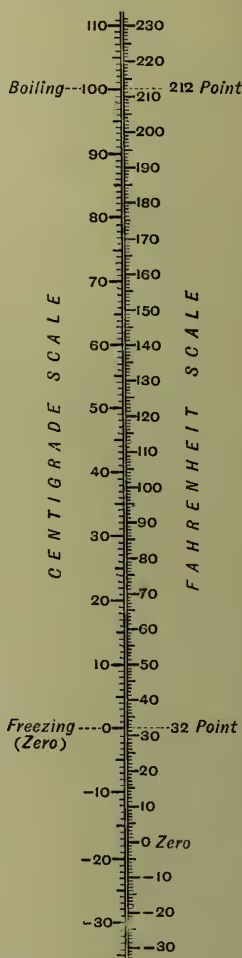
It is often necessary to transform temperature readings from one scale to another, and more especially from centigrade to Fahrenheit, since the latter scale is the more familiar to English readers. The simplest rule is: Double the centigrade number, diminish it by one-tenth of itself, and add 32. The converse rule for changing Fahrenheit into centigrade is: Subtract 32, increase the remainder by one-ninth of itself, and take the half. In the figure the Fahrenheit and centigrade scales are shown side by side. To reduce Réaumur to Fahrenheit, multiply by and add 32. To reduce Réaumur to centigrade, increase the number by one-fourth of itself. These rules are simply expressions of the truth that 9 degrees on the Fahrenheit scale, 5 degrees on the centigrade, and 4 degrees on the Réaumur all measure the same temperature interval.
Various modified forms of thermometer are used for particular purposes. Thus the measurement of the humidity of the atmosphere is effected by means of the wet-bulb thermometer. In this instrument the bulb is covered with a woollen material kept constantly wet by the capillary action of its hanging ends, which dip into a vessel of water. When the air is saturated with moisture (see DEW) there will be no evaporation from the moist surface covering the bulb, and the wet-bulb thermometer will give the same indication as the ordinary dry-bulb. In a dry and warm air the water surrounding the bulb will evaporate at a rate depending on the dryness and the temperature. This evaporation is accompanied by a cooling of the evaporating substance and the bulb in contact with it, so that the wet-bulb thermometer will indicate a temperature lower than the temperature of the air as shown by the dry-bulb thermometer. The less humid the air is at a given temperature the greater is the difference of readings on the wet- and dry-bulb thermometers.
Maximum and minimum thermometers belong to the self-registering class of instrument. The ordinary clinical thermometer for taking the temperature of the body is one form of maximum thermometer. In it a constriction above the bulb prevents the mercury column flowing back of itself into the bulb. Thus the upper end of the column continues to indicate the highest temperature reached until it is shaken down by the operator. For meteorological purposes maximum and minimum thermometers are usually laid horizontal or nearly so.
In one form of maximum thermometer the mercury pushes a small index in front of it, which remains indicating the highest point reached after the mercury has contracted because of cooling. In the minimum thermometer the index is set in the alcohol which is used as the thermometric substance. As the alcohol contracts it drags with it the index, whose upper end indicates the lowest point reached by the curved capillary surface of the liquid. For measuring the temperatures at different depths of the sea various devices have been used by which the temperature at any required point can be registered, so that it matters not through what temperatures, high or low, the instrument has to pass before it comes into the hands of the observer. The form used so successfully in the Challenger expedition will be found described in the first volume of the Physical and Chemical Reports.
Instruments for continuous registration of successive temperatures, or for self-registration of temperatures at short intervals of time, form an indispensable part of the equipment of complete meteorological observatories. The photographic method is the simplest in which a mercurial thermometer can be employed. Things are so arranged that the sensitive paper, kept steadily moving by clockwork behind the thermometer, can receive only light which has passed through the small bore of the tube above the mercury. When the record has been taken, any point on the line which separates the part of the paper that has been exposed to the light from the part not affected corresponds to the height of the mercury column in the tube at the very instant at which that point on the line lay behind the thermometer. From this record, therefore, any temperature can be picked out at leisure long after the registering of it.
For general convenience and for the certainty of its indications the mercurial thermometer is pre-eminent. Historically older, however, and scientifically superior is the air thermometer. As shown in the article Gases (q.v.), the product () of the pressure and volume of a gas is very nearly proportional to the absolute temperature. Hence if we keep the pressure constant, the change of volume will be a direct measure of the change of temperature. The practical difficulty is to keep the pressure constant. It requires indeed a skilful experimenter to manipulate satisfactorily an air thermometer. Such a thermometer is, however, indispensable for measuring the very low temperatures that must be reached before the ordinary gases can be liquefied under great pressure. Leslie's differential thermometer is virtually a U-tube terminated by two balls, whose air contents are separated by spirits of wine filling the bend. In its day it was perhaps the most delicate instrument of its kind; but thermo-electricity (see ELECTRICITY) has now provided us with much more delicate methods of measuring minute changes of temperature.
For the measurement of very high temperatures it is necessary to make use of the expansion of solids. Such an instrument is generally called a Pyrometer (q.v.). By suitable contrivances the very small changes of length for moderate ranges of temperature may be so magnified as to make such a metallic thermometer serviceable for ordinary purposes. Certain forms of self-registering instruments used in meteorology are constructed on this principle. A particularly delicate form of metallic thermometer is Bréguet's. It consists of two thin strips of differently expansible metals soldered together, bent into the form of a helix and fixed at its upper end. A horizontal index is attached to the lower end. When the temperature changes, the one strip expands or contracts more than the other and the helix twists or untwists through an angle nearly proportional to the change.