Thorn-apple (Datura), a genus of plants of the natural order Solanaceæ, having a tubular five-cleft calyx, a large funnel-shaped five-lobed corolla, a two-laminated stigma, and an imperfectly four-celled, prickly, or unarmed capsule. The species of this genus are annual herbaceous plants, rarely shrubs or trees; they are in general narcotic, and productive of wild excitement or delirium. The common Thorn-apple, or Stramonium (D. stramonium), is an annual plant, with smooth stem and leaves, white flowers, and erect prickly capsules, a native of the East Indies, but now often met with in Europe, as also in Asia, the north of Africa, and North America. It contains a peculiar alkaloid, Daturine, which is practically identical in its action with atropine. The leaves and seeds are employed in medicine (see ASTHMA). The dried leaves have a faintly narcotic smell, and an unpleasant bitter taste; the seeds, which are of a black colour, are still more poisonous. A variety with pale violet flowers and purplish violet stem is frequently cultivated in gardens as an ornamental plant. Still more narcotic is the Soft-haired Thorn-apple (D. metel), a native of the south of
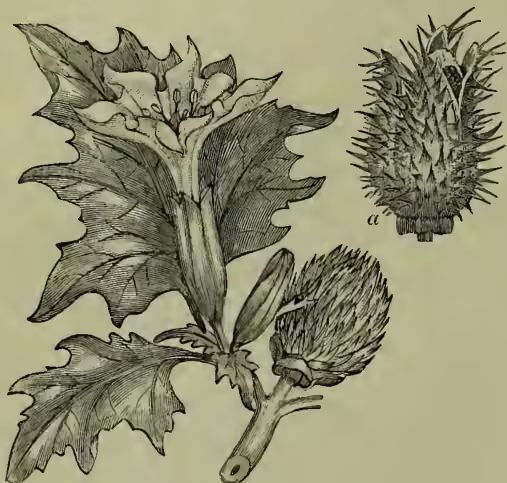
a, ripe fruit.
Asia and of Africa. The Thugs (q.v.) of India employed it in order to stupefy their victims, or, in other cases, to poison them outright. From its seeds, along with opium, hemp, and certain spices, a strong intoxicating substance is prepared, which the Mohammedans of India use in order to produce in themselves an indescribable joyfulness and extremely pleasurable feeling for a short time; but the use of it destroys the constitution. D. tatula, another Indian species, has similar properties, and is very energetic. D. sanguinea, the red thorn-apple of Peru, is used by the Indians to prepare a very powerful narcotic drink called tonga, which stupefies when very diluted, and when strong brings on maniacal excitement. The beautiful D. fastuosa has flowers externally of a violet colour, and white within, and is cultivated as an ornamental plant, especially a variety with what are called double flowers, which consist rather of two corollas, one within the other. D. arborea, a native of Peru and Colombia, has begun to be also very generally cultivated in flower-gardens in Europe. It has very splendid pendulous white flowers, 9 to 12 inches long, which diffuse a sweet smell in the evening and at night.